More than a set list: five anime about making music with other people
A shy guitarist, a club looking for members, a concert-band newcomer, young women pushing back and the Nanas’ Tokyo lives. Five reasons to follow the people around the music.
Reviewed 2026-10-01 · Premise-level spoilers · Editorial selections, without a universal ranking.
The group structures differ: a small band, a school club, a large concert ensemble and an adult network are not the same career stage. Nana includes much more than rehearsal life. We compare tone and belonging before performance or popularity.
Choose your starting point
Follow the branch that sounds most appealing. This is a selection map, not a shared universe or a chronology.
How we chose these five
Each selection needs a theme that shapes its premise, a distinct reason to choose it and a verifiable anime project. We distinguish films from television, explain tone differences and use official production, studio, publisher or licensed-distributor pages for project identity. The order groups viewing experiences; it is not a score based on popularity or a claim that one work is objectively better.
Bocchi the Rock!
TV anime · Playing well and joining others are different challenges

The official introduction follows the shy guitarist Hitori Gotoh, whose solitary practice begins to acquire a group context after she meets Kessoku Band’s drummer Nijika.
Why choose it?
Choose this when musical ability should be only one part of being in a band. The premise distinguishes practice alone from the social act of working with other people, which gives the collection its anxious-beginner branch. Compare K-ON! for a newcomer entering a school club, or Girls Band Cry for a more confrontational struggle to find a place. Our attraction is the mismatch between an imagined confident performance and the difficulty of an actual encounter. The comedy can exaggerate that gap without making the character’s insecurity irrelevant. We recommend the original television opening before band-event coverage or later project announcements, which assume familiarity with the group.
Where to start
Begin the original 2022 television series at episode one. The official site also carries compilation-film and second-season information; those are separate project labels. The manga begins at its first named volume, without an assumed chapter jump from a song or concert release.
Tone & scope: Social anxiety, embarrassment and expressive comedy. Music products and live events are not additional story episodes.
Read the full Bocchi the Rock! guide & visual adaptation map →
K-ON!
TV anime · A school club needs people before a performance

Kyoto Animation’s first-series description introduces a light-music club seeking enough new members to remain open, with instrument beginner Yui Hirasawa joining the group.
Why choose it?
Select this when the group’s everyday existence should be as appealing as the prospect of a stage. The membership problem gives the opening a modest practical goal and leaves room for a beginner to enter. Compare Bocchi for solitary skill meeting social anxiety, or Sound! Euphonium for an ensemble with a more explicit competition context. Our thematic reading asks what makes people want to keep gathering before they have achieved a public success. A school club can supply a routine and a place, not simply a ladder to a professional career. Choose this branch for friendship and club life; it does not promise a detailed documentary about the economics of a touring band.
Where to start
Begin K-ON! from 2009, then distinguish the second television series K-ON!! and the later film. The additional exclamation mark is a real project distinction. Start the manga at volume one if choosing reading; do not count music albums as narrative sequels.
Tone & scope: Light school comedy, friendship and growing attachment to a shared routine. The performance goal is not the only focus.
Sound! Euphonium
TV anime · An ensemble makes individual ambition public
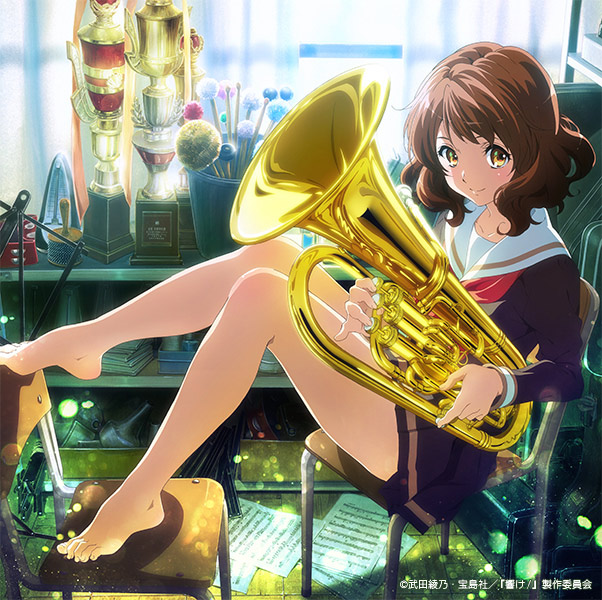
The studio’s 2015 opening introduces Kumiko Oumae encountering her new high school’s concert band and a former classmate, while deciding whether to join.
Why choose it?
Choose this when making music together should involve both belonging and the prospect of being evaluated. A concert band gives individual aspiration a larger structure than a small rock group: people must participate in a sound they cannot produce alone. Compare K-ON! if an informal club routine is the desired mood, or Nana when adult relationships and a commercial music environment should extend beyond school. Our recommendation starts with Kumiko’s hesitation rather than a later audition’s outcome. The distinction between wanting to play and wanting a particular place in a group is the useful interpretive question, not a claim that every installment uses the same competition format.
Where to start
Begin the 2015 first television season. Later seasons, compilation films, Ensemble Contest and later school-year films need their own route labels. The current Final Movie portal promotes the ending, not a first viewing; the original prose is a separate edition route.
Tone & scope: Competition, relationship tension and artistic insecurity. Later film descriptions reveal school-year and performance outcomes.
Read the full Sound! Euphonium guide & visual adaptation map →
Girls Band Cry
TV anime · A band can become a place to push back

The official TV introduction begins with young women facing disrupted schooling, betrayal or insecure lives in the city, who continue seeking somewhere to belong through music.
Why choose it?
Select this when music should express frustration as well as companionship. The official starting situations give the wish to make a place for oneself a rougher edge than preserving a comfortable school club. Compare Bocchi for insecurity explored through comic imagination, or Nana for music within adult relationships and career expectations. Our thematic lens is not that anger automatically makes a song better, but that people can need a shared activity before they agree on how to proceed. Choose this branch when friction and emotional confrontation are appealing parts of a band story. The original television route is distinct from its later compilation films and real musical events.
Where to start
Begin the original television series at episode one. The official navigation distinguishes the TV project from the two compilation films. This is an original animation project; a prior manga or light novel is not a prerequisite established by its opening route.
Tone & scope: Bullying-related distress, family conflict, insecurity and heated disagreements. The band premise is emotionally sharper than a uniformly cozy club story.
Read the full Girls Band Cry guide & visual adaptation map →
Nana
TV anime · Music shares space with adult relationships

Ai Yazawa’s licensed series follows two women named Nana whose lives meet in Tokyo. Their relationships, living circumstances and the music scene are connected parts of its appeal.
Why choose it?
Choose this when the group’s future should matter alongside life outside rehearsals. The adult city setting gives friendship, romance and ambition a different scale from a high-school club. Compare Girls Band Cry for a more direct starting emphasis on young women finding a place through music, or K-ON! for a lighter school routine. Our selection is deliberately broader than a five-member-band checklist: the relationship between the two Nanas is part of why the surrounding musical lives matter. We recommend it for the friction between public ambition and private attachment, without exposing later relationship outcomes. A licensed anniversary manga edition identifies a reading package, not a new anime season.
Where to start
Begin the 2006 television adaptation at episode one or the licensed manga at its first volume. VIZ distinguishes original and anniversary editions; Nippon TV identifies the television project. The anime ending should not be described as proof that the whole source narrative is complete.
Tone & scope: Sexual relationships, substance use, emotional dependency and painful adult conflict. This is the most mature interpersonal branch here.
Case check: technique alone does not explain why a group exists
Bocchi’s official introduction gives Hitori substantial solitary practice but difficulty finding people. Kyoto Animation’s K-ON! synopsis gives a club a need for new members and welcomes an instrument beginner. Our comparison is that these openings make belonging a problem with different starting resources. Sound! Euphonium introduces a former player hesitant to join a new ensemble; Girls Band Cry describes a search for a place amid difficult circumstances. The decision map distinguishes those invitations without ranking musical skill. A fictional performance is not an audited account of a real band’s commercial success, and music-product sales are not evidence supplied by these premises.
Confirmed: the linked primary descriptions establish project identity and starting premises. Editorial reading: the thematic fit and comparisons are our interpretation. Not established here: exact adaptation endpoints, production costs, complete viewing availability or a scene-by-scene source comparison.
Discuss and continue
Community and catalog links are secondary navigation. They can help you find contrasting responses, but they are not evidence of audience-wide agreement. Discussion threads and later-season pages may contain spoilers.
Use official source pages for project identity and check your licensed service for regional availability.
Find community discussions on Reddit · Watch-order guides · Reading routes · Visual adaptation maps
Another experience to explore
- Farming & countryside life
- Food at the heart of the story
- Build, craft & organize
- Time loops & changing the past
- Life after battle
Review and artwork notes
This selection was reviewed on 2026-10-01. Original official or licensed images identify each project; later-season art is labeled where used. Artwork is reproduced under permission asserted by the site owner, with attribution and source links retained. This is not an open-license claim. Future revisions can replace a pick, improve source routes or add a maintained Work guide while preserving the selection’s published purpose.