Start the twelve-episode 2022 anime or Aki Hamazi’s manga at volume 1. Re: and Re:Re: are compilation films, while the officially announced second season has no verified premiere date in the inspected notice. Comic anthologies remain separate reading products.
Reviewed 2 October 2026 · Opening premise and format relationships; major ending revelations withheld. Linked publisher summaries and discussions may reveal later events. · Licensed access varies by country.

The source and screen branches

Compilation films retell the first TV season. Season 2 is announced without a verified date. Anthology numbering and main-manga numbering are separate.
- READ · main manga: Main manga volume 1 → Continue main numbered volumes
- WATCH · television: 2022 episode 1 → 2022 episode 12 → Season 2 · announced / undated
- WATCH · compilation alternative: Re: Retell first TV season Re:Re:
- READ · separate guest collection: Comic Anthology → Not a main-source continuation
Start with the first band encounter, not the compilation films
Begin Bocchi the Rock! with the twelve-episode 2022 television series or Aki Hamazi’s manga at volume 1. Hitori Goto has practiced guitar alone but struggles with social interaction. The opening places that private ability beside an unexpected invitation to support a band, giving the music premise a specific interpersonal problem.
The 2024 theatrical titles Re: and Re:Re: are compilation films. They provide a compressed screen route for the first television material rather than two new sequel chapters that must be inserted after episode 12. A newcomer seeking the fuller television presentation can follow its episodes without treating the films as missing homework.
An official 15 February 2025 announcement confirms a second TV season and lists its production team. The notice does not supply a verified premiere date. On this review, Season 2 belongs in an announced continuation lane, not among available episodes or in a release calendar with a guessed month.
| Item | Start or relation | Distinction |
|---|---|---|
| Source manga | Hamazi · volume 1 | Original four-panel comic route |
| 2022 TV | Episodes 1–12 | Full first-season beginning |
| Re: / Re:Re: | 2024 compilation films | Retell first-season material; not mandatory sequels |
| TV Season 2 | Officially announced | No verified premiere date in the inspected notice |
| Comic anthology | Separate guest material | Not the next numbered main-source volume |
Anthology numbering belongs to a different comic product
Yen Press’s source-series catalog provides the English main-manga route. A separate product is labeled Bocchi the Rock! Comic Anthology volume 2, ISBN 9798855409406. Its anthology identity matters: a second collection of guest material is not automatically the second main volume or the next source chapter after the anime.
Keep the full product name beside a number when buying. A store search can place main volumes, anthologies and related publications in adjacent results, but shared characters do not make their content or source position identical. The roadmap uses the original manga as its central reading lane.
No original prose novel route was verified here. Music products, concert notices and stage performances likewise describe other presentations of the property. They can be covered on separate pages without changing which book the television adapts or turning a live performance into a required reading-order step.
A source handoff must account for the comic’s short-form rhythm
The supported manga entry is volume 1. This review does not certify an exact chapter after the first television finale. A trustworthy handoff would compare the chosen screen endpoint with the licensed collection and identify earlier material that was moved, expanded or omitted.
Four-panel source storytelling makes that caution practical. Animation can give an expression, musical passage or internal reaction more duration than a small page unit occupies. Similar incidents can therefore contribute differently to the viewer’s understanding of the band even when the broad event is recognizable.
Reading from the beginning offers a comparison of those choices rather than simply repeating a plot summary. If you later prefer a shorter continuation, record the screen endpoint and source edition beside it. The forthcoming television season should remain a separate future route until its episodes and adaptation scope are actually documented.
A guitar-lined room does not make social ease automatic
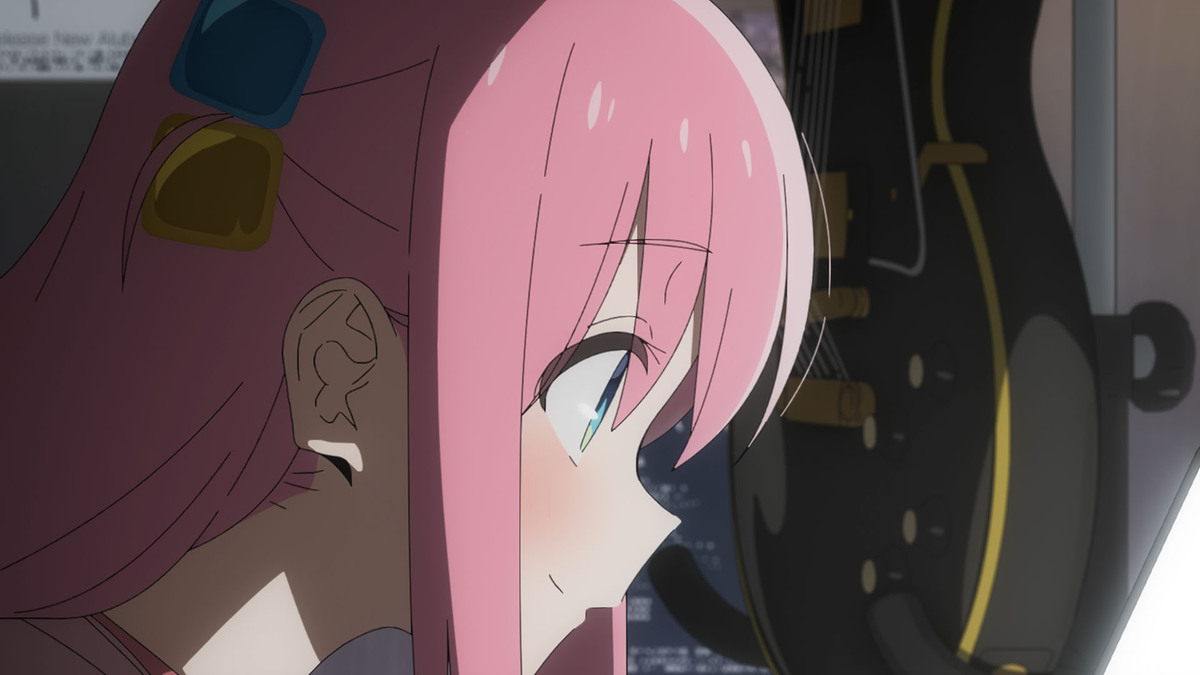
The selected official first-episode frame shows Hitori sitting stiffly in profile beside a wall of guitars. Its full composition is retained. She is alone in the visible image; the caption does not invent another band member beside her or mislabel the frame as a live concert.
The first-episode synopsis establishes solitary practice and drummer Nijika’s request for one-day guitar support. Those facts give the room a context without revealing the performance’s outcome. The still cannot establish the quality of Hitori’s playing, and her posture alone is not a basis for a medical diagnosis.
Our interpretation is that the instrument-filled setting makes a useful contrast with the figure’s restrained posture. The familiar tools of an interest can surround somebody while the social situation remains unfamiliar. The opening’s question is therefore more specific than whether a person has talent: how can that ability become usable in an encounter with others?
Original visual reference
Private practice and ensemble coordination are different achievements
Our reading of the music premise is that repetition in private can produce ability without supplying all the skills needed to play alongside people. An ensemble requires attention to timing, expectations and communication as well as individual technique. A strong solo performance does not remove the uncertainty of finding a shared working rhythm.
That gives the story room to value practice while recognizing its limits. A character’s preparation matters, but the band can still create problems that preparation alone has not rehearsed. Growth need not be reduced to an inspirational declaration that somebody was talented all along.
Watch what changes when another person makes a request. The same guitar can become a source of reassurance, pressure or responsibility depending on who is listening and what they need. This is a useful analytical lens for the music-group collection: the group transforms the meaning of an existing skill rather than merely adding more musicians to the frame.
Internal intensity and outward hesitation can coexist
Our interpretation is that Hitori’s expressive interior and constrained outward behavior create the central comic tension. A person can have an elaborate imagined response while producing very little audible conversation. The difference allows the audience to understand more than the people sharing her immediate space.
Animation has several ways to make that interior legible: changes in visual presentation, performance and the duration of a reaction can distinguish an imagined catastrophe from an observable event. A source-comparison essay should ask what each device makes clear, rather than assuming every exaggerated image is a literal occurrence inside the scene.
The guide does not turn that reading into clinical advice or a diagnosis of a fictional character. Its purpose is to examine how the work communicates hesitation and intensity. The most useful question is whether the humor lets you recognize the character’s perspective while still noticing the needs of the people around her.
A new director belongs to the announced season’s credits
The first-season official credits name director Keiichiro Saito, series composition Erika Yoshida, character designer Kerorira, composer Tomoki Kikuya and CloverWorks. The Season 2 announcement names Yusuke Yamamoto as director and Keimon Oda alongside Kerorira for character design. The source remains Hamazi’s manga, but individual screen responsibilities need their season labels.
In the linked premiere discussion, SIRTreehugger notices the distinction between Hitori’s solo ability and learning to play with others. Nayko214 contrasts the group’s temperaments with K-ON!’s ensemble. These are individual comparisons, useful for identifying different expectations of a band story; they do not constitute a representative audience survey.
The displayed AniList metric concerns only the 2022 twelve-episode TV entry. It does not rate the manga, the compilation films or an unreleased season. The external observation date is retained so a later update can refresh the metric without rewriting it as an editorial score assigned by this site.
A concert notice is not a new story-season date
The property’s official screen portal and publisher catalog document animation and books. Music events or a stage production can extend audience activity, but their schedules should keep the products they actually describe. A performance date is not evidence that the announced TV continuation premieres on the same day.
No audited title-level production budget or net profit was verified in the inspected records. The existence of compilation films and related books shows multiple distribution choices; it does not justify inventing a financial success percentage. A guest anthology’s availability likewise says nothing by itself about the anime’s production costs.
Choose the original TV season or first main manga volume, then use the clearly labeled related products according to interest. Future maintenance should check the official Season 2 notice for an actual date and any newly published main-source editions. Until then, the continuation stays announced without a fabricated calendar entry.
Primary sources and useful navigation
- Official first television production
- First episode · synopsis and original gallery
- First-season staff and cast
- Official compilation-film project
- Official Season 2 announcement · 15 February 2025
- Yen Press · main manga catalog
- Yen Press · separate Comic Anthology volume 2
- AniList · named TV audience score
Community and catalog routes
- MyAnimeList · named television catalog
- Reddit · 2022 premiere discussion and individual band comparisons
- Wikipedia · secondary production navigation
The production and publisher links support project facts. Catalog and community pages are secondary navigation and may reveal later events.
Find this work in our thematic collections
Original series imagery is reproduced under permission asserted by the site owner; the source and rights credits are retained. The route diagram is Animeteor’s own explanatory graphic.
Future English volume and a separately announced TV season
The already announced second television season now has a linked adaptation record. Its 15 February 2025 announcement is retained as a historical production notice; no verified premiere day or episode count is added.
Second-season adaptation record
English manga volume 8 is scheduled for 24 November 2026: paperback ISBN 9798855440362, 136 pages; digital ISBN 9798855440379, 128 pages. The edition page counts are distinct, and this future source release is not an anime broadcast date.