Start manga volume one or the 24-episode television anime. Watch the OVA afterward if interested; prose tie-ins and spin-offs are optional, not the anime source.
Reviewed 3 October 2026 · Opening premise and adaptation relationships. Major endings withheld; linked catalog summaries and discussions may contain spoilers. · Licensed access varies by country.

The source and screen branches

Prose books are optional tie-ins. Old collection catalogs do not prove current stock or the latest source volume; games remain outside this map.
- READ · manga source: Manga · volume 1 onward → Use one named edition
- WATCH · animation route: Television · 24 episodes → OVA · optional afterward
- OPTIONAL · prose / related books: Named prose tie-ins → Anthologies / reference books
- OPTIONAL · adult cast: Konata 30 · manga spin-off → Original: Kagami Yoshimizu; manga: Haruki Hongo
Start with school conversation, then explore the extras
Lucky Star offers a compact twenty-four-episode anime introduction and a four-panel manga source. Start either at the television beginning or at manga volume one. The separate OVA is an optional follow-up viewing choice; it is not the first episode of a hidden second television season.
Konata Izumi and her classmates turn everyday concerns into extended conversations. Food habits, homework, games and different approaches to leisure create the situations. Recognizing every pop-culture reference is unnecessary: the initial comic question is often how people who know one another still disagree about something very ordinary.
The official book catalog also lists prose tie-ins and spin-off publications. They demonstrate that novels exist within the wider product line, but they are not the source of the television adaptation. Our map places those books on an optional branch rather than making a reader alternate manga, novel and anime installments to follow classroom conversations.
A short strip and a long conversation use different clocks
Kagami Yoshimizu’s four-panel source builds comic rhythm through compact exchanges. The anime can stretch a seemingly minor topic into a performed discussion. Our comparison suggestion is to notice where the final panel’s reversal becomes a pause, a response or a change of voice on screen.
The retained official book page is a historical catalog with manga volumes, prose titles, anthologies and guides. It should not be treated as proof of the latest available volume everywhere in 2026. We identify a starting edition and publication type rather than assigning a current total from a decade-old promotional list.
A fan anthology, a source volume and a prose tie-in may use related artwork while offering very different reading experiences. Check the author and product description before choosing a book. A numbered chapter in a newer digital edition is not automatically a numbered collected manga volume.
The official collection covers twenty-four television episodes
The official home-video record specifies twenty-four television episodes for the Blu-ray collection and documents the OVA separately. Those are the main and optional animation objects used in this guide. The repeated promotional wording on an old page refers to its original sales period, not an upcoming release today.
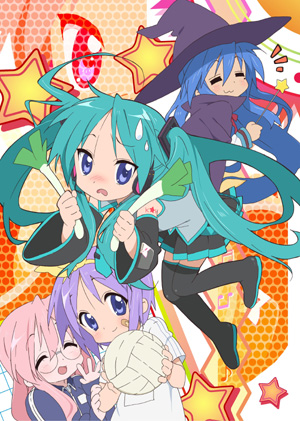
The separate OVA cover below identifies that actual product. The inner-jacket ensemble illustration identifies the television collection. Neither establishes that all manga material has been animated, and neither supports a precise chapter to continue with after episode twenty-four.
For a first viewer, complete television before choosing the OVA. Related shorts, spin-offs and prose stories can be investigated by their individual titles afterward. Our route does not absorb game adaptations into the reading sequence or infer a new season from an anniversary campaign.
Original visual reference
Familiarity turns an argument about nothing into characterization
Our analysis starts with conversational investment. A character can care intensely about a food habit that another person regards as trivial. The mismatch lets the viewer discover how each person classifies ordinary experiences. A long exchange is doing character work even when it does not advance a conventional quest.
Konata’s enthusiasm for entertainment can make her knowledgeable in one context and distracted in another. That is more interesting than reducing her to a list of recognizable references. Watch when she shares enthusiasm, when she uses a joke to redirect attention and when another person draws a practical boundary.
The classmates supply different pressures on the same discussion. A correction, an uncertain question and an indulgent response can each reveal a relationship. Notice who is comfortable letting a topic drift and who wants it resolved. The group’s rhythm depends on those contrasts rather than one participant always winning.
Pop-culture references have more than one possible function. They can reward recognition, characterize a speaker’s interests or make an ordinary moment suddenly theatrical. If a reference is unfamiliar, ask what changes in the interaction when it appears. That question preserves the scene’s social meaning without requiring a catalog of every allusion.
The separation between the main classroom material and the Lucky Channel framing also changes expectations. A program-within-the-program can make performance itself into the subject of a joke. Compare a character’s public presentation with the response behind it. A comic persona is a constructed relationship with an audience, not necessarily a stable description of someone’s feelings.
Repetition supports comfort but can also expose friction. Once the viewer knows how a person is likely to respond, a small departure matters. Returning to an early episode after completing the series is useful because an initially ordinary line can communicate a more specific relationship on a second viewing.
Use Kyoto Animation’s actual credit record
Kyoto Animation’s official work page identifies Yoshimizu’s source and credits Yasuhiro Takemoto as director, Touko Machida for series composition, Yukiko Horiguchi for character design and chief animation direction, and Satoru Kosaki for music. Its record confirms the studio’s production role without requiring an attribution assembled from a fan summary.
The source creator’s involvement and the animated staff’s roles do not make the works identical. Dialogue timing, acting and editing are adaptation choices. We treat our reading of those choices as editorial interpretation, not as a documented statement of the staff’s intentions.
The two credited original promotional illustrations come from the official collection catalog. They are shown as identifiable television and OVA products. Our explanatory map labels the prose branch separately so a shared franchise title cannot make a tie-in novel look like the original source.
A television score does not rate the whole merchandise shelf
The checked AniList television entry has a weighted average of 75/100, displayed as 7.5/10 on October 3, 2026. It applies to the twenty-four-episode anime. It is not an average of manga, OVA and novel opinions, and it is not a rating supplied by Animeteor visitors.
The community and wiki destinations below can help identify references or compare a remembered scene. They remain supplementary navigation and may reveal material beyond a first viewer’s progress. No sampled community posts are presented here as evidence of a universal preference for one adaptation.
A more useful question than whether a reference is dated is whether its conversational function remains legible. Some viewers may enjoy recognition while others enjoy the disagreement around it. Those are possible approaches to the scene, not audience groups measured by a poll in this review.
Historical catalogs require a present-day access check
The official site retains older collection specifications and Japanese prices. Those are edition records, not a promise of current stock or shipping to every country. Check language tracks, player compatibility and included OVA material on the licensed edition you actually plan to use.
The books page includes novels, anthologies and reference products. A higher-priced limited book package may contain supplementary animation, but that does not make the package a mandatory story installment. Compare contents before treating an unfamiliar title as a continuation.
No verified production budget or profit calculation was established here. Collection packaging and tie-ins show a commercial ecosystem, but their prices cannot prove how profitable the television series was. Games and related physical products can receive separate coverage without entering the main adaptation roadmap.
Trace the relationship behind a reference
Choose an early conversation and follow who introduces the topic, who changes its direction and who ends it. Then compare the corresponding style of manga strip. The most useful difference may be the duration of an awkward pause rather than the inclusion or omission of a recognizable joke.
After the main anime, explore the OVA or a named prose tie-in according to your interests. These optional objects are visibly separated below. The source manga is best approached from its own beginning rather than through an unverified exact continuation instruction.
The official studio and product records anchor production and coverage. Community pages provide places to ask about references, with spoiler caution. Later publication checks can update edition availability and source totals without changing the basic distinction between manga source, television adaptation and optional prose products.
Primary sources and useful navigation
- Kyoto Animation · source, staff and production
- Official · television collection and separate OVA
- Official · source manga and prose product types
- AniList · named anime audience score
Community and catalog routes
- MyAnimeList · named anime catalog
- Reddit · Lucky Star community
- Fan wiki · references and edition discovery
The production and publisher links support project facts. Catalog and community pages are secondary navigation and may reveal later events.
Explore related story guides
Original series imagery is reproduced under permission asserted by the site owner; the source and rights credits are retained. The route diagram is Animeteor’s own explanatory graphic.
Games and live-action adaptations
- Lucky Star Moe Drill — Game: Character-based drill and adventure · 2005
Konata 30 and the original Moe Drill are separate optional products
KADOKAWA’s current Konata 30 listing follows the familiar friends around their thirties and credits Kagami Yoshimizu for the original work and Haruki Hongo for the manga. Its catalog posting dates are not treated as the original spin-off premiere. The optional manga branch is reflected in the source map; no new anime season is inferred.
The original Japanese Nintendo DS Moe Drill was released on 1 December 2005. It remains outside the core anime and manga order and is distinct from the later Shin game.
Original Moe Drill game guide · Exact edition / event record