Lucky Star Moe Drill — Japanese Nintendo DS game guide
GAME GUIDE · Sources checked 04 October 2026 · Opening-premise spoilers; original promotional screenshots can reveal creatures and environments.
Kadokawa Shoten’s original Lucky Star Moe Drill mixes short training questions with character and adventure modes. Nintendo’s catalog identifies this 2005 DS product separately from its later sequels.
- Product
- らき☆すた 萌えドリル; original game
- Publisher
- Kadokawa Shoten
- Japanese release
- 1 December 2005
- Platform
- Nintendo DS
- Images
- Separate original 256 × 192 DS display panels
- Identity boundary
- Not Shin Lucky Star Moe Drill or later PlayStation products
Product and edition
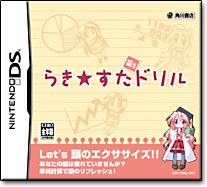
Nintendo’s original product record names Kadokawa Shoten and dates this Japanese DS game to 1 December 2005. It describes training questions alongside character-development and adventure elements, with touch and voice input among the product features. The word original matters here: a later Moe Drill title or PlayStation product is not another edition of the same pictured software. The catalog’s packaging and individual display panels are preserved at their native dimensions. Their guest-credit list remains available through the direct source, without treating every guest contributor as the author of Lucky Star’s manga. This interactive product is a separate optional branch from the twenty-four-episode television adaptation and its supplementary animation.
Gameplay and story
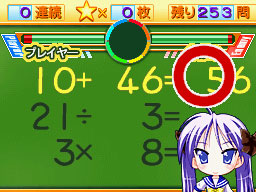
The selected question panel places an arithmetic prompt alongside a character, counters and a compact status area. Our editorial interpretation is that familiar character imagery accompanies a repeated activity rather than functioning only as a finished comic scene. That arrangement can be compared with the everyday rhythm of a short-form manga, but it does not prove that the game adapts any particular strip. The frame also does not establish how quickly someone should answer, whether a shown response is correct or what progression unlocks a character. Its usefulness is visual: the whole original demonstrates that the character and question share an interactive presentation. We have not substituted a character portrait for a gameplay screen or enlarged the panel to suggest detail absent from the official file.
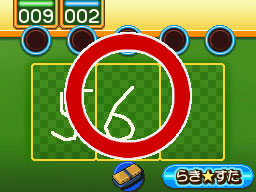
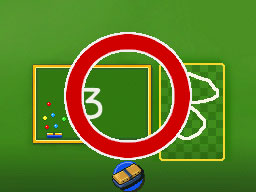
The two additional touch-input panels retain response marks and controls. One includes counters and a handwritten character, while the other shows marked areas in its original composition. Our reading focuses on how a small display gives room to the participant’s action. A comic reader follows marks already chosen by an artist; a touch-interface example leaves space for a player’s response. This comparison is an interpretation of the images, not a claim about handwriting-recognition accuracy or a tested method for answering. Each panel is a distinct original asset. They are not duplicate crops, and their separate presentation does not pretend to reproduce a full physical DS console. Native Japanese text and the exact small image proportions remain visible.
Choosing this route
Use this historical optional branch for the character-based drill product, and use the main Lucky Star analysis for manga and anime discovery. A licensed game connection does not make a brain-training question part of the television chronology. Nor do related guest appearances establish a shared fictional continuity across every credited property. The product’s own identity is more helpful than a franchise-wide label: a visitor can distinguish the 2005 software from later titles before comparing their features. Our story lens asks how recurring characters can accompany a lightweight repeated activity. That question does not require inventing an anime continuation, assigning a chapter number to a question mode or declaring that every game ending belongs to the source. The core route remains separate.
Platforms and access
The record concerns the Japanese Nintendo DS product released in 2005. Historical wireless-player information does not prove current online functionality, stock or compatibility with another system. No current price, unofficial translation, emulator route or installation promise is offered. Nintendo’s publisher-supplied panel files are 256 by 192 pixels and the packaging is 207 by 187; each is shown without artificial enlargement. The source lists additional guest-image credits, which should be read as the product’s credit inventory rather than silently removed or generalized. The discussion is based on original promotional panels and catalog identity. It is not a hands-on account of input recognition, a completion walkthrough or a recommendation to purchase an unverified secondhand edition.
Sources and credits
- Nintendo · exact original game, credits and packaging
- Nintendo · arithmetic and touch-response panels
- Nintendo · distinct touch-response panel
Facts are drawn from the identified publisher and developer records. The story lens is editorial interpretation, not a hands-on review, performance test or audience rating.