Watch the standalone 2001 film. Five film comics or the 2025 all-in-one volume retell it; the art book and picture book are optional companions, not source novels or sequels.
Reviewed 3 October 2026 · Opening premise and adaptation relationships. Major endings withheld; linked catalog summaries and discussions may contain spoilers. · Licensed access varies by country.

The source and screen branches

The original film precedes its print retellings. Numbered film comics and the all-in-one are alternatives. Reference books, other Ghibli films and theatrical reissues do not add sequel chapters.
- WATCH · original feature: 2001 film · 125 minutes · Complete standalone story
- READ · film retelling: Film comic · volume 1 → Film comic · volume 5
- READ · collected alternative: 2025 all-in-one · 856 pages · Retells the animated film
- OPTIONAL · references: Art book · designs and script · Picture-book presentation
A child must learn how to act in a world that will not explain itself
Chihiro is already unhappy about moving when a detour places her family inside an unfamiliar world. Her parents’ transformation leaves her facing a bathhouse governed by Yubaba, where getting help depends on learning rules, earning trust and doing work. The adventure is fantastical, but its first emotional problem is recognizable: a child who wants familiar security must begin making decisions without it.
The original 2001 animated film is the complete main route. Studio Ghibli records an approximately 125-minute running time and a July 20 Japanese opening. No other Ghibli film, television season or novel needs to precede it. Licensed film comics offer a print retelling afterward or an alternative reading experience, rather than an original manga source.
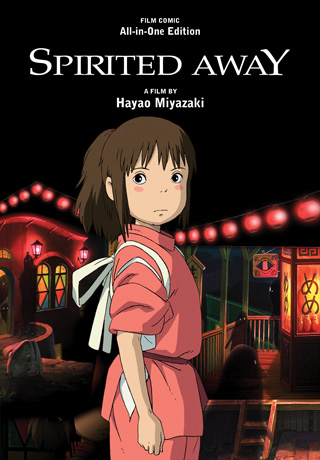
The original train still included here supports a discussion of the film’s pacing. The licensed all-in-one cover identifies the printed retelling. Together they show why a visitor may want both an animated experience and a reading version, while keeping their relationship clear instead of calling the print book a sequel.
Five film-comic volumes can also be read in a single hardcover
VIZ’s film-comic catalog lists volumes one through five. The All-in-One Edition lists 856 pages, ISBN 9781974751556 and a February 25, 2025 release date. That is a book-edition date, not a date for a new animated film or a sixth narrative installment. Choose the numbered set or the collected book according to the format you want to handle.
The publisher uses a manga category for the all-in-one product, but its film-comic title identifies the direction of adaptation. Spirited Away began as an original animated feature. Its panels retell the cinematic work; they do not reveal a source manga that viewers must finish to understand the film’s conclusion.
VIZ separately lists a 170-page picture book and a 240-page art book. The latter includes designs, sketches, storyboards and an English-language script. It is useful for production study, while the picture book presents another illustrated approach to the movie. Page count and a shared title alone cannot tell a reader which publication supplies sequential film-comic reading.
A straightforward film route, with references kept outside the main sequence
Watch the feature in a licensed edition with the language performance that suits you. The complete story does not require an earlier film. When returning to it, compare the busy bathhouse passages with quieter transitions rather than look for a hidden series order. A rewatch can change what you notice without adding a missing installment.
Read the five film comics in numbered order or the single all-in-one volume. The map places these as alternatives. A viewer moving into either format is revisiting the film’s story; there is no verified post-anime source chapter handoff to give for this original feature. Art-book pages and production supplements are reference discoveries rather than story checkpoints.
The current licensed GKIDS page advertises Studio Ghibli Fest dates of October 17–21 alongside a 2026 festival banner. On this guide’s October 3 review, that is an upcoming exhibition listing to check locally, not a promise of screenings in every country. A theatrical return concerns the same film and should not be confused with a new continuation.
Original visual reference
The bathhouse gives identity and generosity a practical cost
Our reading focuses on the difference between wanting to escape and learning how to respond. Chihiro does not become capable simply because someone announces that she is special. She has to notice what other people need, ask for help and persist through situations in which embarrassment, fear and exhaustion can interfere with judgment. The work setting makes growth observable rather than purely symbolic.
The bathhouse is especially effective because it organizes the unfamiliar world around recognizable transactions. People have tasks, authority, customers and expectations. A character can be useful within that organization while remaining vulnerable to it. This makes identity more than a private feeling: who calls you by what name, who recognizes you and which obligations you accept all affect the space in which you can act.
Food and appetite create another set of transactions. Taking something that appears available is not the same as understanding who provides it or what accepting it may cost. The opening family encounter establishes that problem before Chihiro learns the bathhouse’s rules. Later forms of generosity can then be examined more carefully: is an offer attentive to another person, or does it ask the recipient to become part of someone else’s hunger?
No-Face is useful to discuss through reactions rather than through a single fixed label. The surrounding environment helps determine what kinds of exchanges become possible or desirable. If a character’s behavior changes when the social setting changes, the setting is part of the analysis. A description that reduces every creature to one permanent moral category misses how the bathhouse teaches, rewards and amplifies particular actions.
The train passage changes the film’s rhythm. The original still here gives the carriage a long horizontal shape surrounded by water, with open sky occupying much of the image. Movement can continue while confrontation pauses. The characters do not need to explain every feeling aloud for the journey to have weight; distance, light and time give a viewer room to register what has already happened.
That pause is more precise than saying the entire sequence contains no sound. Music, environmental sound and the absence of continuous dialogue have different functions. A scene can feel quiet while remaining carefully composed for listening. When comparing the film with a film comic, ask how a held view or page turn supplies room for attention, and what is lost when a reader determines the duration instead of hearing the animated scene unfold.
Film authorship, music and award dates belong to distinct records
The official work record credits Hayao Miyazaki with original work, screenplay and direction, Toshio Suzuki as producer and Joe Hisaishi for music. Yumi Kimura is credited for the theme song. The Japanese cast list includes Rumi Hiiragi, Miyu Irino, Mari Natsuki and Bunta Sugawara. Toho is identified as the original Japanese distributor.
The Academy’s Miyazaki profile confirms the film’s Golden Bear at the 2002 Berlin festival and Best Animated Feature Oscar at the 2003 U.S. ceremony. These recognition dates follow the film’s 2001 Japanese release. Keeping film year, award eligibility conventions and ceremony year separate prevents a book blurb or regional edition from silently changing the original chronology.
GKIDS lists edition supplements including full-length storyboards, trailers, a voice-recording feature and producer/director statements. VIZ’s art book provides another way to examine how the world was designed. Those are concrete next steps for a reader interested in making animation; they are not evidence that the movie needs an additional narrative chapter to be complete.
Why a quiet journey can feel familiar without matching a personal memory
The linked discussion centers on the train scene’s mixture of calm, melancholy and an unexpected sense of nostalgia. Replies point to passing lights, childhood journeys and Hisaishi’s music, while others imagine the lives of the shadowed passengers. These are viewer interpretations of an evocative sequence, not confirmed biographies of its background figures.
The range of reactions offers a useful viewing exercise: notice what the image and sound give you before naming the emotion. Someone may find the passage comforting, another may feel loneliness, and both can point to the same outwardly peaceful movement. Claims about the scene’s exact length or an artist’s intended meaning should be checked against direct evidence rather than accepted because they appear in a popular reply.
The named AniList record was checked on October 3, 2026. Its weighted audience average was 86 out of 100, normalized here to 8.6 out of 10 for the original 2001 film. This does not rate the print books, stage versions or the whole Ghibli catalog. Individual discussion replies remain separate from the external score, and Animeteor does not collect its own visitor votes.
A historical Japanese cinema record is not a current worldwide total
Studio Ghibli’s institutional history reports 23.8 million Japanese admissions and ¥30.8 billion in box-office receipts for the film’s historical success. Those are the retrospective’s figures for the stated market and period. They should not be relabeled as October 2026 worldwide revenue or a lifetime total including every later reissue.
Gross receipts also do not equal studio profit. Exhibitors, distributors and rights participants can receive different shares, and the sources here do not provide an audited net-profit calculation. The Academy’s recognition confirms awards history; it cannot turn a gross figure into financial return. The analysis therefore retains the concrete historical measure without inventing a present profit estimate.
The 2025 all-in-one book and current licensed exhibition listing show different ways the film remains commercially available. For an individual purchase, identify whether the product is the feature, a film-comic retelling or production reference. Territory, language and present stock require their own checks. An older collector’s price or discussion of a streaming service does not guarantee today’s access.
Let the first viewing remain simple and the return visit become more specific
Begin with the feature. If you want a print retelling, choose five film-comic volumes or the single collected book. If the animation process is the attraction, follow the art book or licensed storyboard supplements. The story map keeps those purposes legible so that a richer guide does not make a straightforward standalone movie appear difficult to enter.
The Ghibli work page anchors original credits, running time and stills; the institutional history anchors the historical Japanese commercial figures. The Academy supplies award context, VIZ identifies the books and GKIDS provides licensed viewing discovery. Community discussion is useful after watching, with plot spoilers expected rather than hidden behind a claim of factual authority.
The original still retains the gallery’s attribution and within-common-sense usage instruction. Future verified editions or exhibition changes can update the discovery information while preserving the film’s identity as an original 2001 feature. A strong return visit should help the reader notice work, exchange, sound and quiet movement in the film, rather than simply repeat its plot in longer form.
Primary sources and useful navigation
- Studio Ghibli · original film record and official stills
- Studio Ghibli · historical Japanese admissions and gross receipts
- GKIDS · licensed viewing, festival listing and edition supplements
- Academy · Miyazaki profile and award-ceremony chronology
- VIZ · five numbered film comics
- VIZ · February 2025 all-in-one edition and original cover
- VIZ · art-book contents and script
- VIZ · picture-book edition
- AniList · named anime audience score
Community and catalog routes
The production and publisher links support project facts. Catalog and community pages are secondary navigation and may reveal later events.
Explore related story guides
Original series imagery is reproduced under permission asserted by the site owner; the source and rights credits are retained. The route diagram is Animeteor’s own explanatory graphic.
Production and edition updates
Spirited Away filmed stage performances — US, October 2026
Fathom’s 1 September 2026 announcement identifies filmed 2022 stage performances for US cinemas: Kanna Hashimoto’s Chihiro version on 1 October and Mone Kamishiraishi’s version on 8 October 2026. They are Japanese performances with English subtitles. The first date has passed at review; the second remains upcoming.
See the separate production record →
Spirited Away stage tour — 2026–2028 schedule
TOHO’s stage schedule lists Taipei in December 2026–January 2027, Japanese engagements in March–August 2027, Toronto in May–August 2027, Los Angeles in September–October 2027 and London in March–July 2028. Those are separate venue windows, not a single worldwide release day; exact days are not invented.