Watch the standalone 1997 film. Five film comics or the 2026 hardcover retell it; The First Story is a different early concept, while art and picture books are optional references.
Reviewed 3 October 2026 · Opening premise and adaptation relationships. Major endings withheld; linked catalog summaries and discussions may contain spoilers. · Licensed access varies by country.

The source and screen branches

The film is original; film comics are retellings. The First Story is an earlier different conception, not a prequel. Restoration revisits the same feature; Mononoke TV is a separate work.
- WATCH · original feature: 1997 film · 133 minutes · 4K edition · same story
- READ · film retelling: Film comic · volume 1 → Film comic · volume 5
- READ · hardcover alternative: 2026 all-in-one · 856 pages · Retells the animated film
- OPTIONAL · early concept: The First Story · 1980 concept · Different from the final film
A search for a cure enters a conflict that has no simple safe side
Ashitaka leaves home after an encounter with a cursed boar and reaches a struggle between an iron-producing settlement and the living forest around it. Lady Eboshi’s town offers a place to people who need work and protection. San, raised by wolves, understands that expansion through the destruction of her home as an immediate threat. The newcomer cannot solve the conflict simply by choosing whichever group first appears sympathetic.
The original 1997 animated film is the main route. Studio Ghibli records an approximately 133-minute running time and a July 12 Japanese opening. It is a standalone feature, not a sequel to Nausicaä, and no preceding television show is necessary. Its violent confrontations and bodily curse give its environmental conflict a different intensity from a gentle family fantasy.
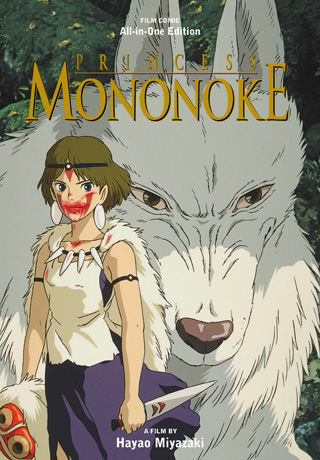
Licensed film comics provide reading versions of the feature. The original still and film-comic cover below serve different purposes: one supports a discussion of labor inside the town, while the other identifies a print retelling. Neither should imply that a later comic was the manga source of this original animated story.
Five film comics, a collected retelling and an earlier different story
VIZ’s numbered film-comic catalog lists volumes one through five. Its hardcover All-in-One Edition lists 856 pages and a January 27, 2026 release date, with ISBN 9781974756988. The film-comic label remains essential even where the publisher places that product in its manga category: this is the animated adventure presented in a reading format.
The First Story is a different publication. VIZ describes Miyazaki’s watercolor story created in 1980 as an initial conception that differs from the final film. Its 104-page English hardcover was released on October 21, 2014. That later publication date should not erase the earlier date of conception, but the earlier concept should not be treated as a required first installment of Ashitaka and San’s finished film.
The same catalog also distinguishes a film picture book and The Art of Princess Mononoke. A buyer looking for a retelling, an early creative version or production artwork is making three different choices. Similar titles and illustrated pages cannot establish that they contain identical narratives, and none supplies a verified post-film sequel here.
A restored screening revisits the same film rather than adding a new chapter
Watch the 1997 feature in an available licensed edition. GKIDS describes a new 4K remaster overseen by Atsushi Okui and an IMAX presentation. Those details concern the preparation and exhibition of the existing film. A restoration can change the viewing experience without becoming Princess Mononoke season two or requiring a second position after the original in the story order.
For reading, choose the five numbered film comics or the single hardcover retelling. Keep the film picture book and art collection as optional companions. The First Story belongs on an early-concept comparison lane, with its relationship explained before a reader opens it. It is not a missing first volume in the numbered film comics.
The separate anime called Mononoke, centered on the Medicine Seller, is another work. A shared word in an English title does not connect the two plots. The map on this page concerns Miyazaki’s Princess Mononoke only; likewise, Nausicaä and Castle in the Sky are creator comparisons rather than prior chapters in the same world.
Original visual reference
Protecting vulnerable people does not settle the cost of protecting a town
Our reading begins inside Iron Town rather than with an abstract opposition between evil industry and innocent nature. A settlement can provide dignity, practical skills and shelter while depending on extraction that damages another community. Recognizing its social value does not make that damage disappear. The film asks a viewer to hold those facts together instead of using one to cancel the other.
The official still included here makes work visible. Ashitaka joins a group operating a large mechanism; the image gives us bodies, coordinated movement, equipment and a shared interior. The town’s industrial power is not an empty symbol of greed. People expend effort to keep it functioning. That is why a simple instruction to stop the machinery immediately leaves a human question unanswered: what would replace the livelihood and protection it provides?
Lady Eboshi’s authority is also more specific than a generic villain’s ambition. Her ability to improve some people’s circumstances can coexist with confidence that she may defeat whatever stands in the town’s way. The ethical tension lies in the boundary of her concern. Who counts as someone she must protect, and who becomes an obstacle outside that boundary? An admirable act inside one community does not automatically justify every act directed outward.
San makes that boundary painful because the forest is a home rather than an attractive view. Her relationship to the wolves resists the assumption that human society has an automatic claim to her loyalty. The threat to her world is material and immediate. Yet anger can narrow the actions she considers possible, just as the town’s defensive determination can narrow its own. Understanding why a person fights is not the same as declaring every response harmless.
Ashitaka’s position between groups would be weak if it meant only refusing to have an opinion. It becomes meaningful when he must act under competing obligations and cannot avoid the consequences of doing so. His curse gives hatred a bodily presence: conflict is not merely a conversation between neatly separated philosophies. A damaged body travels through the same world in which people propose confident solutions.
The forest’s beauty and frightening capacity likewise belong together. Animation gives nonhuman life scale, movement and an ability to resist that exceeds a picturesque backdrop. This makes coexistence harder than a slogan. The film’s sustained question is what arrangements could let different lives continue, rather than which side can win one confrontation and declare the whole world repaired.
Original-film credits, restoration credits and a production diary
The official work page credits Hayao Miyazaki for original work, screenplay and direction, Toshio Suzuki as producer and Joe Hisaishi for music. Yoshikazu Mera is credited for the theme song. The Japanese voice list includes Yoji Matsuda, Yuriko Ishida, Yuko Tanaka and Kaoru Kobayashi; the original feature was distributed in Japan by Toho.
GKIDS separately identifies English performers including Billy Crudup, Claire Danes, Minnie Driver and Gillian Anderson. Language performance and the new remaster’s technical oversight are edition-specific information. They should not replace the original film’s author or producer credits, and a new exhibition year should not change its 1997 origin.
Ghibli’s linked production-diary index covers daily studio activity from August 1994 through July 1998. It is valuable as a primary archive for readers interested in production work rather than a fan reconstruction. Individual entries need their own context: the index spans a period of studio activity, so its first date is not by itself an exact start date for every scene or task in this film.
The disagreement is whether complexity changes a familiar environmental story
The linked discussion begins with a viewer who admires the animation and music but does not feel the film exceeds the studio’s other work. Replies argue that the town’s protection of marginalized people complicates a straightforward nature-versus-greed reading. A later reply challenges whether that automatically makes every character morally ambiguous. The disagreement is more useful than a manufactured consensus that everyone finds the same message.
Use the thread as a prompt to identify specific acts of protection, harm and self-interest. Saying that characters are complex is a starting observation; a stronger analysis asks what they do, whose lives those actions affect and what alternatives remain visible. The discussion contains plot spoilers and reflects a small group of commenters, not a measured audience-wide verdict.
AniList’s named 1997-film record was checked on October 3, 2026. Its weighted average was 85 out of 100, normalized here to 8.5 out of 10. The number does not rate The First Story, film comics or every Ghibli work. It is an external audience figure, kept separate from our scene-based interpretation and from optional reader discussion.
A documented production cost is not an audited profit calculation
Studio Ghibli’s institutional history describes a production cost of ¥2 billion for Princess Mononoke and explains that the project was considered financially risky. This is a studio retrospective’s work-specific historical figure, not a current restoration budget. It supplies firmer context than an unsourced online estimate.
That cost alone cannot establish net profit. Distribution shares, marketing, rights arrangements and later releases affect what different participants receive. A contemporary remaster or a January 2026 hardcover shows that the property continues to be exhibited and published, but it does not supply an audited return on the original production expenditure.
For a reader choosing an edition, the practical distinctions are film, print retelling, early-concept story and reference art. The all-in-one hardcover’s page count helps identify its format; it is not a measure of added fictional content beyond the film. Licensed availability varies by territory and retailer, while an archived discussion about preferred editions cannot guarantee present stock or a current price.
Keep the original adventure separate from its publishing history
Begin with the feature, then decide whether you want a print retelling or a closer look at how the work developed. Read the five film comics or the all-in-one volume as alternatives. Open The First Story for a deliberately different early conception, and choose the art book or production archive for reference rather than an imagined continuation.
The Ghibli record anchors original credits, running time, release and stills. GKIDS explains the licensed remaster and viewing discovery, while the individual VIZ records identify book contents and dates. The linked discussion can deepen a comparison after viewing, with spoilers expected. This structure remains usable when another licensed edition is verified later.
The original gallery’s within-common-sense usage instruction and image attribution remain attached to the scene reference. A future update can revise availability or add edition details without merging separate stories or changing the source relationship. The central analysis should continue to connect ethical claims to work, protection and harm visible within the film itself.
Primary sources and useful navigation
- Studio Ghibli · original credits, release and official film stills
- Studio Ghibli · institutional history and historical production cost
- Studio Ghibli · primary production-diary index
- GKIDS · licensed feature and new 4K remaster scope
- VIZ · five numbered film comics
- VIZ · January 2026 hardcover retelling and original cover
- VIZ · The First Story and its different 1980 conception
- VIZ · film picture-book edition
- VIZ · film art book
- AniList · named anime audience score
Community and catalog routes
- MyAnimeList · named anime catalog
- Reddit · disagreement over environmental storytelling and character complexity
The production and publisher links support project facts. Catalog and community pages are secondary navigation and may reveal later events.
Explore related story guides
Original series imagery is reproduced under permission asserted by the site owner; the source and rights credits are retained. The route diagram is Animeteor’s own explanatory graphic.
Separate products and edition details
Princess Mononoke 4K UHD + Blu-ray — Japan, June 2026
Studio Ghibli’s 10 April 2026 notice dates Walt Disney Japan’s Princess Mononoke 4K UHD + Blu-ray set to 24 June 2026. The two-disc package has one UHD disc and a Blu-ray prepared from a new master. The notice places it after the 2025 North American and Japanese IMAX exhibitions and identifies a roughly 26-minute IMAX premiere-stage extra. This is a home-video edition of the 1997 film, not a sequel.
See the exact separate record →
Princess Mononoke Super Kabuki — 2026 stage production
Shochiku’s official theater record identifies Super Kabuki Princess Mononoke at Shinbashi Enbujo from 3 July through 23 August 2026 and now marks the run as ended. This is a performed stage adaptation, not an announced live-action film or television series. The historical run is recorded separately from current ticket or streaming availability.
See the exact separate record →
Princess Mononoke quote karuta — 2026 Japanese edition
Ensky’s official listing identifies a renewed Japanese Princess Mononoke quote-karuta product, code 4970381812249, with initial shipment starting in late June 2026. It contains 48 picture cards, 48 reading cards and four spares, plus twelve list cards, and adds three lines in the renewed edition. The manufacturer notes that the selection does not cover every Japanese initial sound. The month-level shipment window must not be converted into an invented exact release day.