Watch season one (24 episodes), optional Chapters L/F, then season two (12). Read the main manga in 10 volumes; two separately published Japanese manga extras are optional afterward.
Reviewed 3 October 2026 · Opening premise and adaptation relationships. Major endings withheld; linked catalog summaries and discussions may contain spoilers. · Licensed access varies by country.

The source and screen branches

First-view recommendation: season one, optional side stories, then season two. Main manga precedes supplemental stories; fanbook is reference. Games and live-action remain separate.
- WATCH · main animated route: Season one · 24 episodes → Season two · 12 episodes
- WATCH · optional first-season extras: Chapters L and F · two side stories
- READ · source and extras: Main manga · volumes 1–10 → Optional Japanese extras · Yasashii Kaze / Kimi wa Boku no Takaramono
- REFERENCE · companion books: Official fanbook vol.0 / Illustrations
An art college is a place to begin, not a guarantee of direction
Yuta Takemoto studies art in Tokyo, living among friends whose talents, romantic hopes and practical problems refuse to line up neatly. The arrival of gifted Hagumi Hanamoto changes the group’s relationships, but the story is broader than a competition for affection. It follows young people trying to recognize what they want and what they can build. Start with the first anime episode or manga volume, where the shared living environment gives those questions their everyday texture.
The main animated route is Honey and Clover, twenty-four television episodes, followed by Honey and Clover II, twelve episodes. Discotek’s licensed catalogs identify those runs separately, and Fuji Television describes the second as the continuation of the first. Two first-season side stories, Chapters L and F, appear in the official Japanese complete-box contents. They are optional additions rather than a third television season.
For a first visit, finish the first season, optionally watch the two side stories, then continue to the second season. That is our simple viewing recommendation, not a claim that every platform places the extras there. The completed ten-volume manga is the source route. You can read it independently without first watching either season or the separately produced live-action adaptations.
Ten main volumes, plus two separately listed manga stories
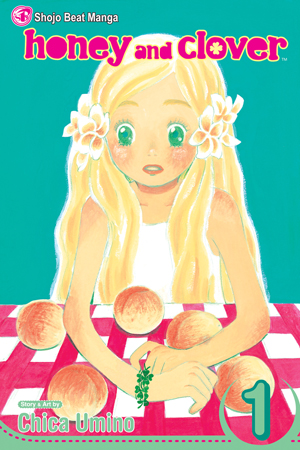
Chika Umino created the manga, credited as Chica Umino on VIZ’s English editions. Shueisha records the Japanese tenth volume, and VIZ provides the English ten-volume route, including a first-volume preview. The two spellings identify the same creator here. The publisher illustrations on this page show the manga’s promotional artwork and English first-volume cover, not screenshots asserted to represent a specific animated scene.
Two additional Japanese manga stories are sold separately under Hakusensha’s uncollected-story label. BOOK WALKER lists Yasashii Kaze as entry one and Kimi wa Boku no Takaramono as entry two. The latter’s licensed description explicitly concerns relationships after the main ending. Read the main ten volumes first, then treat these as optional supplementary fiction; their numbering does not turn the main collection into twelve full volumes.
The second extra’s catalog also mentions the Fujiwara design office before its appearance in March Comes in Like a Lion. That is a specific character connection documented by the listing, not a requirement to read another long series to understand the main Honey and Clover route. Shueisha’s volume-zero official fanbook and Illustrations collection are reference products. Their titles and catalog categories do not establish a prose-novel branch.
Distinguish television episodes, side stories and product extras
The official Japanese complete Blu-ray site identifies first-season Chapters 1–24, the previously unbroadcast Chapters L and F, and second-season Chapters 1–12. That gives a concrete content inventory: thirty-six main television episodes and two side stories. Interviews, opening footage and promotional material on an extra disc are not more narrative episodes. A player’s combined numbering should be checked against these named entries.
The second season continues the central ensemble’s progress rather than resetting the premise as another adaptation. The completed manga remains an alternative way to experience the source, with its own pacing and collected extras. We do not give an exact post-anime chapter jump without comparing scenes in the named English or Japanese edition. A volume count and an episode count alone cannot establish which smaller moments have been retained.
Live-action has its own route. Asmik Ace documents the 2006 feature directed by Masahiro Takada; Fuji Television preserves the Japanese drama’s separate record, while Asahi’s archive concerns the Taiwanese drama. Those are adaptations to discover independently. Under Animeteor’s production rule, they stay outside the anime–manga map and do not become mandatory steps between the two animated seasons.
Original visual reference
Love and artistic work ask different questions
Our interpretation starts with the mismatch between ability and certainty. A student can be good at making something without knowing what kind of life that ability will support. Another can have a strong feeling without knowing whether expressing it will help anyone. Placing these difficulties beside one another gives Honey and Clover its particular weight: progress in one area does not automatically solve the other.
The ensemble makes comparison unavoidable. Living and studying close to talented people creates opportunities for affection, admiration and envy to occupy the same space. A visible achievement can conceal the work or doubt behind it, while an apparently aimless person may be struggling to name a direction. Watch who gets to explain an ambition and who is understood mainly through someone else’s attention.
Unreturned affection also changes the meaning of waiting. A romance organized only around the eventual formation of a couple would treat delay as an obstacle to remove. Here, time can expose the limits of a hope without making the person who holds it foolish. The useful critical question is whether a scene gives that person a life beyond their desired relationship: work, friendships, pride and an evolving sense of what they can accept.
The art-school setting makes material choices part of the emotional story. A project, a job or the ability to continue creating can change what support means. Animation supplies voices and musical duration; manga lets readers linger over a reaction or move quickly through an exchange. Comparing those experiences is more productive than calling one automatically deeper because it uses more minutes or pages. Their different pacing can draw attention to different parts of the same uncertainty.
The change of director is documented, not an invented reboot
Discotek identifies Kenichi Kasai as the first-season director and Tatsuyuki Nagai as the second-season director. The official second-season website credits Kasai with supervision, Yosuke Kuroda with the screenplay, Shuichi Shimamura with character design and J.C.STAFF with animation production. The credited collaboration helps explain why a personnel change should not be described as the launch of an unrelated continuity.
The same official page credits DEPAPEPE and Yuzo Hayashi with Salon 68 for music, and names YUKI and Suneohair for the second season’s opening and ending songs. Music gives the anime another way to organize reflection and transitions. A soundtrack listing is nevertheless a companion product, not a story chapter. This article links the verified production records without embedding unauthorized song files or turning music credits into invented financial figures.
Fuji’s first-season archive explains the creation of the noitamina programming slot around reaching viewers outside an assumed conventional anime audience. Its second-season archive explicitly places Honey and Clover at the beginning of that slot’s history. That is a useful institutional context for a university ensemble drama. It does not prove that every viewer was new to animation or that the broadcaster’s intended audience perfectly matched the actual audience.
Returning to a college story changes the questions
The linked viewer conversation includes a reader who remembers the series from student years and wonders how it will feel on returning as an older adult. That is a useful discussion prompt rather than a demographic survey. A student might attend to the difficulty of choosing a direction; an older viewer might recognize the limits of trying to secure another person’s future. The same uncertainty can remain meaningful while the point of identification changes.
Our recommendation is to approach the work as an ensemble coming-of-age drama with romance, rather than a promise of one uncomplicated romantic payoff. The first season gives time to comic daily life, while the continuation brings unresolved choices back into focus. A preference for faster plot movement may affect the experience. Naming that pacing expectation is more useful than treating a favorable audience average as proof that everyone will respond alike.
The external score shown here is AniList’s named 2005 first television season, checked on October 3, 2026: 76 out of 100, normalized to 7.6 out of 10. It does not include the second season, the two specials, the manga or live-action. The collector discussion is a separate lead about owning older releases, not an authority on current stock or the plot. Community links can reveal later developments; open them with that distinction in mind.
Historical circulation and remaster claims have a scope
Fuji’s archive for the second television season reports eight million manga copies in circulation at that promotional stage. Its later Japanese drama announcement reports more than eight and a half million across the ten-volume series. These are historical statements from different campaigns. They describe the manga’s circulation and should not be added together or presented as a newly checked 2026 total.
Those figures do not reveal the television production budget or adaptation profit. Copies in circulation are not the same as paid viewing transactions, and a disc’s suggested retail price is not revenue received by its producers. The primary records used here support discussing a work with substantial publisher and broadcaster promotion, but they do not support a break-even calculation or a numerical return on investment.
The Japanese complete-box campaign advertises restoration through a 4K remastering process and a Blu-ray release. That wording does not make it a 4K UHD disc product or a new season. Its inventory is useful for checking the two specials and reference extras. For an English release, inspect the actual seller’s language, region and episode specifications; Discotek’s two season catalogs document named products without guaranteeing present stock in every market.
Keep the main route and the optional discoveries legible
Begin with VIZ’s official first-volume preview if you want to test the source’s pacing, or use the named season records to identify the animated introduction. The original anime website and Fuji archives provide production and broadcast context. Shueisha’s tenth-volume and reference-book entries identify different kinds of books; their summaries may contain late-story information, so they are verification resources rather than spoiler-free introductions.
After the ten main manga volumes, BOOK WALKER’s licensed extra-story listing offers two specifically identified Japanese additions. Availability or an English translation should be checked separately rather than assumed from VIZ’s main-series license. The official fanbook and illustration collection are for readers who want character information or artwork. Their volume-zero and collection labels should not make them look like required narrative installments.
The Kare Kano guide offers another comparison of public identities, relationships and an adaptation’s distinct form. It is a thematic discovery link, not a crossover. Honey and Clover’s own map keeps the two main seasons, optional animated side stories, main manga and supplemental manga fiction visible. Future release information can be added to those named routes without quietly changing the source’s ten-volume endpoint or folding live-action into the watch order.
Primary sources and useful navigation
- VIZ · official manga introduction and artwork
- VIZ · English volume one preview and cover
- VIZ · English volume ten
- Shueisha · Japanese volume ten
- Official anime · complete-box content inventory
- Official anime · second-season staff
- Discotek · first-season licensed catalog
- Discotek · second-season licensed catalog
- Fuji Television · first-season archive and noitamina introduction
- Fuji Television · second-season archive and historical circulation
- Fuji Television · Japanese live-action drama archive
- Asmik Ace · separate 2006 live-action feature
- Asahi Television · separate Taiwanese drama archive
- BOOK WALKER · licensed Japanese uncollected manga stories
- Shueisha · reference official fanbook vol.0
- Shueisha · reference illustration collection
- AniList · named anime audience score
Community and catalog routes
- MyAnimeList · named anime catalog
- Reddit · viewer discussion about returning to the college story
- Reddit · collector conversation mentioning both season releases
- Fandom · community title navigation
The production and publisher links support project facts. Catalog and community pages are secondary navigation and may reveal later events.
Explore related story guides
Original series imagery is reproduced under permission asserted by the site owner; the source and rights credits are retained. The route diagram is Animeteor’s own explanatory graphic.
Games and live-action adaptations
- Honey and Clover (2006) — Live action: Film · 2006
- Honey and Clover (Taiwan series) — Live action: Series · 2008
- Honey and Clover (Japanese 2008 series) — Live action: Japanese television drama · 2008
The Japanese 2008 television drama is a separate adaptation
Fuji Television’s archive identifies the Japanese television adaptation broadcast from 8 January to 18 March 2008. Its current FOD catalog lists 11 episodes, with Riko Narumi as Hagumi and Toma Ikuta as Takemoto. It is separate from the 2006 feature film and the Taiwanese 2008 series already linked here. A Japanese catalog entry alone does not certify international access.
Fuji Television — exact Japanese drama archive · FOD — exact 11-episode production