Choose either 2001 TV (26 episodes) or the newer 1st → 2nd → The Final → optional Prelude route. Manga editions: original 23 or collector 12. Another is a separate four-volume next-generation branch.
Reviewed 3 October 2026 · Opening premise and adaptation relationships. Major endings withheld; linked catalog summaries and discussions may contain spoilers. · Licensed access varies by country.
The source and screen branches

The 2001 series is not a prerequisite for the newer second season. Prelude mixes earlier history, a TV summary and later new scenes; watch it after The Final. Collector books are alternative source editions. Games and live-action remain separate.
- WATCH · older alternative: 2001 television · 26 episodes
- WATCH · newer first-viewing route: 2019 1st Season · 25 episodes → 2nd Season · 25 episodes → The Final · 13 episodes → Prelude · optional afterward
- READ · source then later generation: Main manga · 23 or collector 12 → Another · 4-volume next generation
- REFERENCE · optional extras: Three Musketeers material · Takaya illustration collections
Choose an adaptation before choosing a season
Fruits Basket begins with Tohru Honda trying to manage life after her mother’s death. Her hidden tent becomes the unlikely starting point for living with members of the Sohma family, whose relationships are constrained by a supernatural secret. Start from the beginning of a chosen adaptation or manga edition. The emotional effect depends on discovering what the household means to different people, rather than treating the animal-transformation premise as the whole story.
The 2001 television anime is a 26-episode Studio DEEN production. The newer adaptation begins with 1st Season in 2019, followed by 2nd Season and The Final. Their episode counts are 25, 25 and thirteen respectively. These are different adaptations: the newer first season is not a continuation that starts after the twenty-sixth episode of the older production.
For a newcomer seeking the newer long-form animated route, our recommendation is 1st Season, 2nd Season, The Final and then the optional Prelude film. Choose the 2001 production separately if its older presentation interests you. Reading the completed manga is another complete starting route. Neither a newer screen production nor a collector’s book edition makes the original introduction something you should skip.
The original manga and collector editions use different numbering
Natsuki Takaya created the manga. Hakusensha identifies original volume 23 as its conclusion and catalogs a twelve-volume collector edition on its dedicated series page. Yen Press likewise publishes a completed twelve-volume English Collector’s Edition. The counts represent different packaging of the source, not a twenty-three-book story followed by a twelve-book sequel. Keep the edition name with any progress record.
Yen Press credits Sheldon Drzka for the Collector’s Edition translation and Lys Blakeslee for lettering. Its final volume also includes reference extras, including an interview and a series timeline. Those materials are useful after the story, but the publisher’s final-volume synopsis openly reveals late developments. Visitors looking only for a buying route should know that an official catalog can still contain spoilers.
Fruits Basket Another is a separate next-generation manga, cataloged by Yen Press in four volumes. Its closing-volume description identifies Sawa and Shiki and also lists additional comics. It belongs after familiarity with the original story, not between its numbered source volumes. The Three Musketeers material and illustration collections need their own labels. We have not established a required prose-novel branch for the main route, and an illustration book is not a novel.
Prelude is best placed after the newer television story
The official Prelude site describes the first animated account of Tohru’s parents, Kyoko and Katsuya, alongside a television summary narrated by Kyo and newly written material about Tohru and Kyo afterward. That combination is why a title suggesting a prelude should not automatically be watched first. A newcomer would encounter retrospective material and later relationship context before seeing the television development that supports it.
Our practical order is the three newer television seasons and then Prelude. Its February 18, 2022 Japanese opening date and the later June disc release belong to different release events. A timeline can show that the parents’ story concerns earlier events while the viewing recommendation keeps the film later. Distinguishing story chronology from first-viewing order is more useful than forcing every component of a mixed film into one position.
The 2001 adaptation remains a separate branch. Moving directly from its finale into the newer second season would assume that an older adaptation has established the same scenes and relationship context as the newer first season. We do not recommend that shortcut or invent an exact post-2001 manga chapter jump. The reliable source-comparison route begins with the manga, in a named edition, and any future selective handoff needs a documented scene comparison.
Original visual reference

Kindness meets a household that cannot explain itself easily
Our reading of the opening centers on the tension between being welcomed and understanding the conditions of that welcome. Tohru’s practical contribution to the household gives her a place, but the family’s supernatural restriction creates rules around closeness that are not initially obvious. A relationship can appear comic in one moment and reveal a more difficult social boundary in the next.
Tohru’s position also asks the viewer to separate kindness from unlimited availability. A person can help others while having needs they are reluctant to name. That question makes the domestic setting interesting beyond a romance checklist. Watch when someone interprets her effort as a natural resource and when someone notices the effort itself. The difference can change a scene’s meaning without requiring an immediately dramatic revelation.
A comparison between versions should follow an early household exchange instead of announcing an overall winner from visual polish alone. Ask how long a joke lasts, whose reaction closes the scene and whether discomfort is expressed through speech, silence or a shift in framing. The manga lets the reader control the pause; each anime gives that pause a performance. Those are specific adaptation choices to examine without spoiling the family secret’s later explanations.
The transformation rule also makes physical distance legible. A small movement can carry social information that a newcomer has not yet learned to read. On a second viewing, notice whether a character approaches, retreats or lets another person define the space. Those choices can turn an apparently simple domestic exchange into an account of trust without requiring a speech that explains it.
The two television productions have distinct credited teams
Bandai Channel’s licensed record identifies Akitaro Daichi as director of the 2001 adaptation, Rika Nakase for series composition and Akemi Hayashi for character design, with Studio DEEN producing the animation. It credits Yui Horie as Tohru, Aya Hisakawa as Yuki and Tomokazu Seki as Kyo. Those names belong to the older version and should not be transferred to a page describing the newer series.
TMS’s official first-season record names Yoshihide Ibata as director, Taku Kishimoto for series composition, Masaru Shindo for character design and Masaru Yokoyama for music. Natsuki Takaya is credited for the source and overall supervision. Manaka Iwami voices Tohru, Nobunaga Shimazaki voices Yuki and Yuma Uchida voices Kyo. The separate teams make vocal and visual interpretation a worthwhile comparison alongside source coverage.
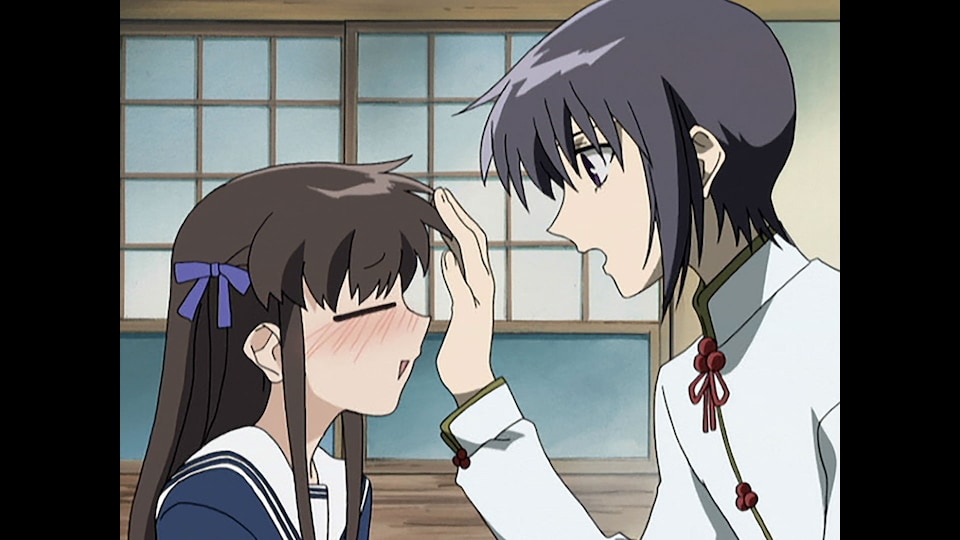
The Prelude catalog retains the newer production identity, while its official presentation distinguishes adapted parental material from new scenes created by Takaya. Our images likewise distinguish scope: the lead is an original 2001 screen image from a licensed catalog, and the interior image is newer official promotional artwork. They do not imply that the same character design or episode collection applies to both productions.
Attachment to an edition can shape a comparison
AniList’s named 2001 television entry reports 75 out of 100, displayed as 7.5 out of 10 and observed October 3, 2026. Its scope is the older 26-episode adaptation. This is an external audience score, not our editorial grade or a combined score for all three newer seasons. It also does not rate Prelude or the manga. A higher or lower number attached to another entry would require its own clearly named scope.
A selected community discussion compares official English translations. One reader describes attachment to the wording they grew up with and uncertainty about changes in forms of address and character nuance. Other replies treat the comparison as an opportunity to reconsider familiar passages. These comments show why a difference can feel meaningful even when the reader is not disputing the basic plot.
We treat the thread as an edition-specific conversation, not a verified judgment that one translation is objectively correct throughout the series. It includes spoilers and links to additional comparisons. A useful reader exercise is to choose one scene and record the edition, translation credits and wording that matters to you. That produces a more grounded discussion than mixing a memory of an older English book with subtitles from a different anime.
Completion, format and bonus content are separate product questions
Hakusensha’s original final-volume record dates volume 23 to March 19, 2007. Yen Press’s Collector’s Edition final-volume page separately lists print and digital publication dates. Those dates should remain attached to their formats; a digital release is not evidence that the original story first ended that year. A collector edition can offer a different translation and extras while still presenting the same completed source narrative.
The English final collector volume advertises more than 150 pages of supplementary material. That is a concrete reason for someone interested in creator context to inspect this particular edition. It does not create another required story volume or guarantee that every earlier publication contains identical extras. Likewise, Another volume four includes additional material beyond its next-generation conclusion, so a book’s contents deserve inspection rather than an assumption based only on its number.
These sources do not supply a production budget, royalty breakdown or profit statement. We do not turn multiple anime versions or a recognizable title into an invented financial analysis. The supported commercial observations are about named editions, credited translations and release formats. Historical theater sales, anniversary campaigns and stage performances should be dated separately; an old homepage banner does not guarantee that the same event or licensed stream is currently available.
One clear route prevents several predictable mix-ups
For the newer anime, use 1st Season, 2nd Season, The Final and then optional Prelude. For the older anime, choose its 26-episode route separately. For source reading, choose original twenty-three-volume numbering or a twelve-volume collector edition, then investigate Another as a later-generation branch. This checklist preserves the difference between an adaptation, a new edition and a sequel with another cast.
The map’s reference label covers illustrations and the Three Musketeers extras without implying that a picture collection must be read to understand the original ending. Stage productions belong in separate screen-or-performance discovery rather than between manga volumes. Games and live-action remain outside the anime, manga and prose roadmap under the site standard. A medium label should explain the object a visitor will open, not merely decorate a card.
Hakusensha and Yen Press verify the source editions and later manga. TV Tokyo, TMS and the licensed older-animation catalog distinguish the productions; the Prelude site explains the film’s mixed contents. AniList supplies the scoped older-anime score, while community and fan wiki links provide optional exploration. Future updates should verify new releases and access, preserve edition distinctions and add any precise reading shortcut only after matching actual source scenes.
Primary sources and useful navigation
- TV Tokyo · original 2001 series archive
- Bandai Channel · licensed older anime staff, cast and original image
- TMS · newer first season scope and production credits
- Official newer anime · second-season episode guide
- TMS · The Final production scope
- Official newer anime · artwork and production
- Official Prelude · adapted history, recap and new later scenes
- TMS · Prelude theatrical record
- Hakusensha · original manga final volume 23
- Hakusensha · collector edition and related manga
- Yen Press · English collector conclusion, translation and extras
- Yen Press · Another four-volume next-generation series
- AniList · named anime audience score
Community and catalog routes
- MyAnimeList · named anime catalog
- Reddit · official-English translation comparison; spoilers
- Fruits Basket Wiki · optional fan navigation; spoilers
The production and publisher links support project facts. Catalog and community pages are secondary navigation and may reveal later events.
Explore related story guides
Original series imagery is reproduced under permission asserted by the site owner; the source and rights credits are retained. The route diagram is Animeteor’s own explanatory graphic.
Stage performance is a separate presentation
The official Fruits Basket stage portal archives The Final, performed in Tokyo from 18 through 27 October 2024. This is a stage production, distinct from the animated Final season and Prelude. Its archived paid-streaming window does not establish current viewing access, a new 2026 anime or a live-action film/TV series.
Official stage production archive
The official anime portal’s 27 May 2021 notice also records a Fruits Basket island and custom designs inside Animal Crossing: New Horizons on Nintendo Switch. This is a historical in-game promotional collaboration, not a standalone Fruits Basket video game. The old notice is not a new agreement and does not certify current dream-island access.
Official anime portal — dated Animal Crossing collaboration notice