Begin with TV series 1–6 (154 episodes). For later story context, watch World Series before Message; their release order differs. The film is optional. MAJOR 2nd follows the next generation.
Reviewed 3 October 2026 · Opening premise and adaptation relationships. Major endings withheld; linked catalog summaries and discussions may contain spoilers. · Licensed access varies by country.

The source and screen branches

The six TV series total 154 episodes. OVA order here is our story-context recommendation; Message was released in 2010, World Series in 2011–2012. Film optional; MAJOR 2nd is a new-generation sequel. Prose adapts selected periods, not the full 78-volume manga. Games/live-action stay outside this map.
- WATCH · core television: Series 1 · 26 episodes → Series 2 · 26 episodes → Series 3 · 26 episodes → Series 4 · 26 episodes → Series 5 · 25 episodes → Series 6 · 25 episodes
- WATCH · after TV6: World Series · OVA → Message · later-story OVA → MAJOR 2nd · next generation
- READ · choose a medium: Source manga · volumes 1–78 · Japanese prose · books 1–4 · Film comic · separate product
- OPTIONAL · animated film: Winning Shot of Friendship · Childhood gap · older-Goro frame · Return after TV4 or main TV run
Start with Goro’s childhood, rather than the season with the biggest stage
MAJOR follows Goro Honda, later known as Goro Shigeno, as his enthusiasm for baseball becomes a long commitment. His father’s professional career gives that ambition a personal starting point, but the story keeps changing the environment in which Goro must make it work. Beginning with the first television series preserves the relationships and expectations that later competitions revisit. A visitor attracted by the American professional setting should still meet the child before jumping to that stage.
The core television route contains six numbered series. The first four have 26 episodes each, and the fifth and sixth have 25 each, for 154 television episodes. This distinction matters when a community overview casually calls every season a 26-episode block. MAJOR 2nd is the next-generation sequel, not another name for the original second television season.
The source manga is complete at 78 Japanese volumes. A Japanese prose adaptation supplies another reading option, while the animated feature revisits a childhood period. These alternatives can enrich the main experience without requiring constant switching between media. This guide keeps the later OVA material visible and distinguishes release order from our recommended story-context order. Official summaries of those endings can be highly revealing.
The manga, prose books and film comic are different reading products
Shogakukan’s electronic manga catalog marks the original MAJOR complete at 78 volumes. Its final printed-volume record is dated December 17, 2010 and explicitly describes the conclusion. Start at volume one for the original presentation. The final book’s synopsis is useful for checking the endpoint, but a newcomer should avoid reading its account of the decisive match and subsequent family developments.
The National Institute of Informatics’ CiNii bibliographic record lists four Japanese prose books: Yokohama, Fukuoka, Middle School and Kaido High School. Its authorship note assigns the first two to Michihiro Tsuchiya; the later books are by Manabu Tanzawa, with Takuya Mitsuda credited for the source. The first provides a pre-story connection to the animated feature and the second novelizes the film’s Fukuoka story. These are adaptations of selected periods, not a four-book replacement for all 78 manga volumes.
Shogakukan separately catalogs an all-color anime version of The Winning Shot of Friendship. That illustrated film-derived book should remain labeled as a film comic, rather than being mistaken for the Fukuoka prose volume. Likewise, the published MAJOR 2nd novels belong to the sequel’s product family. A useful reading recommendation names the medium and work instead of treating every book carrying MAJOR as one numbered novel sequence.
The later OVAs need a story-context label
ShoPro’s rights-holder catalog places the original television production in 2004–2010, the feature in 2008, Message in 2010 and World Series: Yume no Shunkan e in 2011–2012. Those are production and release periods. Following them strictly puts Message before the later-produced World Series animation, even though Message’s official synopsis refers back to the championship period.
For story context after the sixth television series, our recommended order is World Series followed by Message. This is an editorial sequence based on the licensed synopsis relationship, clearly distinguished from release order. The material elaborates later parts of Goro’s journey that the television production did not show in the same way. It is not a seventh television season, and its separate packaging should remain visible in a collection checklist.
The feature’s central childhood story occupies the gap between the first and second series, but its framing involves an older Goro looking back. To preserve the television introduction and avoid interrupting it, we recommend returning to the optional film after the fourth series or after finishing the television run. A strict childhood-timeline placement is another choice; the framing explains why that is not identical to a completely spoiler-free viewing instruction.
Original visual reference
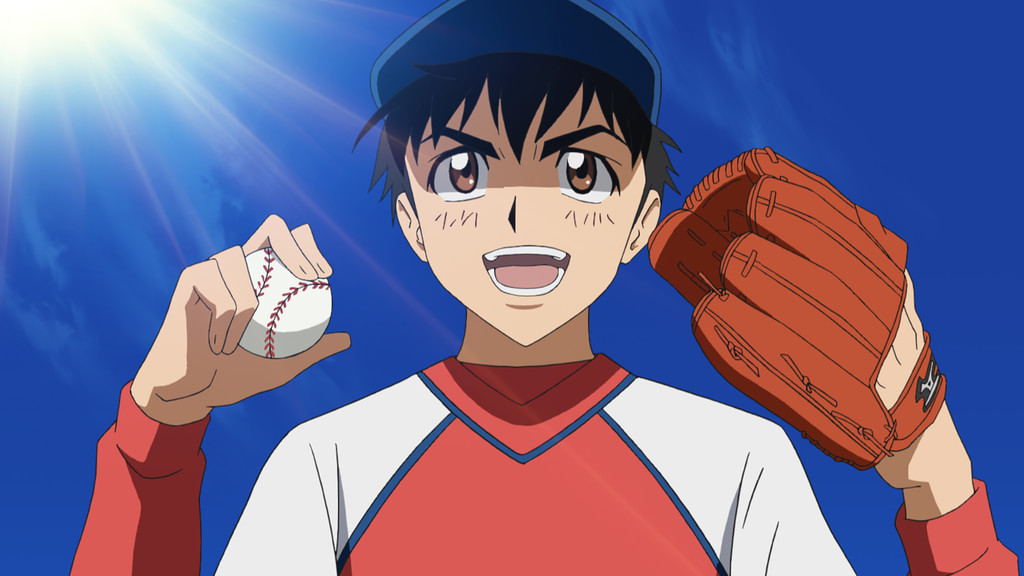
A career makes yesterday’s strength into tomorrow’s limitation
Our central reading is that MAJOR keeps changing what ambition demands. Success in a familiar team does not ensure that the next school or professional environment will reward the same behavior. A talented player must repeatedly renegotiate the relationship between personal confidence and the people around him. That makes the long structure meaningful: development is tested by a new setting rather than simply certified by the previous victory.
Goro’s forcefulness can energize a group while also making cooperation difficult. The useful question is who bears the consequences of his determination. A teammate may experience the same action as inspiration, pressure or an unnecessary risk. Watching those reactions gives the sports drama an interpersonal scale. This is our interpretation of the character dynamics, rather than a claim that persistence alone guarantees real athletic success.
The family connection also changes the meaning of achievement. A childhood dream attached to an admired parent does not remain untouched when the protagonist becomes an adult with responsibilities of his own. MAJOR 2nd develops that question through a different young lead living under an established reputation. It is worth preserving the distinction between those two perspectives instead of reducing the sequel to another opportunity for the original hero to win.
Credits should follow the production being discussed
Takuya Mitsuda created the source manga for Weekly Shonen Sunday. The original television first series is associated with Studio Hibari in AniList’s named production entry, and the licensed Rakuten overview credits Kenichi Kasai as director for the first three television series. Toshinori Fukushima is credited for the fourth through sixth and the later OVA productions. A franchise-level studio label should not erase the differences between specific installments.
The film has a separate director, Takao Kato. ShoPro identifies it as a 2008 production, while its licensed presentation describes an additional childhood story. Our original images deliberately show two different products: the first television series’ young team and the feature’s Goro artwork. The captions distinguish those sources; neither image is presented as a scene from a later professional-season episode.
The MAJOR 2nd licensed staff listing names Ayumu Watanabe as director, Michihiro Tsuchiya for series composition and Kenichi Onuki for character design. Its young protagonist Daigo is voiced by Natsumi Fujiwara, while Showtaro Morikubo is named for the returning Goro. These credits make it possible to explore continuity of personnel without pretending that a change of lead is simply the original television production continuing with the same cast focus.
Separate enthusiasm for the career story from claims about animation budgets
AniList’s first-season entry reports 80/100, shown here as 8.0/10 and observed October 3, 2026. Its scope is the 2004 television first series with 26 episodes. This does not average all six seasons, the feature, OVAs or MAJOR 2nd. A visitor considering the full commitment should read the route and format notes alongside this specific entry’s external audience score.
A selected r/anime baseball guide praises the first season’s appeal while questioning how quickly some early emotional beats pass. Its replies include appreciation of the childhood story and concern about repetition before the professional stages. The same contributor’s second-and-third-season discussion enjoys the school period but questions the heightened obstacles and training methods. Those responses help describe a possible taste divide without becoming a representative audience survey.
The community post also makes an animation-budget claim, which we do not turn into financial fact. Visible production limitations and a viewer’s explanation for them are different kinds of evidence. Our recommendation suits someone willing to follow a long career across changing teams and life stages. Readers seeking a shorter sports-and-relationships commitment may prefer Cross Game; visitors who primarily want the original scene pacing can investigate the manga from its first volume.
A final volume and an OVA bundle answer different purchasing questions
The final manga’s publisher page advertises a simultaneously released limited edition with an anime DVD containing an additional ending. That is useful collection information: owning the ordinary manga volume does not automatically mean owning the associated animation. A later streaming edition, a secondhand bundle and a standard book can contain different components despite sharing the same franchise name.
The publishing-industry Books catalog dates the first prose book to October 7, 2008 and lists 336 pages. CiNii supplies its Japanese-language bibliographic scope and the later numbered books. Those facts verify a prose publication, not an English license or a promise of present stock. We have not established a current official English manga or prose purchase route here, so an English-language guide should not redirect readers to an unofficial translation as if it were licensed access.
This research does not establish a trustworthy franchise budget or profit total. The source manga’s 78-volume completion and the many screen productions describe the scope of the catalog, while a rights-holder listing shows how the property is organized for licensing. Neither supports calculating adaptation returns. The Animehodai pages provide Japanese licensed viewing navigation, whose territory and service conditions need checking separately from the historical production dates.
Use the full route, then choose the optional comparisons
The practical first pass is television series one through six in numerical order. Afterward, our story-context recommendation places World Series before Message while retaining their different release years. The film is an optional childhood expansion with an older-Goro frame. It can be revisited after the fourth series or after the main television run, rather than being presented as a mandatory additional season. Keep the installment title on a watch checklist: a bundled video called Message and a book carrying the same franchise logo should not silently become interchangeable entries.
Read the original Japanese manga from volume one for its complete source route. For prose, the verified four-book sequence covers selected earlier periods, with Fukuoka connected to the feature. The all-color film comic is a separate adaptation product. MAJOR 2nd introduces Daigo and should remain a labeled next-generation branch, not be confused with the original series’ second season or counted as another Goro installment.
ShoPro supplies franchise relationships and production periods; Shogakukan verifies the manga and film-comic products; the licensed viewing pages identify the television and feature. CiNii and Books verify the prose bibliography. AniList supplies a scoped audience snapshot, and the selected Reddit posts add optional discussion with spoiler risks. Future revisions should prioritize licensed access changes and new sequel material while keeping these edition and chronology distinctions intact.
Primary sources and useful navigation
- ShoPro · rights-holder franchise relationships and release periods
- Shogakukan · original manga78 and completion
- Shogakukan · final manga and anime-DVD edition distinction
- Shogakukan · all-color film comic, not prose
- Animehodai · licensed first-series entry and original artwork
- Animehodai · film story placement and original artwork
- Rakuten TV · licensed season counts, staff and OVA synopsis relationships
- ShoPro · MAJOR 2nd official anime site
- CiNii · Japanese prose1–4, authorship and film relationships
- Books · publishing-industry first prose record
- AniList · named anime audience score
Community and catalog routes
- MyAnimeList · named anime catalog
- Reddit · first-series pacing and long-career discussion
- Reddit · school seasons and heightened training discussion
- MAJOR Wiki · optional fan navigation; chronology needs verification
The production and publisher links support project facts. Catalog and community pages are secondary navigation and may reveal later events.
Explore related story guides
Original series imagery is reproduced under permission asserted by the site owner; the source and rights credits are retained. The route diagram is Animeteor’s own explanatory graphic.
Games and live-action adaptations
- MAJOR DREAM: Major Wii Perfect Closer — Game: 3D baseball · story missions
Separate historical Wii baseball game
Nintendo’s manufacturer-supplied archive identifies MAJOR Wii: Perfect Closer, published by Takara Tomy in Japan on 11 December 2008. It is a one-or-two-player 3D baseball product using Wii Remote input, with story and team-edit features. The linked guide preserves the small original archive images and distinguishes this historical game from the manga and television chronology.