Start with the 2000 anime, then Champion Road, Mashiba vs. Kimura, New Challenger26 and Rising25. The manga is a separate source route; collection extra76 is labeled separately.
Reviewed 3 October 2026 · Opening premise and adaptation relationships. Major endings withheld; linked catalog summaries and discussions may contain spoilers. · Licensed access varies by country.
The source and screen branches

Recommended placement: explore the collection extra and Mashiba vs. Kimura after the original series, before New Challenger. Manga and language editions are independent reading options; no verified exact continuation chapter is asserted.
- WATCH · main route: Original TV · 1–75 → Champion Road · special → New Challenger · 1–26 → Rising · 1–25
- WATCH · companions: Collection extra · 76 · Mashiba vs. Kimura OVA
- READ · source manga: Morikawa · chapter 1 · Japanese Kodansha volumes · Official English · K MANGA
Begin with the original anime or chapter one of the boxing manga
Hajime no Ippo follows Ippo Makunouchi, a bullied schoolboy whose encounter with professional boxer Mamoru Takamura leads him into the Kamogawa gym. The initiating question is what strength feels like, rather than simply how quickly a newcomer can acquire a championship. For an anime entry, start with the original 2000 television series. For the source route, start with George Morikawa’s manga, available through the Japanese publisher and a verified official English K MANGA entry.
The practical screen sequence is the original series, the Champion Road special, the Mashiba vs. Kimura OVA, New Challenger and Rising. The special and OVA are distinct productions, and New Challenger is a continuation rather than a reboot. This recommended route keeps the named items visible so that a collection with extras is not mistaken for a separate fourth television season.
You do not need the much later manga volumes to understand the opening anime. Equally, finishing Rising is not evidence that you have reached the manga’s conclusion. The reading and viewing lanes therefore separate a substantial screen adaptation from a source series with its own publishing life. Games and other franchise products, when separately documented, belong outside this core watch/read sequence.
The manga’s long publication and official English chapter service are separate catalog facts
Morikawa’s source manga is published by Kodansha in Weekly Shonen Magazine. The publisher’s title catalog links the beginning of the series and a verified volume 145 record, dated January 16, 2026. We use that numbered volume as a confirmed catalog observation, not as a promise that 145 is a permanent final count or that every language edition has caught up to it.
Kodansha’s K MANGA carries the English title Hajime no Ippo: Fighting Spirit!, with its first chapter explicitly identified as The First Step. The English credit uses Joji Morikawa, while other international sources use George Morikawa; those name forms should not be mistaken for two unrelated authors. A chapter-service release date describes that service’s publication, not the manga’s original Japanese debut or a newly created remake of the opening story.
For reading, begin with chapter one or Japanese volume one and keep the chosen language and edition visible. We have not verified a narrative prose-novel sequence that must be inserted into this source route. Nor do we provide a supposedly exact anime-to-manga jump based on a fan index alone. The safest complete reading option is the source from the beginning; a future verified transition guide can add precise chapter coverage with named editions and evidence.
Seventy-five TV episodes and a seventy-six-episode collection can both be correctly labeled
The AniList entry for the original television adaptation has 75 episodes. Discotek’s final original-series collection explicitly includes episodes 49–76 as well as the OVA and Champion Road. This is why a visitor can encounter a 76-episode package without discovering another full season. Our map names the original TV run and a collection extra separately, while the article preserves the distributor’s actual inclusion list.
Discotek also distinguishes audio coverage: its collection description lists the original English and Spanish dubs for episodes one through 75, an English dub for Champion Road, and Japanese audio with English subtitles across all 76 episodes, the OVA and special. Those distinctions are useful when choosing a package. They should not be flattened into a claim that every bonus item has every listed language track.
VAP’s New Challenger collection identifies all 26 episodes of the second season, and Nippon TV’s English Rising catalog identifies 25 episodes for the third. The broadcaster’s New Challenger overview explicitly describes its story as continuing after the earlier TV series, first defense special and Mashiba–Kimura adaptation. Follow those named relationships without adding a promised fourth season merely because later manga chapters exist.
Original visual reference
Finding strength means learning to interpret fear, effort and other people
Our reading begins with the difference between possessing force and understanding what to do with it. Ippo’s introduction connects vulnerability with a new social environment. Takamura and the gym offer practical demands, but they also give him people through whom he can reconsider his own worth. The drama is more interesting when training changes his habits and understanding, rather than functioning only as a montage that guarantees a stronger punch.
A useful viewing question is what a bout makes visible about both competitors. Preparation, hesitation and obligations outside the ring give a contest meaning beyond the exchange of blows. An opponent can have a comprehensible purpose without the story requiring the viewer to stop supporting Ippo. That double attention helps explain why a sports narrative can remain compelling even to viewers who do not follow the real sport.
The series can also be read as a story about learning through repetition. A skill that once solved a problem can become something another opponent studies. Progress therefore creates exposure as well as confidence: others now have evidence about how the boxer works. This is an interpretation of the dramatic structure, not a claim that animated training methods form a safe real-world program or that a spectacular impact accurately measures physical force.
Production credits should stay attached to the relevant season
Discotek identifies Satoshi Nishimura as director of the original adaptation. For New Challenger, VAP credits Jun Shishido as director, Kazuyuki Fudeyasu for series composition, Koji Sugiura for character design and chief animation direction, Yoshihisa Hirano for music and Madhouse for animation production. These named credits help a reader investigate how a later season was made without assigning every version to one unchanged production team.
New Challenger’s broadcaster cast includes Kohei Kiyasu as Ippo, Rikiya Koyama as Takamura, Wataru Takagi as Aoki, Keiji Fujiwara as Kimura, Tomokazu Seki as Miyata and Kenji Utsumi as Kamogawa. VAP identifies LAST ALLIANCE’s HEKIREKI and coldrain’s 8AM as that season’s opening and ending. A soundtrack or performance discussion should identify the production being discussed, especially when moving between Japanese tracks and a licensed English release.
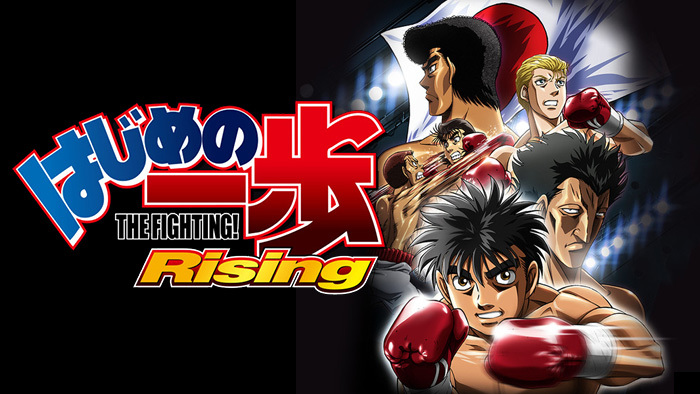
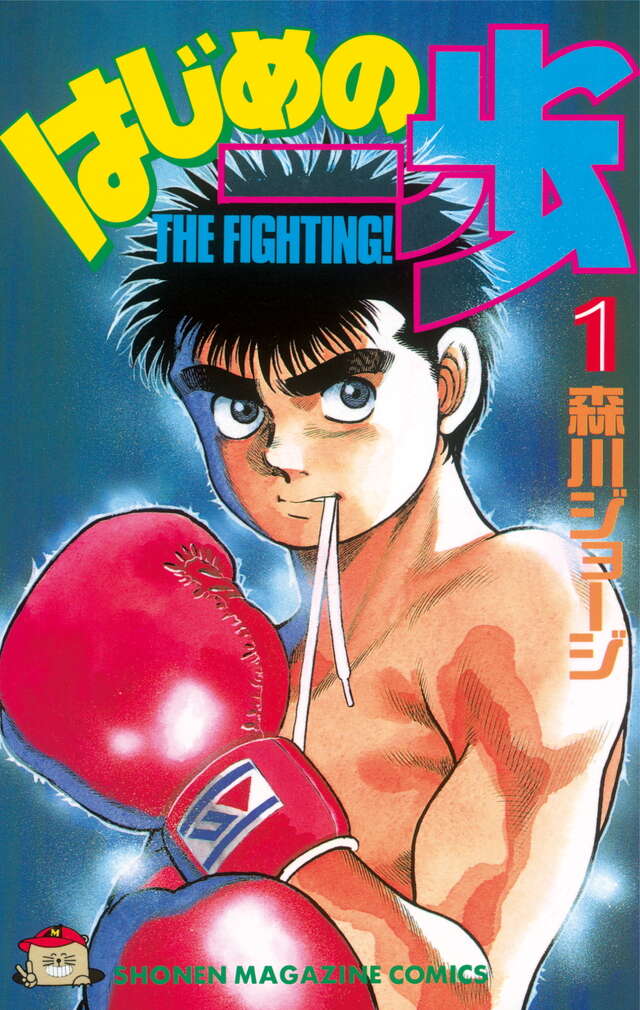
The two original images here belong to different media contexts: the broadcaster’s Rising promotional artwork and Kodansha’s first manga cover. The later-season logo in the former remains visible, rather than being relabeled as a still from episode one. The source cover supplies a direct visual entrance to Morikawa’s manga. Neither a cover nor a key visual alone proves the pacing, shot composition or fidelity of a specific animated bout.
Distinguish being overlooked from receiving a low rating
The official AniList record for the original 2000 television adaptation reports 87/100, displayed here as 8.7/10 and observed October 3, 2026. Its named scope contains 75 TV episodes. The score is not an average of New Challenger, Rising, the OVA, Champion Road and the manga. Including another item in a disc package does not automatically expand what that external audience score measures.
A selected r/anime first-season reflection praises the fights, sound, supporting characters and stakes for people outside the ring. Replies question the writer’s use of underrated, and the writer revises the wording toward overlooked. That exchange identifies a useful distinction: a work can be less visible in someone’s current conversations while still being strongly rated by people who know it. The thread’s historical ranking claims are not used as current catalog facts.
Our recommendation is strongest for viewers who enjoy sustained training, opponent preparation and a gym ensemble alongside the matches. A newcomer need not be a boxing follower, but should expect a long serial experience. The external score supplies one broad signal; the actual structure and tone supply a more useful personal fit. Discussion of later manga developments can spoil changes far beyond the available screen route, so those debates are best opened deliberately after choosing how far to read.
Historical circulation and home-video coverage do not disclose net profit
Nippon TV’s Rising sales catalog reports that the source manga had passed 94 million copies in circulation as of July 2013. This is a dated, publisher-facing promotional circulation figure for the manga. It is not an October 2026 total, a count of anime discs, an audited profit figure or a measurement of individual readers. The date and medium are essential parts of the claim.
The documented home-video catalog provides a different kind of commercial evidence. Discotek’s original-series collection groups episodes and extras with explicitly different dub coverage, while VAP’s second-season set groups the 26 New Challenger installments. These are concrete packaging choices that affect a purchaser’s experience. They do not tell us the production budget, royalty split, marketing expense or return on investment for a season.
The English chapter service, Japanese collected volumes and historical anime packages also have independent availability and release schedules. A high Japanese volume number does not guarantee the same amount of English material, and a catalog listing does not establish worldwide streaming access. We retain the official reading links and package identities without inventing universal stock, prices or a financial explanation for why the screen adaptation has not covered every source installment.
Follow the verified screen sequence and keep the source route open
Begin with the original series. Check whether your package includes the extra numbered 76, then choose Champion Road and the Mashiba vs. Kimura OVA before the 26-episode New Challenger continuation and 25-episode Rising. This is a practical route through the named screen material. It does not require waiting for an unannounced future season or treating a platform’s catalog arrangement as an official story chronology.
For reading, use Kodansha’s Japanese catalog or the official K MANGA English title and start at the beginning. A verified later volume demonstrates the ongoing scale of the source catalog without serving as an entry point for a new reader. Nippon TV and VAP provide the season relationships and counts; Discotek clarifies collection and language coverage. MyAnimeList offers a second catalog navigation point, while the selected discussion adds individual reactions without replacing primary evidence.
A future update should check publisher volume announcements, the English service’s actual coverage and any new official anime production notice. It should retain the 75-episode rating scope when updating a 76-item package description, and distinguish a collector reissue from a newly animated sequel. That produces a guide that can grow with the manga while continuing to give a newcomer a clear, usable route through the screen adaptations already verified here.
Primary sources and useful navigation
- Discotek · original collection3,76 count, special,OVA and audio coverage
- Nippon TV · New Challenger continuation and cast
- VAP · second-season26 collection
- VAP · New Challenger production credits
- VAP · Champion Road original special
- Nippon TV · Rising25 and dated July2013 circulation
- Nippon TV · Rising original artwork
- Kodansha · source catalog and first volume artwork
- Kodansha · verified volume145, January2026
- K MANGA · official English chapter service
- Magazine Pocket · Japanese chapter reading
- AniList · named anime audience score
Community and catalog routes
- MyAnimeList · named anime catalog
- Reddit · first-season reflection and underrated/overlooked disagreement
The production and publisher links support project facts. Catalog and community pages are secondary navigation and may reveal later events.
Explore related story guides
Original series imagery is reproduced under permission asserted by the site owner; the source and rights credits are retained. The route diagram is Animeteor’s own explanatory graphic.
Production and edition updates
Hajime no Ippo Fighting Souls — Japanese mobile RPG
Rudel’s official portal identifies Fighting Souls as a boxing RPG for iOS and Android, with a player boxer, familiar series characters and gym competitions. The exact Japan App Store is id1526267101 and the Google Play package is jp.pjbox. Current Japanese store listings identify this product; they do not prove worldwide availability or a new anime season.