Watch TV 1–11 → The King of Eden → Paradise Lost. Air Communication is an optional recap. Japanese prose novelizations and screen-derived film comics are companions, not earlier source manga.
Reviewed 3 October 2026 · Opening premise and adaptation relationships. Major endings withheld; linked catalog summaries and discussions may contain spoilers. · Licensed access varies by country.
The source and screen branches

The anime is original. Novelizations and film comics are screen-related companions; Air Communication repeats TV material rather than continuing after the films.
- WATCH · main: TV · episodes 1–11 → Film I · The King of Eden → Film II · Paradise Lost
- WATCH · recap: Air Communication · TV compilation · optional
- READ · prose: Japanese TV novelization → Japanese theatrical novelization
- READ · companions: TV film comic → Theatrical film comic · Profile / settings books
The television ending is a doorway to two continuing films
Eden of the East opens with Saki Morimi, a Japanese student visiting Washington, encountering Akira Takizawa in bewildering circumstances. He has lost his memory and holds a phone connected to an extraordinary amount of money. Their meeting gives the viewer a human entry point into a larger mystery about intervention, responsibility and what it might mean to change a country. Beginning with a film synopsis risks revealing the very identity questions the opening establishes.
Watch the eleven television episodes first, then The King of Eden and Paradise Lost. Production I.G identifies the television production and two subsequent theatrical releases, while distributor Asmik Ace describes Paradise Lost as the conclusion after the television series and first film. These two films are continuations, rather than optional side adventures that can safely be skipped if completing the screen story is the aim.
Air Communication is different: it is a compilation of the television series. After watching all eleven episodes, treat it as an optional refresher before the films. Our first-entry recommendation favors the television presentation rather than replacing it with the recap. A box containing three films can therefore include one compilation and two continuations; the number of film files does not by itself describe their narrative functions.
| Item | Function | First-view route |
|---|---|---|
| TV episodes 1–11 | Original screen story | Start here |
| Air Communication | TV compilation | Optional refresher after TV |
| The King of Eden | Continuing film I | After TV |
| Paradise Lost | Concluding film II | After The King of Eden |
An original anime with prose and film-comic companions
This is not an anime adapted from an earlier manga by Chica Umino. The studio credits Kenji Kamiyama for the original work, scripts and direction, and Umino for the original character concepts. Kamiyama also writes the Japanese novelizations. Keep that direction of adaptation visible: the existence of a novel or printed comic does not automatically make it the source from which the television series was produced.
The documented prose route consists of the television-related novel followed by the separately titled theatrical novel, The King of Eden Paradise Lost. The publisher dates the latter April 23, 2010. For the first novel, KADOKAWA lists September 18, 2009, while the studio’s older book announcement lists September 16. We retain that discrepancy rather than inventing an explanation for the two-day difference; it does not alter the recommended reading sequence.
Production I.G also lists a television film comic and a theatrical film comic published by Fusosha, alongside profile books and a complete settings collection. Film comics and reference books should not be presented as an independently drawn source manga that the viewer must read to understand a missing arc. Their titles identify screen-related companion formats. No official English publication of the Japanese prose books was established in the reviewed catalogs, so we do not promise an English purchase route.
Visual case: one face addresses the viewer, two faces address each other
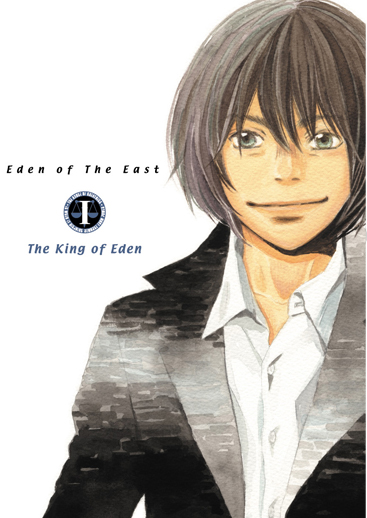
The official first-film artwork isolates Takizawa against a white field. His dark hair and jacket occupy most of the right side, while the title and Roman numeral I remain on the left. His eyes and slight smile address the viewer directly. Softly rendered color and visible tonal texture differ from the harder outlines of the second image. The emptiness around him helps make identity, rather than a crowded action scene, the promotional focus.
Our interpretation is that the image turns the question of who he is into an invitation to approach a person. That does not establish his reliability or reveal the answer to the plot’s mystery. We identify it as first-film promotional artwork supplied by the distributor, retaining its original composition rather than creating a newly imagined canonical moment.
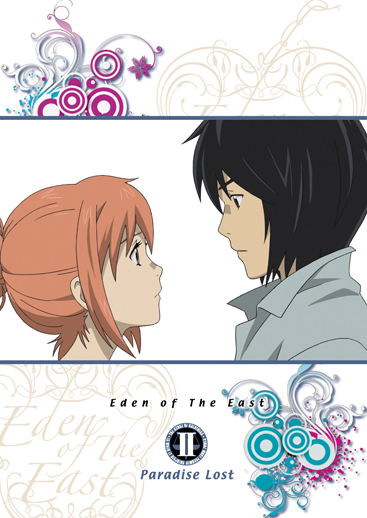
The Paradise Lost artwork centers Saki and Takizawa in profile, facing each other across a narrow distance. Decorative circles and curling lines occupy white bands above and below the central image; the Roman numeral II distinguishes its film identity. Unlike the first artwork’s direct address, their attention stays within the pair. Comparing the images offers a useful reading lens: a mystery about one person also carries consequences for a relationship. The image alone is not proof of how that relationship ends.
Original visual reference
A powerful phone does not answer what a good intervention would be
Our analytical starting point is the separation between resources and judgment. The phone makes extraordinary action possible, but access to money does not supply a shared definition of a desirable outcome. A person acting to improve society still chooses whom to trust, what to prioritize and which consequences can be tolerated. The thriller premise consequently asks more than whether a device can perform an impressive task.
Saki’s encounter with Takizawa gives that abstract problem an everyday scale. She can respond to a person before understanding the full system around him. Our reading is that the contrast between interpersonal trust and large-scale ambition makes their connection useful to the mystery, rather than mere decoration beside it. The official introduction’s memory loss also complicates how much confidence either character can place in an account of his earlier intentions.
For a rewatch, track the difference between a request, the mechanism fulfilling it and its effects on people outside the conversation. Consider who gets to define success and who becomes visible only after a decision has been made. This is an interpretive approach to the fictional premise, not a claim that the story offers a tested policy solution. Its phone balance is a narrative resource, not a verified production budget or real investment return.
Original character concepts and screen character design are separate credits
Production I.G credits Kamiyama for the original work, scripts and direction, Umino for the original character concepts, and Satoko Morikawa for character design. Kenji Kawai provides music, with Masayuki Yoshihara credited as assistant director and Satoru Nakamura as chief animation director. Yusuke Takeda handles art direction. Those distinctions help readers discuss an appealing character image without assigning every stage of its creation to one person.
The official cast lists Ryohei Kimura as Takizawa and Saori Hayami as Saki. A screen relationship depends on performance as well as drawing and dialogue, so an adaptation discussion should distinguish the script’s situation from the way a hesitation or reply is delivered. That is a framework for comparison, not a statement that a particular actor invented a documented scene.
The films preserve the principal creator and studio identities in the distributor’s credits. Their status as later films should not be confused with a second numbered television season. The Japanese prose novelization is another Kamiyama-authored format, while profile books and settings material have their own publishing roles. A drawing, a novelization and an audiovisual installment can be related without each being an equivalent new chapter in the route.
Two kinds of question: whether the films continue the story, and whether you enjoy them
The displayed AniList score is 74/100, normalized to 7.4/10 and observed October 3, 2026, for the eleven-episode 2009 television anime. It does not rate Air Communication, either continuing film or the prose books. We do not blend different entries into an apparently authoritative franchise score, and the figure is an external audience score rather than Animeteor’s own judgment.
A selected r/anime thread asks whether the movies are worth watching after the television series. A reply distinguishes the recap from the two direct continuations. That small exchange reveals a practical problem with unnamed movie numbering: advice to skip the first film can mean skip Air Communication, not skip The King of Eden. Our route uses exact titles to remove that ambiguity, with primary studio and distributor evidence supporting the films’ functions.
Whether a viewer likes the concluding films is a separate question from whether they continue the plot. Our recommendation is to finish both before assessing how the larger mystery is resolved, while treating the recap as a choice. The show includes violence, nudity and adult situations; its inviting character designs do not establish an all-ages viewing category. Discussions of the ending and later publisher summaries can also reveal information that a first-time viewer is trying to discover.
The same story can arrive in packages with very different extras
The distributor’s first-film Japanese Blu-ray listings distinguish a premium edition including the complete 125-minute Air Communication compilation from a standard edition without that compilation disc. The premium package also advertises character-concept material and a drama CD. Those are named product differences: do not assume that a copy of The King of Eden automatically includes every companion item.
The 2012 Noblesse Oblige box collects the eleven television episodes, both continuing films and the compilation, with a phone-themed package and other extras. That is a consolidated edition of existing material, not an announced new screen season. A listed package runtime combines included works; it should not be used as the running time of Paradise Lost alone. Check the exact regional edition, subtitle options and contents before buying.
No audited franchise profit or production budget was established in the sources examined here. The story’s fictional money and old retail prices cannot fill that gap. A catalog’s historical release date also does not establish current stock or worldwide streaming access. When discussing a commercial edition, the useful facts are what it contains and where its availability has been checked, rather than an invented estimate of the project’s return.
Choose a named continuation instead of relying on platform season labels
Complete TV episodes one through eleven, then The King of Eden and Paradise Lost. Air Communication can sit beside that progression as a refresher. For Japanese prose, distinguish the first novelization from the theatrical novelization; for printed screen material, distinguish the television and theatrical film comics from profile and settings books. The map gives these products different functions rather than treating every title as a mandatory new story.
The studio and distributor pages remain the primary evidence for the original credits, film sequence and edition coverage. The older dedicated anime domain did not yield a usable page in this check, so its absence is not filled with unverified new-release claims. Fandom can help navigate characters after viewing, but its summaries contain spoilers. Community discussions provide reader questions and opinions, not a replacement for official installment records.
Ghost in the Shell: Stand Alone Complex and Moribito provide other Kamiyama-directed works for readers interested in how institutional systems and individual choices can interact. These creator connections do not establish a shared universe or a required prequel. Games and live-action material remain outside the core anime/prose/film-comic route under the site’s format rule. A future update should distinguish a new adaptation announcement from a catalog reissue before adding another continuation.
Primary sources and useful navigation
- Production I.G · original premise and release sequence
- Production I.G · named staff and cast
- Asmik Ace · The King of Eden, recap and collection contents
- Asmik Ace · Paradise Lost conclusion and editions
- Production I.G · novels, film comics and reference books
- KADOKAWA · first prose novelization and publisher date
- KADOKAWA · theatrical prose novelization
- AniList · named anime audience score
Community and catalog routes
- MyAnimeList · named anime catalog
- Reddit · selected post-TV film navigation question
- Eden of the East Wiki · character and version navigation; spoilers
The production and publisher links support project facts. Catalog and community pages are secondary navigation and may reveal later events.
Explore related story guides
Original series imagery is reproduced under permission asserted by the site owner; the source and rights credits are retained. The route diagram is Animeteor’s own explanatory graphic.