Watch the original 13 TV episodes, then Il Teatrino 13 and its two OVAs. Read source manga 1–15; the English route is omnibus collections 1–6 plus the separate Finale (volume 15).
Reviewed 3 October 2026 · Opening premise and adaptation relationships. Major endings withheld; linked catalog summaries and discussions may contain spoilers. · Licensed access varies by country.
The source and screen branches

English omnibus numbers and source volume numbers differ. The viewing route follows production order; no unverified novel branch or exact chapter handoff is supplied.
- WATCH · anime: Original TV · 13 episodes → Il Teatrino · 13 TV episodes → Il Teatrino · two OVAs
- READ · source: Manga · volume 1 → Follow volumes 2–14 → Volume 15 · conclusion
- READ · English: Omnibus 1–2 · source 1–6 → Omnibus 3–6 · source 7–14 → Finale · source volume 15
A rescue institution that turns children into instruments of violence
Gunslinger Girl is set around an Italian organization whose public language of welfare hides a violent operational purpose. Henrietta and other severely injured girls receive cybernetic bodies and conditioning, then work alongside adult handlers. The premise makes a troubling question unavoidable: how much choice can a child exercise when the people offering care also control her memories, capabilities and duties? The presence of guns should not obscure that unequal relationship.
Our first anime route is the original 2003 television series, episodes one through thirteen, followed by Il Teatrino’s thirteen television episodes and its two supplementary OVAs. This follows the order in which viewers encountered the screen productions. It is not a promise that every event occupies an uninterrupted calendar sequence or that the two productions reproduce the source with identical tone.
The manga provides the complete fifteen-volume source route. Choose it from volume one if a sustained, finished reading project is your priority. No verified prose adaptation or novel continuation was established in the reviewed sources, so this guide does not add a novel branch simply to make a symmetrical three-format diagram. Video-game products remain outside the anime/manga reading and viewing map.
| Route | Start here | What completion means |
|---|---|---|
| Original anime | Episodes 1–13 | First television production |
| Il Teatrino | TV 1–13 → two OVAs | Second screen production and supplements |
| Source manga | Volumes 1–15 | Completed source story |
| English omnibus | Collections 1–6 → Finale 15 | Seven physical books, not seven source volumes |
Six omnibus collections do not contain fifteen volumes by themselves
Yu Aida writes and draws the manga. The Japanese publisher identifies volume fifteen as the conclusion, with its paper edition dated December 15, 2012 and a later digital edition dated May 1, 2014. Those two dates describe formats of the same numbered story volume. They are not evidence for an additional sequel that appeared between the paper and digital editions.
Seven Seas packages the English sequence differently. Collection one contains source volumes one through three; collection two contains four through six. Collections three, four, five and six contain seven–eight, nine–ten, eleven–twelve and thirteen–fourteen respectively. The separate Finale book contains volume fifteen. Read those six collections and Finale in that order, or the fifteen source volumes in their own numerical sequence.
After either anime production, we recommend restarting the manga at volume one if the aim is to compare characterization and narrative emphasis. The primary catalogs establish edition coverage, not an exact universal episode-to-chapter handoff. A first-season viewing experience can also shape expectations about the characters in ways that are worth comparing from the beginning. We therefore avoid telling readers to skip a fixed number of early chapters based solely on a fan summary.
Visual case: armed poses beside an intentionally peaceful jacket
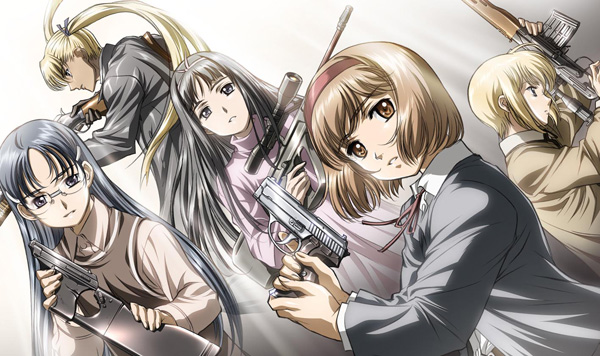
The original first-series Blu-ray illustration places five girls across a pale field. In the foreground, a brown-haired girl turns toward the viewer holding a pistol; a glasses-wearing figure and a long-haired figure occupy the left and central spaces, while two blond figures face outward toward opposite edges. Weapons extend along several diagonals. Their ordinary clothes and differing gazes make the armed grouping feel less like a uniform military formation.
Our interpretation is that the composition allows incompatible impressions to remain visible together: youth, apparent everyday individuality and readiness for violence. The nearby viewer-facing pistol does not erase the quieter expressions behind it. This is collection artwork credited to first-series character designer Hisashi Abe, not evidence that the five figures stand in this exact arrangement in a television scene.
The OVA jacket by toi8 takes a different approach. Henrietta runs forward in a light sailor-style outfit and hat, with Rico in a green shirt to the right and two adult men farther behind. Sunlit earth and greenery replace the first illustration’s weapons and pale field. The official page explicitly says this imagined vacation moment is not shown as a corresponding anime scene, and credits Aida for its concept. That distinction matters: an illustration can express the possibility of respite without supplying another canonical episode.
Original visual reference

Kindness is difficult to separate from dependence in this premise
Our main analytical lens is the difference between feeling cared for and possessing freedom. A handler can be gentle in an everyday interaction while still benefiting from a system that conditions a child to obey. Treating every affectionate gesture as proof of an equal relationship would miss the institution that makes that gesture meaningful. Conversely, calling every moment of warmth fake would flatten the characters’ emotional experience into a simple mechanism.
The uncomfortable space between those interpretations is where the premise becomes more than an action hook. Ask who can refuse a mission, who controls treatment and whose memories can be altered. These questions concern the fictional organization’s distribution of power; they are not real-world medical claims about cybernetics or an endorsement of the institution’s reasoning. The story’s public language of rescue invites scrutiny of what happens after rescue.
For an adaptation comparison, examine how an ordinary pause is framed before or after violence. A held expression, a quiet room or a page showing a small gesture can redirect attention from operational success toward the person carrying out the task. The emotional significance need not be proportional to the amount of action. We would compare named scenes before reducing a whole season to a simple faithfulness score, because scene order, sound and pacing can alter emphasis even when a premise remains recognizable.
The two television productions have different creative responsibilities
The original official staff page credits Morio Asaka as director, Junki Takegami for series composition, Hisashi Abe for character design and Madhouse for animation production. Toshihiko Sahashi supplies music. The opening credits identify the Delgados for The Light Before We Land. Source authorship, screen design, direction and musical presentation are therefore different jobs; no single cover credit identifies the author of every audiovisual choice.
Il Teatrino’s licensed Bandai Channel listing credits Hiroshi Ishiodori as chief director, Akira Mano as director, Aida for series composition and Tatsuhiko Urahata for composition cooperation. It identifies Artland for animation and Kow Otani for music. Aida’s documented participation allows a precise statement about responsibility without inventing a private dispute with the first production’s creators.
The OVA artwork adds another illustrator, toi8, whose promotional jacket should not be attributed to Abe merely because both images represent Gunslinger Girl. The publisher also identifies The Valiant Must Fall as another manga written and drawn by Aida. That offers a creator connection for readers interested in his work; it is not evidence that its characters belong to this series’ continuity.
Tone can matter as much as whether an adaptation reaches an ending
The displayed AniList score is 71/100, normalized to 7.1/10 and observed October 3, 2026, for the original thirteen-episode 2003 television anime. It does not rate Il Teatrino, its OVAs or the completed manga. We keep that scope visible instead of combining a viewer’s preference for one production with a numerical claim about the entire franchise.
In a selected r/GunslingerGirl discussion, a reader who has finished the manga asks what to expect from the anime. Replies describe a more dramatic first production and a more vibrant second one, while disagreeing about how closely to characterize the adaptations. These are individual responses, not a survey. We do not adopt a commenter’s chronology assertion as the basis of a mandatory episode rearrangement.
Our recommendation is to notice your own priority. If the first season’s atmosphere matters most, expect another production to feel different rather than requiring it to replicate that experience. If completing the source’s narrative matters most, the fifteen-volume manga is the clearly documented route. The premise includes severe child trauma, coercive conditioning and lethal violence; its youthful cast and moments of daily life do not make it an uncomplicated light action series.
A box specification describes a product, not the story’s commercial success
The official 2009 Japanese Blu-ray announcement separates the original thirteen-episode collection from an Il Teatrino collection containing thirteen television episodes plus two OVAs. Both advertise 1080i material and specified audio features, while their disc counts and extras differ. A high-definition label is a format specification, not proof of newly drawn animation or an unannounced third season.
English manga product pages likewise require edition-aware comparison. The first omnibus lists 544 pages and contains three source volumes; collection six contains volumes thirteen and fourteen, while the 224-page Finale is a separate book. Compare the actual included volumes when assessing a set. A seller’s claim of six complete omnibuses would still leave Finale to be checked unless it is explicitly included.
No audited production budget or title profit was established in the sources examined here. An old catalog price is not a current worldwide secondhand value, and a retailer link is not confirmation of stock. The publisher warns that availability and digital coverage can vary. We avoid turning nostalgic demand, a change of studio or a fan’s animation criticism into an unsupported explanation of the franchise’s finances.
Use edition names to choose the next step
For screen viewing, begin with the original thirteen episodes, then Il Teatrino’s numbered television sequence and its two OVAs. For complete source reading, follow manga volumes one through fifteen, translating that into the six English omnibus collections plus Finale when using the Seven Seas edition. The OVA jacket is a visual companion, not a secret extra scene required to complete the plot.
Official product pages are the first stop for installment counts, credits and included materials. Community discussions are useful for contrasting tone after a viewing, while the Gunslinger Girl Wiki can help identify terms and characters. Both discussions and later-volume publisher summaries may expose major events, so follow the spoiler boundary that fits your progress. We retain the original images’ credits rather than presenting them as openly licensed illustrations.
Witch Hunter Robin provides another institutional story to compare when thinking about people carrying out an organization’s tasks. Monster offers a different sustained inquiry into responsibility and consequences. Those are thematic next reads, not connected-universe installments. Future updates should distinguish a reissued physical collection from new narrative material and verify its regional specifications before changing the route map.
Primary sources and useful navigation
- Official first anime · staff and music
- Fuji TV · original broadcast and premise
- Official collections · episode counts, formats and Abe artwork
- Official Il Teatrino · television and OVA story entries
- Official OVA · two supplements and imagined toi8 jacket scene
- Bandai Channel · Il Teatrino staff and Artland credit
- Seven Seas · manga author and English edition coverage
- KADOKAWA · Japanese manga 15 conclusion and edition dates
- Seven Seas · first omnibus, three source volumes and 544 pages
- Seven Seas · sixth omnibus, source 13–14
- Seven Seas · separate Finale 15
- Seven Seas · another Yu Aida manga
- AniList · named anime audience score
Community and catalog routes
- MyAnimeList · named anime catalog
- Reddit · selected manga-to-anime comparison discussion
- Gunslinger Girl Wiki · anime navigation; spoilers
The production and publisher links support project facts. Catalog and community pages are secondary navigation and may reveal later events.
Explore related story guides
Original series imagery is reproduced under permission asserted by the site owner; the source and rights credits are retained. The route diagram is Animeteor’s own explanatory graphic.
A historical PlayStation 2 adaptation
The official game catalog identifies the first GUNSLINGER GIRL PlayStation 2 game, released in Japan on 8 April 2004, with Bandai as seller, a 3D action format and an original story. Its anime-DVD bundle is packaging, not another television season. This historical product record does not certify a current digital store listing.