Watch the complete 74-episode 2004–2005 anime, or read VIZ’s source manga in Perfect Edition books 1–9 (a different binding from standard volumes 1–18). Another Monster is an optional investigative prose companion for after the main story, not the anime’s source novel.
Reviewed 1 October 2026 · Opening premise and format relationships; major ending revelations withheld. Linked publisher summaries and discussions may reveal later events. · Licensed access varies by country.

The source and screen branches

The companion is retrospective and spoiler-heavy. No English prose license or exact episode-to-chapter concordance is asserted. Games and live action are outside the core roadmap.
- READ · complete source editions: Perfect Edition books 1–9 Different bindings OR standard volumes 1–18
- WATCH · complete main TV story: Episode 1 → Continue through episode 74
- READ · optional investigative prose: Finish the main story first → Another Monster · 2002 companion
A medical decision becomes a question that cannot be closed
Monster follows Dr. Kenzo Tenma, a Japanese surgeon working in Germany, whose decision to save a child places professional ethics against institutional expectations. Naoki Urasawa’s manga is the source. Read the complete manga in a consistently chosen edition, or watch the seventy-four-episode 2004–2005 anime in release order.
The practical English manga route is VIZ’s nine-book Perfect Edition. Its numbering is a collected binding sequence, not a new sequel to the original eighteen-volume format. Another Monster is a later investigative prose companion; it is best treated as spoiler-heavy additional reading after the main story rather than the novel source of the anime.
Choose this if you enjoy sustained psychological suspense, moral decisions and a mystery whose effects extend beyond the central antagonist. Expect murder, abuse, disturbing histories and threat to children. The suspense is not only about discovering a culprit; the premise asks how a decision remains meaningful when its consequences become frightening.
Seventy-four episodes form one consecutive screen story
Nippon TV’s official international catalog lists Monster as a seventy-four-episode production by Madhouse. Its current Japanese project record dates the broadcast April 2004–September 2005. Begin at episode 1 and follow the numbered sequence through episode 74; no separately invented first-season sequel is needed to complete the main screen run.
A platform may divide that long run into smaller seasons or batches. Such menus help navigation, but they do not by themselves establish a new production or a chronology different from the original episode sequence. Keep the total episode number attached to a discussion reference when comparing services.
The mystery introduces information at specific times. Moving every past event into absolute chronological order would disclose answers before the main narrative intends them to be known. Our map therefore shows the complete release-order route, while a full spoiler timeline would require its own warning and separately sourced reconstruction.
| Route | Order | Meaning |
|---|---|---|
| Anime | Episodes 1–74 | Complete main TV sequence |
| Perfect Edition manga | Books 1–9 | Collected source bindings |
| Standard manga | Volumes 1–18 | Earlier source binding sequence |
| Another Monster | After the main story | Investigative prose companion; major spoilers |
Nine Perfect books are not nine ordinary volumes
VIZ labels the English collected manga as Monster: The Perfect Edition. Simon & Schuster, its distributor, records Perfect Edition book 9 as published by VIZ on 19 July 2016, ISBN 9781421569147, with 482 pages. These details belong to the English collected edition, not the original Japanese serialization’s ending date.
The ordinary eighteen-volume format and nine-book Perfect Edition contain different amounts of material per numbered book. A recommendation that names only volume nine is consequently ambiguous. Choose one sequence and follow its contents rather than assuming that the same number means the same story boundary across bindings.
VIZ’s first-volume page and the distributor’s final-volume listing have very different spoiler risks. The latter synopsis discusses ending material. This guide uses that record for the edition endpoint and publication information without reproducing the resolution. Buyers can verify a complete set without reading every later book’s description.
Another Monster looks back through an investigative form
Shogakukan catalogs Another Monster under ISBN 9784091852793, released 21 June 2002, with 362 pages. Its listed credits include Werner Weber, Urasawa and Takashi Nagasaki. Weber belongs to the book’s investigative framing; the catalog’s naming should not be treated as proof of a real journalist independently verifying the fictional crimes.
The publisher describes interviews with people connected to an Austrian case whose patterns recall the main story. Its contents range across main-story events and later perspectives. That makes it unsuitable as a beginner prequel, even though the book’s individual case concerns another investigation.
Our interpretation is that a dossier changes the reader’s position: instead of following an event as it unfolds, you assess accounts of what people believe occurred. That is a useful supplementary format after the manga or anime. We have not established a licensed English edition here, and an unofficial translation should not be represented as a publisher-approved access route.
A complete screen run does not need a guessed source seam
The seventy-four-episode anime supplies a complete main viewing route. A reader can still begin the manga at Perfect Edition book 1 to experience Urasawa’s page construction. We have not inspected a full licensed episode-to-chapter concordance, so no chapter shortcut is certified merely because the broad stories correspond.
For this mystery, returning to the opening can be useful precisely because you recognize more on a second encounter. Keep the knowledge of a first-time character separate from your later understanding. That distinction makes an argument about foreshadowing more convincing and prevents an apparent contradiction from being created by silently importing a later revelation.
The optional prose companion should follow the main story because its interviews and table of contents reveal significant information. It is not episode 75, and its later publication does not automatically make every passage a linear sequel. The map marks it as a separate viewpoint rather than a mandatory final installment.
Nippon TV’s promotional image separates a face from a silhouette
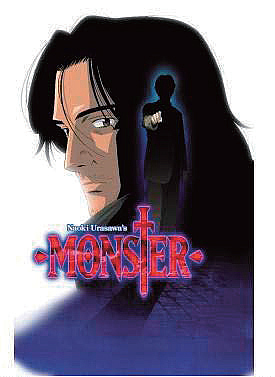
Nippon TV’s original catalog artwork places Tenma’s face in the foreground, with a dark standing silhouette and cool blue landscape behind it. We retain the supplied 275-by-377 image at its native composition. It is promotional anime artwork, not an episode still; the larger lead illustration separately comes from VIZ’s manga presentation.
Our reading is that the composition gives a visible individual a shadowed problem that cannot yet be read clearly. The smaller standing form recedes into darkness, while Tenma’s face remains the viewer’s nearest point of contact. That suits a story in which knowing one person’s decision does not explain every consequence that follows.
The broadcaster’s synopsis confirms the surgeon’s opening moral choice and the later threat associated with the person he saves. The image supports observations about scale, light and juxtaposition, not a specific episode location or a matching panel. We do not name a hidden identity beyond the opening premise or use promotional symbolism as proof of a particular plot theory.
Original visual reference
An equal value principle is tested by consequences
Tenma’s opening dilemma matters because saving a person is treated as a professional obligation before the larger mystery changes its apparent consequences. Our interpretation is that the suspense asks whether an ethical principle can survive the discovery that its result was not reassuring. A good action and a safe outcome are not necessarily the same thing.
That is more interesting than reducing the premise to a doctor who made a mistake. The action can be defensible at the time and still leave its actor facing later responsibility. A viewer can ask which obligations belong to the original decision, which arise afterwards and who has the authority to judge either.
The story’s medical setting is a narrative institution, not a clinical guide. Its relevance here is how professional status and equal treatment come into conflict. We evaluate the moral construction of the opening, not the suitability of an actual procedure or a diagnosis of the antagonist. Dramatic psychology should not be converted into a claim about real patients.
A large mystery can depend on small acts of recognition
The long episode count allows a viewer to encounter people whose lives are changed by events outside the immediate focus. Our interpretation is that this can widen a mystery without making each person merely a container for a clue. A minor account may matter because it changes the moral picture as well as the factual one.
When following the opening, distinguish what somebody observes, what they infer and what they have been told. That creates a clear vocabulary for discussing uncertainty. A confident theory can still be built on hearsay, while an apparently ordinary detail can be meaningful without proving an entire conspiracy.
Urasawa’s page sequence and the television’s duration offer different ways to control that attention. A reader can stop over an expression; a viewer can be held in a pause. Comparing those tools gives more substance to an adaptation discussion than declaring one medium slower without explaining what the additional time allows you to notice.
Creator connections expand the reading list without inventing canon
The broadcaster identifies Madhouse as animation producer; its Japanese project credits Masayuki Kojima as director, Tatsuhiko Urahata for series composition and Kuniaki Haishima for music. These are project-specific roles. Urasawa’s authorship remains the source connection, not a substitute for identifying who shaped the television presentation.
VIZ and its distributor list other Urasawa works, including 20th Century Boys, Master Keaton and Pluto. They provide useful creator routes for somebody interested in mystery construction. They are not prerequisites to Monster and should not be joined to its chronology because of a similar face, motif or professional protagonist.
The linked MonsterAnime and MangaCollectors discussions address reading choices and book availability. They are navigation aids, not proof of current stock or an edition conversion. The score above is AniList’s audience average for the original seventy-four-episode TV entry only. It is not a rating of Another Monster or a combined judgment of every Urasawa work.
A collected edition gives a reliable buying scope
Nine Perfect Edition books provide a defined English set to plan around. A publisher or distributor record can confirm a book’s edition and release date, while a retailer must confirm present stock and price. Historical online complaints about reprints should not be rewritten as a permanent statement that the set is impossible to obtain.
The manga, long-form anime and prose companion document different uses of the property. The linked records do not establish an audited animation profit or a production budget. Neither a high audience score nor a long episode count supplies a defensible revenue calculation, so no financial estimate is invented.
Start with Perfect Edition book 1 or anime episode 1, then explore the investigative companion once the main story is complete. The medicine-and-care collection below places Tenma’s ethical problem beside very different professional fantasies. Future updates can add a verified access edition or a detailed spoiler concordance while preserving the main route and edition labels.
Primary sources and useful navigation
- VIZ · source manga and creator
- VIZ · first Perfect Edition book
- Simon & Schuster · Perfect Edition 9, edition endpoint
- Nippon TV · 74-episode record and original artwork
- Nippon TV · Japanese project and full staff
- Shogakukan · Another Monster credits and investigative contents
- Shogakukan · prose companion print catalog
- Shogakukan · anime adaptation credits
- AniList · named TV audience score
Community and catalog routes
- MyAnimeList · named television catalog
- Reddit · MonsterAnime edition discussion
- Reddit · manga edition and reprint discussion
- Monster Wiki · Another Monster; major spoilers
- Wikipedia · adaptation overview; spoilers
The production and publisher links support project facts. Catalog and community pages are secondary navigation and may reveal later events.
Find this work in our thematic collections
Original series imagery is reproduced under permission asserted by the site owner; the source and rights credits are retained. The route diagram is Animeteor’s own explanatory graphic.
A historical live-action development statement
In an older direct public reply, Guillermo del Toro stated that his team still held the rights and continued trying to realize a Monster project. This documents a historical development statement; it does not verify a currently commissioned series, filming, a cast or a release date. The released television route remains the seventy-four-episode anime.