Watch the original 2002 television anime in episode order 1–26. No required manga or novel continuation is verified in the official records used here. Studio music and production material are optional context.
Reviewed 3 October 2026 · Opening premise and adaptation relationships. Major endings withheld; linked catalog summaries and discussions may contain spoilers. · Licensed access varies by country.

The source and screen branches

The television is the verified story route. Production notes and music remain optional context; no unverified manga, novel or revival is inserted.
- WATCH · main route: Original television anime · 2002 → Episodes 1–26 · numbered order → No required prequel or sequel added
- EXPLORE · context: Studio credits and scene commentary · Official Sound Score 1 and 2 links · Optional context · not plot installments
One twenty-six-episode television route
Witch Hunter Robin introduces Robin Sena, a craft user recruited into STN-J, the Japanese branch of an organization that hunts dangerous witches. Her ability to create fire makes her useful to the team, while her position within that system creates the central question: how securely can an organization distinguish its own permitted power from the power it treats as a threat? Sunrise’s international catalog identifies twenty-six television episodes beginning in July 2002.
For a first viewing, watch episodes 1–26 in numbered order. The investigation-based opening and the later institutional mystery belong to the same run. There is no need to replace the first episodes with a summary or to search for a separate “real beginning.” The cases teach the viewer how this workplace operates before that understanding becomes vulnerable. Skipping them risks losing the baseline against which a later change has meaning.
This guide’s verified route contains the original television anime. The official records inspected do not establish a required manga source, a novel continuation or a second television season. Accordingly, the format badge and map say Anime rather than manufacturing a three-medium chain. Soundtracks and promotional artwork are useful companion material, but listening to an album is not the next plot installment.
| Purpose | Route | What it does not mean |
|---|---|---|
| First viewing | Television episodes 1–26 | One original television series |
| Case-focused opening | Keep numbered order | Not a disposable prologue |
| Later mystery | Continue the same episode run | Not a separately numbered season |
| Music exploration | Official Sound Score 1 and 2 links | Companion albums, not story sequels |
| Manga or novel transfer | No verified branch added | No invented continuation chapter |
| Future production | Add only after primary confirmation | Fan campaign is not an announcement |
An anime original needs a different kind of reading guide
Bandai Channel categorizes the production as an original work, and Sunrise names Hajime Yatate and Shuko Murase for the original story. The practical consequence is simple: the television is the entry to follow, rather than the adaptation of a numbered manga volume supplied by these records. A reader seeking “where the manga continues” needs a verified book, author and publisher before such a transfer instruction can exist.
For this work, useful further reading instead means the studio’s production catalog, character descriptions and scene commentary. Those pages help identify design responsibilities and the world’s presentation. They also disclose substantial plot information. An official source can be reliable while still being unsuitable to a first-time viewer who wants surprises preserved. Use its credit and format fields before exploring its whole character section.
Our map therefore keeps a watch route and a separate context route. It does not put an arrow from episode twenty-six into a soundtrack or a fan encyclopedia. Nor does it imply that a television mystery becomes incomplete merely because there is no prose column beside it. The right amount of branching follows the evidence of this work, not a visual requirement to fill the same number of lanes on every page.
Visual case: a monumental silhouette and a small cup
The original Sunrise poster gives Robin a tall, almost architectural presence. Her dark coat occupies most of the vertical composition, and her distinctive hair arrangement is drawn against a pale background. Large red title lettering crosses the lower body; the surrounding dark outlines make the outfit feel heavy rather than decorative. It is a character image that sells reserve and unease instead of an obvious attack pose.
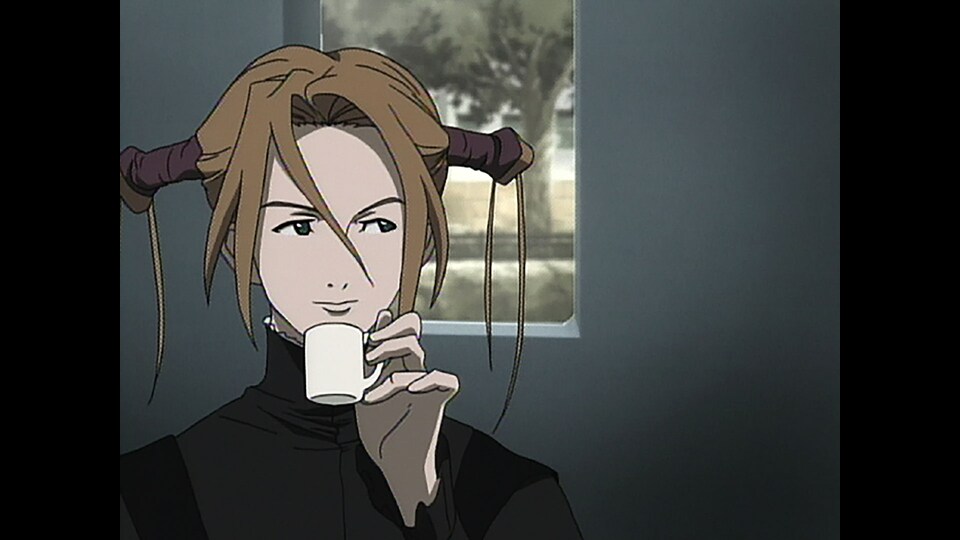
The licensed opening-episode image shows a different scale of action: Robin holds a small white cup near her mouth. Muted gray surroundings and a visible window keep the scene subdued. The picture retains its original television proportions, including the black side space in the distributor’s supplied preview. We preserve that framing rather than stretching the face to fill a modern widescreen rectangle.
The comparison is useful because the same character can be presented as a striking gothic emblem and as someone taking part in an ordinary social moment. Our interpretation is that the second image gives the viewer a place to look for gestures, reactions and hesitation between supernatural incidents. It does not prove a particular unseen motive or identify a later episode twist. Both pictures are original series material with their source and copyright credit retained.
Original visual reference
The workplace is the engine of the mystery
The organization creates an apparent starting answer: a threat exists, trained people are assigned to remove it and an unusually capable newcomer joins their work. What makes the premise interesting is that the answer depends on definitions controlled by the organization. A useful viewing habit is to separate what the team knows, what a manager permits it to know and what an investigator can infer from a case. Those categories can overlap without becoming identical.
Our reading of Robin’s position is that the ability to do a job does not automatically confer authority over its rules. She can be operationally valuable and still have limited power to question classifications or procedures. That tension makes quiet scenes relevant: a glance, instruction or withheld explanation can establish hierarchy before a fight demonstrates strength. The mystery operates through permission and access as well as through supernatural capability.
The official Sunrise commentary distinguishes the earlier case/action emphasis from the later organizational mystery. That is a useful expectation to set, without spoiling individual reveals. A viewer primarily seeking immediate serialized escalation may find the opening patient. A viewer interested in how a team normalizes its routines can use the same material to identify what later becomes questionable. These are different reasons to watch, not grounds for declaring all early episodes unnecessary.
Murase’s direction, Takahashi’s designs and Iwasaki’s music
Sunrise’s international catalog credits Shuko Murase as director. Bandai Channel names Kumiko Takahashi for character design and Taku Iwasaki for music. Those responsibilities matter to the work’s identity: the director’s overall staging, the shapes that keep characters recognizable and the score’s atmosphere are related contributions, not interchangeable author labels. The named animation studio is Sunrise.
The fuller studio record identifies Aya Yoshinaga as chief writer and lists distinct set and conceptual design responsibilities. It also identifies this as Murase’s first directorial work. Those fields offer a better route into production history than guessing influences from a resemblance alone. A viewer may compare the series with live-action investigative drama, but resemblance should be labeled interpretation unless a creator or other primary record confirms the relationship.
The same studio page names Bana for the opening Shell and ending half pain, and provides links for Original Sound Score 1 and 2. These are authorized ways to explore the music associated with the series. The opening, ending and background score are different catalog items; matching the song title to the recording prevents a cover version or unrelated track from being mistaken for an original release. No automatic player or hosted audio is added to this guide.
A named score and a visible disagreement about remaking the series
The external score here is AniList’s 2002 television entry, observed October 3,2026:68/100, normalized to 6.8/10. The entry covers twenty-six episodes. It is not a score for a hypothetical remake, a soundtrack or a franchise average, and it is not a local Animeteor vote. A single aggregate is a starting reference for audience reception; it cannot explain which features mattered most to different viewers.
A selected community thread asks whether fans should campaign for a remake, reboot or continuation. Responses do not all want the same thing: some support a revival, another prefers a sequel to remaking an existing work, and others worry about preserving Robin’s characterization or the series’ tone. That difference is editorially useful. “Fans want more” conceals a meaningful disagreement about whether more means replacement, extension or improved access to the original.
We link that discussion as a small community conversation, not a production announcement. Its claims about studio interest, past commercial success or what a petition might achieve are not adopted as established facts here. Our recommendation is to watch the existing series on its own terms before deciding which kind of revival would preserve its value. A current fan campaign is evidence of interest from those participants, not a market survey.
Check the edition before judging the image quality
Crunchyroll’s named first-episode page lists Japanese and English audio with English subtitles. Its December 2022 platform release date describes that service’s entry, not the anime’s original production year. Availability can differ by country and change over time. The direct series and episode links help verify your own region rather than treating a catalog page as a worldwide promise.
The Bandai Channel listing is a separate Japanese licensed access point. Its membership terms are not the same product as a physical collector’s edition or an English-language stream. When comparing access, identify region, audio, subtitles, episode coverage and the actual release you can use. A request for “better quality” cannot be answered simply by increasing the resolution of a promotional preview or stretching its original aspect ratio.
No audited budget, revenue breakdown or production profit was located in the primary records used here. Merchandise mentions and a revival discussion cannot supply those missing figures. The practical economic question for a reader is the cost and suitability of a verified edition; the production-history question is who made and distributed the work. Keeping those questions distinct avoids converting collector enthusiasm into an unsupported financial verdict.
Choose a comparison that follows the question you care about
For the screen story, the next step remains the next numbered episode. For visual context, use the Sunrise production material after considering its spoiler scope. For music, use the studio’s two named soundtrack links. For conversation, distinguish a thread discussing the original from one proposing a new production. None of these activities silently adds a new canon entry or changes the twenty-six-episode order.
Our Blood+ guide offers another young protagonist whose powers and history are entangled with an institution. Paranoia Agent offers a different approach to cases, collective fear and changing points of view. These are thematic comparisons, not shared-world connections. Their route maps should be consulted separately because the presence of several versions in one work does not imply the same structure exists here.
A later verified book or production can be added without rewriting this guide around speculation. It needs a named publisher or rights-holder record, a clear format and an established relationship to the television. Until then, the complete original run is the route we can substantiate. Its lack of mandatory cross-media homework is a useful feature for someone who wants one contained series to begin tonight.
Primary sources and useful navigation
- Sunrise · international catalog, original story and 26 episodes
- Sunrise World · production credits, artwork and soundtrack links; spoilers
- Bandai Channel · licensed original-work catalog and core credits
- Bandai Channel · original first-episode imagery
- Crunchyroll · named first episode, languages and platform date
- Crunchyroll · television series listing; regional availability varies
- AniList · named anime audience score
Community and catalog routes
- MyAnimeList · named anime catalog
- Wikipedia · production and episode navigation; spoilers
- Reddit · selected revival discussion; claims not production confirmation
The production and publisher links support project facts. Catalog and community pages are secondary navigation and may reveal later events.
Explore related story guides
Original series imagery is reproduced under permission asserted by the site owner; the source and rights credits are retained. The route diagram is Animeteor’s own explanatory graphic.