Start with Blood+ television episodes 1–50. Optional next: Fujisaku’s BLOOD♯ novel. Main manga 1–5 and Ikehata novels 1–4 are parallel routes; Adagio, Kowloon Nights and Russian Rose are separate earlier-history branches.
Reviewed 3 October 2026 · Opening premise and adaptation relationships. Major endings withheld; linked catalog summaries and discussions may contain spoilers. · Licensed access varies by country.

The source and screen branches

BLOOD♯ follows the television story. Main adaptations and earlier-history branches retain separate identities; they are not episodes 51 onward.
- WATCH → CONTINUE: Television anime · episodes 1–50 → Optional BLOOD♯ · Fujisaku novel → Confirmed later story · 2017
- READ · main versions: Katsura manga · volumes 1–5 · Ikehata novels · volumes 1–4 · Parallel entries · start each at beginning
- READ · side branches: Adagio manga 1–2 · earlier history · Kowloon Nights · one manga book · Russian Rose novelsI–II · separate pair
Begin with fifty television episodes; the continuation is a novel
Blood+ follows Saya Otonashi, a schoolgirl living with an adoptive family in Okinawa, whose missing memories become inseparable from the hunt for blood-feeding Chiropterans. Her relationship with Haji and the organization Red Shield moves the story beyond its opening setting. Aniplex identifies this as a new construction of characters, setting and story from the earlier Blood concept, rather than the next chapter of the 2000 film’s exact continuity.
For a first viewing, follow the 2005–2006 television series in episode order, 1–50. Production I.G’s final-episode record and Aniplex’s complete collection agree on the fifty-episode scope. No earlier film or manga is required to understand this entry. The publisher-confirmed later continuation is BLOOD♯, a Japanese novel written by television director Junichi Fujisaku and released on February 28, 2017. Read that after the television ending if you want this specific subsequent story.
The novel’s cover and synopsis contain information about what survives the television story. That makes it unsuitable as a starting-point summary for a viewer avoiding all later character clues. It is an optional prose continuation, not an announced second television season. The four Ryo Ikehata adaptation novels and Asuka Katsura’s manga are other ways through the premise; their publication numbers should never be appended as television episodes 51 onward.
| Route | Order | Relationship |
|---|---|---|
| Television | Episodes 1–50 | Primary first-entry route |
| After television | Optional BLOOD♯ novel | Fujisaku’s confirmed later story |
| Main manga | Asuka Katsura volumes 1–5 | Parallel adaptation/companion |
| Main prose | Ryo Ikehata novels 1–4 | Parallel illustrated adaptation |
| Side manga | Adagio 1–2; Kowloon Nights one book | Optional earlier-history branches |
| Side prose | Russian Rose I–II | Separate earlier-history novel pair |
Three manga branches and two different kinds of prose
Dark Horse’s publisher guides distinguish the five-volume main manga, two Adagio volumes and the single Kowloon Nights book. The main manga is credited to Asuka Katsura, Adagio to Kumiko Suekane and Kowloon Nights to Hirotaka Kisaragi. Those are different authored branches. Production I.G describes Adagio’s Russian Revolution setting and the Haji focus of the other side manga; the distributor places Kowloon Nights before the main television events.
The main illustrated novel adaptation is by Ryo Ikehata, with illustrations by Chizu Hashii, and spans four volumes in the English publisher’s guide. Russian Rose I–II is a different Japanese prose pair by Karino Minazuki, illustrated by Ryo Takagi. The fact that both kinds are sold as books does not make their volume numbers interchangeable. Select the author and subtitle before deciding whether a missing number means an incomplete purchase.
For first entry, our recommendation is to complete one main version before exploring its side branches. This is an editorial route rather than a claim that all variants have identical events. Start a different adaptation at its beginning instead of using an invented television-to-manga chapter conversion. Earlier-history side stories can reveal identities or relationships that the television deliberately develops later, so chronological placement alone is not a spoiler-safe starting order.
Visual case: a diagonal blade versus an embrace
The Aniplex collection illustration puts short-haired Saya in the foreground, looking directly toward the viewer while her blade runs diagonally across almost the full image. Haji stands above and behind her with a second angled weapon. A dark creature silhouette occupies the street behind them; red light and shop signage place the danger within an inhabited urban setting. The image offers a clear action threshold without needing a collage of severed bodies or a frame that exposes a late plot revelation.
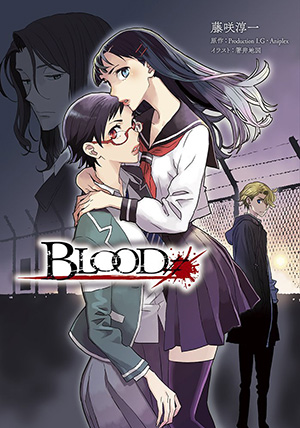
The official BLOOD♯ cover changes that emphasis. A long-haired school-uniformed figure holds a younger figure wearing glasses, while a large subdued portrait of Haji sits behind them and another figure stands near a fence. The embrace replaces the crossing weapons as the central relationship. Even without reproducing the publisher’s spoilery synopsis, the arrangement signals that the later book asks the reader to consider protection and continuity, not simply a new monster fight.
This is a comparison of visible promotional images, not proof that the anime and novel use the same scene or character perspective. The original compositions and their credits remain intact. The first illustration supports the anime’s entry point; the second identifies the actual continuation product. Neither is presented as an AI reconstruction, a manga panel, or evidence of an unannounced adaptation.
Original visual reference
Memory creates obligations before it supplies answers
The most useful way to read the opening is to distinguish personal memory from social responsibility. Saya can be cared for by a family while still not understanding the history others associate with her. That creates competing definitions of who she is: the person established through everyday affection, the fighter demanded by a crisis and the historical figure described by outsiders. Our interpretation is that the friction among those roles matters more than treating every revelation as a trivia answer.
A long television run can place ordinary behavior between confrontations. Family conversations, travel and a change of setting can show how loyalties are maintained, rather than asking an action scene to express all emotional information. For a viewer expecting uninterrupted combat, that structure can feel slow. For a viewer interested in what the fighting interrupts, it gives the disruption a cost. Those are distinct viewing preferences; neither needs a claim that an episode is universally filler.
The geographical movement also changes what counts as home. The opening setting establishes a life that seems locally understandable, then the wider conflict puts its safety under pressure. It is worth tracking who gets to make decisions for Saya and how that authority is justified. A useful discussion question is whether an explanation of her past actually increases her agency or merely equips another person to tell her what to do. That question can be followed without revealing the final answer.
An original television production with specific creative responsibilities
The official credits name Junichi Fujisaku for direction and series composition, Chizu Hashii for original character designs and Akiharu Ishii for animation character design and chief animation supervision. Jun Matsumoto is credited with chief direction. Production I.G supplies animation, with Aniplex and MBS in the production structure. These jobs should not be flattened into a single “creator” credit: conception, drawable character models and episode direction solve different problems.
The music credit is equally worth preserving accurately. Mark Mancina is credited for music and Hans Zimmer for music production. A shorthand that calls Zimmer the sole score composer hides the official division of labor. Opening and ending songs are another category again. A future music feature can link to authorized releases, but a song list is not a substitute for the screen sequence or a license to host recordings here.
In the studio’s interview, producer Yutaka Omatsu explains that the earlier film’s detailed design approach was difficult to sustain across fifty television installments. He also describes allowing the manga authors room for their own treatment rather than requiring every fine detail to match. This is valuable primary context for recommending separate adaptation routes. It does not authorize a reader to assume that every discrepancy is accidental, or that any fan-made timeline has been approved by the production team.
Selected viewer reactions, with their limits visible
The audience score shown here is AniList’s named 2005 television entry, observed on October 3, 2026: 73 on its 100-point scale, displayed as 7.3/10. Its fifty-episode scope excludes the separate prose and manga variants. This is an external audience aggregate, not our own rating, a franchise average or evidence that the sequel novel was assessed by those same voters. We do not offer a local vote on this page.
A selected September 23, 2026 anniversary discussion recalls weekly viewing, opening songs, endings and the series’ atmosphere. Other replies are less enthusiastic about engagement, and some simply have incomplete memories. The coexistence of affection and criticism is more useful than extracting only the favorable comments. It suggests that music and remembered mood can remain strong even when viewers disagree about the experience of following the full story.
That thread is a small, self-selected retrospective discussion, not a representative survey or a current viewing service directory. We use it as a place to continue conversation, not as proof of demographics, licensing or sales. The work contains graphic violence, disturbing material and sexual assault-related themes. Readers seeking content advice should treat linked detailed discussions as potentially spoilery and distinguish their own comfort threshold from someone else’s praise for dramatic intensity.
A complete Japanese box is not a worldwide viewing license
Aniplex’s February 26, 2020 Japanese Blu-ray box specifies all fifty episodes, seven discs and upconverted video. Its included production materials and artwork describe an edition’s added value. They do not announce new story episodes, establish native high-resolution animation or prove English subtitles. Before buying, compare the exact product’s languages, playback compatibility and disc contents rather than importing those fields from another Blood title.
For English reading, the Dark Horse catalogs establish the adaptation ranges, but an older catalog is not a current stock guarantee. The active distributor page for Kowloon Nights includes a digital edition; access to one side story does not establish that every other book is available in every country. Printed and digital records should be compared separately. A price encountered in a historical product record is also not a current resale quotation.
Omatsu describes staff development and the studio’s capacity to sustain a long television production as goals alongside commercial performance. That distinction is helpful when discussing the project’s scale. The sources checked for this guide do not supply an audited production budget, rights-income breakdown or net profit. A named international musician, a later collector’s box and continuing fan affection are evidence of production choices and circulation, not figures from which we can calculate financial success.
Use the branch labels when choosing what to explore next
If you want the main screen experience, begin at episode one and continue through fifty. If you have finished that route and want a confirmed later story, look for Fujisaku’s BLOOD♯ by title and author. If you want to compare the premise in print, choose Katsura’s main manga or Ikehata’s illustrated novels from volume one. Adagio, Kowloon Nights and Russian Rose serve readers who deliberately want supplementary earlier-history material; they need their own labels and spoiler expectations.
Blood: The Last Vampire is relevant to the franchise’s development, but this guide does not turn its film or other media into compulsory prologues for Blood+. Similar titles can be a trap when shopping or searching: verify the plus or sharp symbol and the named production. Games and live-action material are excluded from our anime/manga/prose route map. A future dedicated feature can discuss those formats without silently changing this reading order.
Our Shiki and Hellsing guides offer other examinations of threatening beings, moral boundaries and adaptation choices. They are separate thematic recommendations. For corrections or later updates, prioritize the studio, rights holder and named book publisher before a community chronology. A new edition can improve access without adding a story, while a verified prose continuation can add a genuinely new route even years after the television has ended.
Primary sources and useful navigation
- Aniplex · original television premise and full staff
- Production I.G · final television episode 50
- Aniplex · 2020 complete collection and original artwork
- Production I.G · authored manga and prose branches
- Production I.G · Yutaka Omatsu production interview
- MAG Garden · BLOOD♯ continuation, author and 2017date
- Production I.G · director’s continuation novel release
- Dark Horse · publisher manga guide, main and side volume counts
- Dark Horse · illustrated adaptation novel range 1–4
- Dark Horse / PRH · main manga adaptation catalog
- Dark Horse / PRH · Kowloon Nights placement and digital edition
- AniList · named anime audience score
Community and catalog routes
- MyAnimeList · named anime catalog
- Wikipedia · adaptation navigation; spoilers
- Blood+ Wiki · community discussion navigation; spoilers
- Reddit · selected September 2026 anniversary reactions
The production and publisher links support project facts. Catalog and community pages are secondary navigation and may reveal later events.
Explore related story guides
Original series imagery is reproduced under permission asserted by the site owner; the source and rights credits are retained. The route diagram is Animeteor’s own explanatory graphic.
Games and live-action adaptations
- Blood: The Last Vampire (2009) — Live action: Related franchise film · 2009