Anime: television episodes 1–13, then optional In Passing Showers as a separate extra. Manga: Japanese volumes 1–12 or English Dark Horse omnibuses 1–4. Current English-disc catalog coverage conflicts with VAP’s record; confirm before buying.
Reviewed 3 October 2026 · Opening premise and adaptation relationships. Major endings withheld; linked catalog summaries and discussions may contain spoilers. · Licensed access varies by country.

The source and screen branches

The original manga is complete in twelve Japanese volumes or four English collections. VAP confirms thirteen TV episodes; Sentai’s current edition page says twelve, so actual disc coverage needs seller confirmation.
- READ · manga: Japanese standard volumes 1–12 → English omnibus 1–4 · alternative → Each English collection covers three originals
- WATCH · anime: 2004 television · episodes 1–13 → In Passing Showers · optional extra → Extra is not episode fourteen of a sequel
- COMPARE · versions: After viewing, start manga at beginning → No certified post-anime chapter shortcut → No confirmed prose route inserted
Choose thirteen television episodes or the complete manga
Elfen Lied begins with Lucy escaping confinement and with Kouta and Yuka sheltering a young woman whose ability to communicate is severely limited. The Japanese rights-holder catalog describes a combination of science-fiction suspense, romance and hard violence. The contrast is central to the experience, and it is also a genuine suitability boundary: graphic violence, nudity and abuse-related material make this an adult-oriented choice rather than a general family recommendation.
For the anime, watch television episodes 1–13 in supplied order. VAP’s Japanese collection record explicitly lists all thirteen and separately identifies the unbroadcast special, In Passing Showers. The special is supplementary material with earlier-history content, not an episode fourteen that resolves the television ending or a confirmed second season. Watching it after the broadcast run as a separate extra preserves a straightforward first-entry route without mistaking disc placement for story chronology.
The complete manga is available in twelve standard Japanese volumes or four English Dark Horse omnibuses. The distributor identifies the first omnibus as the first of four containing all twelve originals. Start at volume one in your selected edition. This guide does not treat the television ending as a certified manga stopping point or offer a guessed chapter that supposedly continues it exactly.
| Choice | Sequence | Boundary |
|---|---|---|
| 2004 television anime | Episodes 1–13 | Named broadcast adaptation |
| Unbroadcast special | Optional extra after the broadcast run | Earlier-story material, not a sequel episode |
| Japanese manga | Standard volumes 1–12 | Okamoto’s complete original manga |
| English manga | Dark Horse omnibus volumes 1–4 | Three original volumes per collection |
| 2026 English disc edition | Check actual contents and seller confirmation | Current web listing says 1–12; conflicts with VAP thirteen |
| After the anime | Read the manga from its beginning | No verified one-chapter transfer point |
Omnibus numbers identify a package, not a new story structure
Lynn Okamoto is credited as both writer and artist of the manga. Shueisha’s final Japanese volume record identifies the conclusion and gives November 18, 2005 for its paper edition, while its digital-edition date is later. Those dates are publication histories, not separate endings. The 2004 anime is its own earlier screen adaptation; a later digital release of the manga does not turn it into a post-anime novel.
For English acquisition, omnibus one covers Japanese volumes 1–3, two covers 4–6, three covers 7–9 and four covers 10–12. The publisher-distributor’s final-volume page explicitly confirms the last group. A reader asking for English volume twelve will not find the same numbered package because that material is inside omnibus four. Compare the contents and ISBN rather than concluding that the translation stops at four original volumes.
Our adaptation recommendation is to restart the manga when moving from screen to page. That is an editorial recommendation for preserving context, not a claim that no scene resembles another. Reading from the start lets you compare character access, pacing and what the manga carries toward its own conclusion. No verified prose route is inserted into the format badge or map merely because a third column would make the layout look balanced.
Visual case: restraint and ordinary clothing create competing first impressions
The official anime-catalog artwork shows a pink-haired figure wearing bandages and part of a broken metallic restraint helmet. One eye is hidden while the exposed face is turned slightly downward. Golden lettering and dense ornamental curls surround her, so an image associated with captivity is presented through an attractive decorative surface. The broken equipment identifies constraint even before a viewer understands the institution behind it.
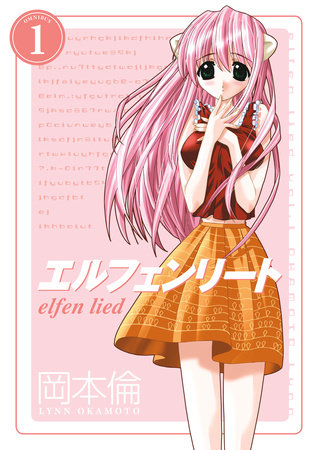
The first English manga omnibus cover uses a pale pink field around a long-haired figure in a dark sleeveless top and orange patterned skirt. Her hands are held near her face, while the small horns remain visible through her hair. The light typography and restrained palette are very different from the anime image’s heavy gold and metal. This is the actual publisher cover rather than a generated imitation of the character.
Our comparison asks how a cover invites sympathy or familiarity before its reader encounters the violence inside. The anime image foregrounds an imposed object on the body; the manga cover emphasizes an approachable pose and ordinary clothing alongside a visible difference. Neither picture establishes innocence or explains an ending. They illustrate the mismatch between an inviting surface and a story that repeatedly makes recognition uncomfortable.
Original visual reference
Compassion and responsibility must remain separate questions
The opening contrast between a dangerous escape and a vulnerable person needing shelter makes the viewer judge behavior before having a stable explanation of identity. Our analytical question is what happens when the same household must respond to need while lacking knowledge of the danger around it. A story can make care necessary without pretending that care automatically resolves every consequence of another person’s actions.
The research-facility premise also raises the cost of treating a person only as a specimen or threat. Institutional language can make harm appear procedural, while a domestic setting gives a character a name and a place in ordinary life. That change in framing matters, but it should not become a shortcut to excusing every act committed outside the institution. Our reading keeps the means of survival and the treatment of others open to criticism.
The shifts between tenderness, comedy and violence can produce emotional force or tonal disruption. A viewer who finds a tender scene effective may still judge an adjacent joke or sexualized presentation inappropriate to the subject. Discussing those transitions is more precise than calling the work either profound or empty in advance. Its disturbing material is not proof of depth on its own; the question is what a scene changes in our understanding of a character or choice.
Keep manga authorship, anime adaptation and related works distinct
VAP’s production record names Mamoru Kanbe as director, Takao Yoshioka for series composition and scripts, and Seiji Kishimoto for character design and chief animation direction. It lists Kayo Konishi and Yukio Kondo for music, ARMS for animation, and GENCO for production. These are the actual screen roles rather than a generic assumption that the manga creator directed the anime.
The same VAP collection page credits Rinsin for newly drawn package illustration and Okamoto for a separately included manga special. Those are edition-specific contributions. A new cover or booklet can enrich a physical collection without constituting a new television adaptation. Michael Gombos is named as translator for the English manga, another role that should remain visible when comparing the prose of an English edition with a Japanese source.
Shueisha also catalogs Okamoto’s Brynhildr in the Darkness. That gives readers a verified route into another work by the author, without implying shared characters or a continuation of Elfen Lied. A productive comparison might examine recurring interests in memory, danger and interpersonal attachment; similarity in a creator’s concerns is different from a confirmed shared story universe.
The selected rewatch shows attraction and reservations together
The August 2024 whole-series rewatch includes first-time viewers who enjoyed the character dynamics more than they expected, while still identifying shortcomings around the final stretch. A separate July 2024 opening-episode discussion foregrounds expectations about the show’s violent and sexual presentation. These selected reactions help show why its reputation and an individual viewing experience can diverge; they are not a representative survey.
Our recommendation is to judge how a disturbing scene functions before deciding whether its reputation describes your experience. Does it change the stakes, a relationship or the information available, or does it mainly repeat an already established shock? The answer can differ across scenes. Someone drawn to the vulnerable household dynamics may reasonably dislike the surrounding presentation rather than accept every stylistic choice as part of a required package.
The displayed external 6.8/10 is AniList’s audience snapshot for the thirteen-episode 2004 television entry, normalized from a 100-point average. It does not score the twelve-volume manga or the optional special. We do not average individual Reddit rewatch scores into that figure. Both discussion links are marked for spoilers, particularly the whole-series thread, so new viewers can choose to postpone them.
Verify a named edition when a current store page contradicts the episode record
VAP’s Japanese collection page names thirteen television episodes plus an unbroadcast special. Sentai’s current collection page lists January 13, 2026, English and Japanese audio, English subtitles and a TV-MA rating, but its included-release field says television episodes 1–12 alongside the OVA. We preserve that discrepancy rather than silently correcting the seller’s specification or claiming that the physical disc definitely omits episode thirteen. Buyers should confirm that edition’s contents with the seller.
The manga has another harmless date difference that requires an edition label. The publisher-distributor page dates omnibus four’s paperback to October 6, 2020 and its ebook to February 28, 2023; Dark Horse Digital lists March 1, 2023 for its own digital release. That does not establish an extra manga installment. Retailers can have different digital publication records while identifying the same collected material.
The distributor promotes the work’s influence on Stranger Things with an attributed Matt Duffer statement. That is a creator’s reported influence, not shared canon, a license relationship or evidence that one production’s revenue belongs to the other. No checked source provides an audited Elfen Lied budget or net profit. A later collection and a famous comparison demonstrate circulation and reception, without supporting an invented financial-success percentage.
Use the original manga for comparison, not a fabricated television sequel
Complete the thirteen television episodes and treat In Passing Showers as a separately identified extra. If a platform or box groups it at the end, that is not evidence that its events continue the ending. For a first visit, separating the broadcast run from extras is clearer than rearranging the entire series around a fan explanation before you have encountered its own presentation.
For the fuller manga route, begin Japanese volume one or English omnibus one and follow that edition to its conclusion. Keep notes on how a relationship or explanation is introduced rather than assuming the last TV scene corresponds to a single printed chapter. The four omnibuses provide a defined acquisition route, but their numbering is not an episode-to-volume conversion formula.
Our Shiki and Hellsing guides offer other approaches to threatening beings, violence and adaptation differences. They are thematic comparisons, not additions to this canon. A future confirmed new production can be added with its own sources and scope; a rewatch, updated packaging or fan request for a remake cannot be promoted as an announced second season.
Primary sources and useful navigation
- VAP · collection, thirteen-episode coverage and full staff
- VAP Store · numbered episode list and unbroadcast special
- VAP · original anime-catalog image
- Sentai ·2026 edition, languages and conflicting coverage field
- Shueisha · first original manga volume
- Shueisha · final manga volume12; ending spoilers
- Dark Horse / PRH · first omnibus and four-collection coverage
- Dark Horse / PRH · final omnibus, volumes10–12 and format-specific dates
- Dark Horse Digital · first English collection and region restrictions
- Dark Horse Digital · final English collection and digital date
- Shueisha · Okamoto’s separate Brynhildr manga
- AniList · named anime audience score
Community and catalog routes
- MyAnimeList · named anime catalog
- Wikipedia · version navigation; spoilers
- Elfen Lied Wiki · catalog and adaptation navigation; major spoilers
- Reddit · selected July2024 opening-episode rewatch; adult-content discussion
- Reddit · selected August2024 whole-series discussion; ending spoilers
The production and publisher links support project facts. Catalog and community pages are secondary navigation and may reveal later events.
Explore related story guides
Original series imagery is reproduced under permission asserted by the site owner; the source and rights credits are retained. The route diagram is Animeteor’s own explanatory graphic.