First anime route: 2006 episodes 1–26 → Kai 1–24, then optional Rei. Later routes: Gou → Sotsu on screen; English Gou 1–2 → Meguri 1–5 in manga. New television project announced in June 2026; broadcast date unverified.
Reviewed 3 October 2026 · Opening premise and adaptation relationships. Major endings withheld; linked catalog summaries and discussions may contain spoilers. · Licensed access varies by country.
The source and screen branches

Gameplay and live-action are outside this map. Visual-novel games are not printed prose books. The announced 2026 new TV project has no verified broadcast date or exact map placement here.
- WATCH · classic: 2006 anime · episodes 1–26 → Kai · episodes 1–24 → Rei OVA · optional five installments
- WATCH · later: Finish classic foundation first → Gou · episodes 1–24 → Sotsu · episodes 1–15
- READ · manga: Classic · eight principal arcs in order → Later · English Gou volumes 1–2 → Then Meguri volumes 1–5
- READ · prose: Japanese Ryukishi07 / Tomohi books → Onikakushi → principal arc order → Saikoroshi · optional after main route
Start with the original anime; Gou is not its replacement
Higurashi begins with Keiichi arriving in the mountain village of Hinamizawa, making friends and discovering that the village’s cheerful routine conceals a troubling history. For a first anime experience, choose the 2006 television series, episodes 1–26, followed by Kai, episodes 1–24. The official anniversary program identifies those two series as fifty episodes together. Preserve their supplied order: a returning summer and a different perspective are part of the storytelling, not signs that a playlist accidentally restarted.
Rei is optional post-Kai viewing, with five OVA installments in its licensed collection. Gou and Sotsu form a later screen route: finish the classic foundation before Gou’s twenty-four episodes and Sotsu’s fifteen. Their familiar opening circumstances should not be taken as proof that they replace the older adaptation. Readers who want the later manga should similarly distinguish the Gou and Meguri books from the original arc collections.
As of this guide’s October 3, 2026 check, the official portal announces a new television production with Studio DEEN attached. Its announcement appeared on June 21, 2026. We have not verified a broadcast date or a precise placement within the existing anime routes. Keep that project in the announcement category rather than adding an imagined next episode to a completed viewing list.
| Route | Sequence | Boundary |
|---|---|---|
| Classic anime | 2006 episodes 1–26 → Kai 1–24 | First-entry recommendation |
| Optional Rei OVA | After Kai; five installments | Supplementary viewing |
| Later screen route | Classic foundation → Gou 1–24 → Sotsu 1–15 | Separate later project, not a replacement |
| Classic manga / Japanese prose | Read complete arcs in the ordered table below | Start at the first arc, not a guessed anime-end chapter |
| Later English manga | Gou collected volumes 1–2 → Meguri 1–5 | Gou Comic Anthology remains optional |
| 2026 new television project | Announced; production and cast information available | Broadcast date and exact route placement unverified |
Arc names are safer than transferring volume numbers between editions
The franchise originated with Ryukishi07 and 07th Expansion’s visual-novel games. Seikaisha’s introduction separately identifies a prose novelization and Tomohi’s illustrations. That distinction matters: the game format called a visual novel is not the same product as a printed prose book. We acknowledge the source history here while keeping gameplay and live-action routes outside this anime, manga and prose map.
For classic reading, follow the eight principal arcs in their published sequence. Complete every part of one arc before entering the next. The Japanese Seikaisha paperback catalog includes single-part Himatsubushi and three-part Matsuribayashi; a universal two-books-per-arc rule would fail. Optional Saikoroshi material belongs after the principal route. The English manga uses localized arc names and its own collected volumes, so identify both the arc and the named edition when buying or continuing.
The official Japanese Gou manga page lists four volumes. Yen Press publishes Gou in two substantial English collected volumes and lists its comic anthology separately. Its Meguri catalog lists five volumes, with volume five released July 22, 2025. Our recommendation treats Gou followed by Meguri as a complete later manga route to read on its own terms, rather than promising that every scene maps identically onto Sotsu or that a television episode number supplies a manga chapter.
| Position | Japanese arc name | Classic English manga label |
|---|---|---|
| 1 | Onikakushi | Abducted by Demons |
| 2 | Watanagashi | Cotton Drifting |
| 3 | Tatarigoroshi | Curse Killing |
| 4 | Himatsubushi | Time Killing |
| 5 | Meakashi | Eye Opening |
| 6 | Tsumihoroboshi | Atonement |
| 7 | Minagoroshi | Massacre |
| 8 | Matsuribayashi | Festival Accompanying |
Visual case: an inviting gesture in an uneasy landscape
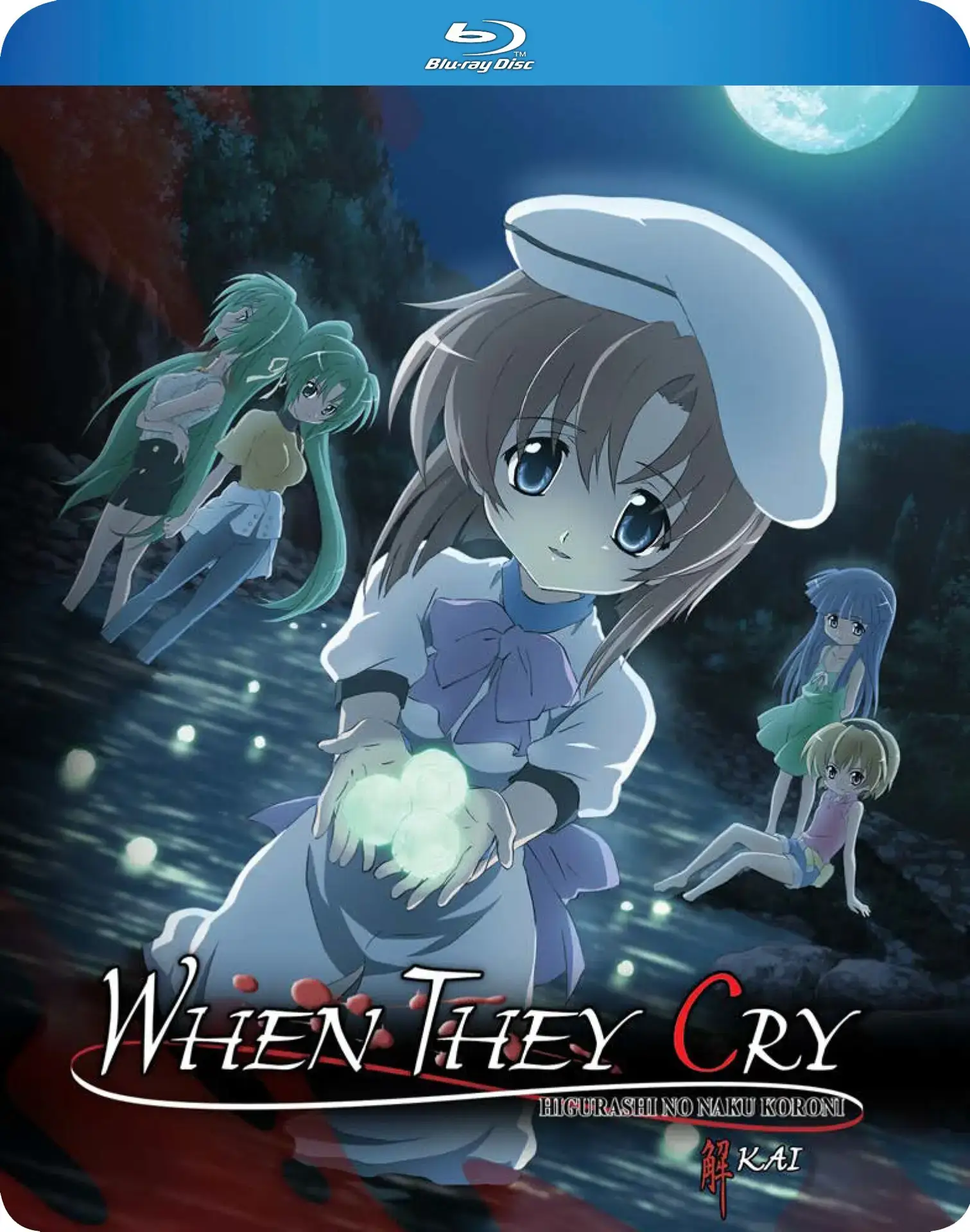
The licensed Kai collection artwork places Rena in the foreground with her hands extended around glowing lights. Other girls stand or sit farther back beside water and trees; a moon fills the upper-right sky. Cool blues connect the figures to the landscape, while her large face and open palms make the image initially welcoming. The environment still gives the invitation an isolated, nighttime setting.
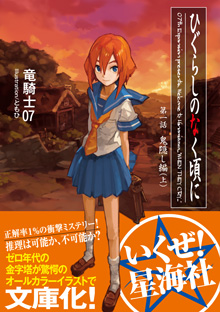
Tomohi’s Japanese Onikakushi upper-volume prose cover also isolates Rena, this time against a village under an orange-red sky. Her white blouse, blue skirt and bright scarf read clearly against the dark roofs. The publisher’s bright orange paperback campaign band is packaging, not an object inside the story. Keeping the complete cover preserves the distinction between an illustration and the commercial design surrounding it.
Our reading compares two ways of making a familiar character approachable while leaving the setting uncertain. One foregrounds offered light; the other pairs a bright figure with a darkening settlement. Neither image establishes who is trustworthy, and neither justifies treating the artwork as an ending clue. That tension between a friendly surface and incomplete knowledge is a more useful entry point than searching promotional images for a hidden culprit.
Original visual reference
A recurring summer changes the reader’s standard of evidence
Higurashi’s opening social rhythm matters because suspicion grows inside relationships that already have warmth. Keiichi’s new friendships make village life worth joining before its history becomes frightening. If a viewer treats those early interactions as disposable padding, the subsequent doubt loses much of its force: the question is not simply whether a stranger is dangerous, but whether an ordinary exchange with someone close can still be read confidently.
Our analytical recommendation is to track observations separately from explanations. Record what a character directly witnesses, what another person claims and what someone concludes under pressure. Similar situations in another arc allow comparison, but familiarity alone does not make two accounts equivalent. An explanation that seems convincing from one perspective can reveal its limits when access to information changes.
This is also why a first viewing should retain release order instead of rearranging scenes into an apparent master chronology. A chronology assembled after the answers may organize events, but it can erase the uncertainty through which the work introduces them. Repetition is valuable when it changes the viewer’s interpretation of ordinary behavior. Its cost is that someone seeking steady linear advancement may find another beginning frustrating rather than productive.
Identify the team attached to the actual version you are discussing
Ryukishi07 and 07th Expansion provide the original-work credit across the official anime material. The Gou/Sotsu staff page identifies Keiichiro Kawaguchi as director, Naoki Hayashi for series composition, Akio Watanabe for character design and Passione for animation production. Those credits belong to that later production; they should not be copied automatically into every older Higurashi entry.
The newly announced project’s own site lists Studio DEEN for animation and names the returning principal Japanese cast. That is verified production information, while a director, episode total or premiere date not supplied in the checked announcement remains unspecified. Ryukishi07’s anniversary comment promises a new story centered on the club members and new tragedy. It establishes creative intent without settling an exact relationship to each completed screen branch.
Printed adaptations also require their own credits. The first English Abducted by Demons manga volume identifies Karin Suzuragi as artist, whereas the later Gou and Meguri books identify Tomato Akase. Seikaisha names Tomohi for its prose illustrations. Comparing character expressions across those editions can be rewarding, but a shared original author does not mean one artist drew every book or that all adaptation choices were identical.
Community confusion is useful evidence of a navigation problem
The selected September 2026 discussion begins with someone who has almost finished the source’s principal chapters but cannot make sense of the many anime catalog entries. Replies distinguish the classic run, Kai, Rei and the later Gou/Sotsu pair. They also contain sharply different judgments of that later pair: one participant defends its treatment of difficult attachments while others criticize its adaptation choices. These are individual responses, not a poll of the audience.
Our editorial conclusion is to make a version choice before opening a discussion about quality. Someone asking whether to start the franchise needs different help from someone comparing a later sequel with the classic foundation. Presenting all catalog entries as one undifferentiated season chain creates avoidable confusion. It also encourages a viewer to interpret disagreement about one adaptation as a verdict on every manga or novel in the franchise.
The displayed 7.6/10 is AniList’s audience snapshot for the original 2006 twenty-six-episode television entry, normalized from its 100-point average. It does not score Kai, Gou, Sotsu, Meguri or the unbroadcast new project. Linked Reddit and wiki discussions may reveal identities, answers and endings; use them after your selected route if preserving the mystery matters to you.
Published editions and a new production do not establish a profit figure
The licensed Kai and Rei disc listings identify Japanese audio, English subtitles and Region A. Their original-release years remain 2007 and 2009 despite the later catalog packaging. Those details are practical purchasing information: an English-facing product page does not itself guarantee an English dub, worldwide compatibility or access in every streaming territory. Check the named edition and current stock rather than relying on a franchise-wide assumption.
The Gou manga shows another commercial distinction. Four Japanese volumes and two English collected volumes are different packaging decisions for related material, not evidence that half the English narrative is missing. Yen Press’s separate anthology is an additional product rather than a third numbered Gou collection. Arc names, contents and ISBNs are more useful comparisons than treating any store’s volume total as a universal story count.
The anniversary announcement, current book catalogs and licensed disc editions demonstrate continued exploitation of the property in specific markets. They do not reveal the classic anime’s audited production cost, current rights payments or net profit. We therefore avoid calculating financial success from a retailer price, an audience score or the mere existence of a new project. A dated announcement is evidence of production activity, not a completed commercial result.
Finish a route before using the answer material to compare adaptations
For the classic anime, complete the original twenty-six episodes and Kai’s twenty-four, then decide whether to add Rei. If you want to compare adaptation pacing, begin the classic manga at Abducted by Demons or the Japanese prose at Onikakushi, rather than skipping to a supposed post-anime chapter. The same arc may distribute its evidence differently across prose, panels and timed scenes.
For later material, choose Gou followed by Sotsu on screen, or the named English Gou collections followed by Meguri in manga. Read the manga route as its own sustained sequence; this guide does not advertise a scene-for-scene equivalence with the television answers. The separately published Oni manga concerns Oryo’s earlier life in 1923 and is optional background reading after familiarity with the principal story, not a spoiler-free first-volume substitute.
The new Studio DEEN project should receive another route update when its broadcast information and adaptation relationship are officially established. Until then, the completed choices already offer several meaningful comparisons. Our Paranoia Agent and Boogiepop Phantom guides extend questions about rumor, unreliable knowledge and recurring perspectives without suggesting shared canon or turning every thematic resemblance into a crossover.
Primary sources and useful navigation
- Official anime portal · dated announcements and version navigation
- Official anniversary marathon · original26 and Kai24 coverage
- Official Gou episode index · twenty-four story entries; spoilers
- Official Sotsu episode index · fifteen story entries; spoilers
- Official Gou/Sotsu staff · Passione and named team
- Official new-project site · Studio DEEN and cast
- Official2026 anniversary comments · new-story intent
- Official Japanese Gou manga · four-volume edition
- MediaOCD · licensed Kai collection and original artwork
- MediaOCD · licensed Rei collection and language/region
- Seikaisha · distinction between source games and actual prose novelization
- Seikaisha · Japanese prose arc editions and covers
- Seikaisha · first Onikakushi prose volume
- Yen Press · classic manga catalog; summaries can reveal endings
- Yen Press · Gou sequel announcement
- Yen Press · English Gou volume1 and edition contents
- Yen Press · English Gou volume2 and separate anthology
- Yen Press · Meguri five-volume catalog; spoilers
- Yen Press · Meguri volume5 publication date; spoilers
- Futabasha · Oni earlier-life background manga
- AniList · named anime audience score
Community and catalog routes
- MyAnimeList · named anime catalog
- 07th Expansion Wiki · franchise navigation; major spoilers
- Wikipedia · franchise catalog navigation; spoilers
- Reddit · selected September2026 anime-order discussion; major spoilers
The production and publisher links support project facts. Catalog and community pages are secondary navigation and may reveal later events.
Explore related story guides
Original series imagery is reproduced under permission asserted by the site owner; the source and rights credits are retained. The route diagram is Animeteor’s own explanatory graphic.
Games and live-action adaptations
- Higurashi: Shrill Cries of Summer — Live action: Film · 2008
- Higurashi: the 2016 television drama — Live action: Series · 2016
- Higurashi: Shrill Cries – Reshuffle (2009) — Live action: Film · 2009
- Higurashi When They Cry Hou — Ch.1 Onikakushi — Game: Sound novel · horror mystery
Separate announced TV project record
The announced Studio DEEN production already appears in the analysis above. Its separate anime adaptation record retains the announcement status without supplying an unverified premiere date or inserting it into a completed viewing sequence.