Start the original six-part OVA. Watch Diebuster afterward for first discovery; the theatrical reconstruction is an alternative presentation and Kabocha’s manga begins at volume 1.
Reviewed 3 October 2026 · Opening premise and adaptation relationships. Major endings withheld; linked catalog summaries and discussions may contain spoilers. · Licensed access varies by country.

The source and screen branches

The original OVA precedes its later comic adaptation. Theatrical versions are reconstructed presentations; no exact post-anime manga handoff is certified.
- WATCH · original OVA route: Gunbuster · installments 1–6 → Diebuster · later installments 1–6
- WATCH · theatrical alternatives: 2006 reconstructed film presentations → Not additional OVA installments
- READ · later adaptation: Kabocha manga · volume 1 → Continue the comic’s own sequence
Six OVA installments give Noriko’s training room to change scale
Gunbuster, originally titled Aim for the Top!, begins with Hideaki Anno's six-part 1988 OVA production. Bandai Channel introduces Noriko Takaya at an Okinawan school training prospective space pilots. Start with installment one and continue through six. The school premise is an entry into a larger science-fiction story, rather than a separate prequel to be skipped before the robot appears.
Diebuster, or Aim for the Top! 2, is a later six-part production directed by Kazuya Tsurumaki. For first discovery, finish Gunbuster before beginning that related sequel. The relationship is worth discovering through the works themselves; an unrestricted timeline can explain later connections before the viewer has experienced their presentation.
The 2006 combined theatrical release contains reconstructed film presentations of the two productions. It is an alternative presentation, not a seventh OVA installment appended to Gunbuster. Our recommendation is the original six installments first for their development, with the film version as a later comparison or a separately chosen compact route.
Kabocha’s comic adapts the animation rather than originating it
KADOKAWA identifies Gunbuster volume one as a comic by Kabocha with GAINAX credited for the original work. Its description explicitly identifies adaptation of the OVA, and its first-volume print record is dated August 2, 2011. Begin the comic at volume one. Its existence does not reverse the relationship by making the 1988 animation an adaptation of that later book.
A viewing edition should distinguish the six-part OVA from the reconstructed theatrical feature. WOWOW's feature record describes re-editing and reunited original voice actors for newly recorded sound. Those presentation changes make a later version comparison meaningful, but the broadcaster's old description is not a current cinema announcement or proof of another distributor's disc specifications.
Check languages, region, version and extras before buying a collector package. A title containing both Aim for the Top! and its sequel may include two film presentations instead of both original OVA series. We do not provide an exact after-anime manga chapter jump: the safe reading comparison begins at the comic's own opening and preserves its actual edition numbering.
| Presentation | Starting point | Role |
|---|---|---|
| Gunbuster OVA | Installment 1 → 6 | Recommended original entry |
| Diebuster OVA | After Gunbuster; begin its installment 1 | Related later six-part production |
| 2006 theatrical presentations | Beginning of the named film | Reconstruction, not OVA installment 7 |
| Kabocha manga | Volume 1 | Later comic adaptation of the OVA |
Effort has a physical setting before it becomes a space spectacle
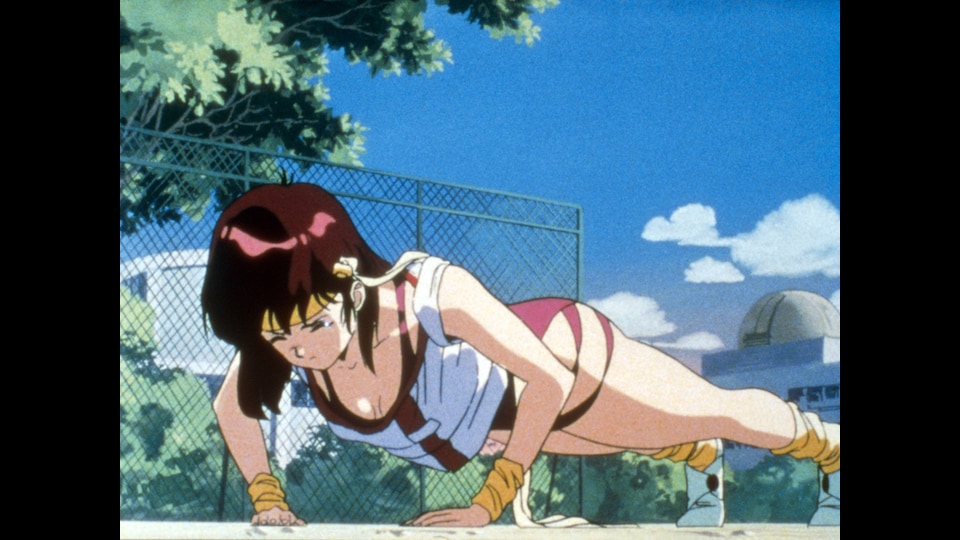
The licensed lead image gives Noriko's determined face a close framing beneath a blue headband, with the title overlaid. The original first-installment reference below instead shows a girl supporting her body on her hands in a training pose, surrounded by a fence, tree branches and a bright sky. The exercise image belongs to the school opening, not a generated reconstruction of a later battle.
Our interpretation follows the visible strain and the ordinariness of the surroundings. The pose makes effort physical; the fence and sky locate that effort in a recognizable training environment. The close promotional face intensifies resolve, while the wider reference makes the labor of acquiring ability easier to see. A still cannot demonstrate the duration of the exercise or its complete dialogue.
Together, the images introduce a question more specific than whether Noriko is naturally talented: how does the story make practiced effort visible, and what does the institution recognize as progress? The original sequence would be needed to judge its complete rhythm. Here, the inspected posture and framing provide a concrete entry into that analysis without giving away the later missions.
Original visual reference
A school hierarchy gives ambition someone to answer to
The licensed premise names Noriko's aspiration, the senior student who watches over her and the coach's training. Our reading asks how those relationships turn wanting to become a pilot into a public test. In a school, improvement is observed and judged; a private ambition becomes something a peer or instructor can endorse, challenge or misunderstand.
That structure can make even a modest exercise consequential. A visible failure may affect a student's standing as well as her immediate performance. Follow whether encouragement comes from recognition, instruction or pressure to match another person. The training reference grounds the question in bodily effort rather than using a heroic outcome to retroactively claim that every earlier setback was meaningless.
The school material should therefore be experienced before reducing the production to its most famous machine. A robot can enlarge a character's reach, but the audience's investment may already have formed around how that character earns trust. A later essay can compare a training scene with a mission sequence using timestamps; this guide keeps the argument at the level supported by the opening premise and image.
Science-fiction scale can make shared time a fragile resource
The licensed theatrical synopsis identifies a central cost of repeated near-light-speed travel: time experienced in space separates the pilots from people on Earth. Our analysis asks what happens when service to a collective future reduces the ability to share ordinary life with particular people. This is a premise-level temporal concern, not a disclosure of the final return or ending image.
The school setting gives that concern a useful starting scale. Training happens in the same environment as peers, under the same daylight. Space travel can make that shared rhythm unavailable. The contrast lets a viewer examine how achievement changes relationships, instead of treating technological reach as an uncomplicated reward for hard work.
Keep the fictional temporal rules distinct from a calculation about real spacecraft. The guide does not supply invented speeds, exact elapsed-year diagrams or claims about the final mission. The relevant first-view question is emotional and structural: when a character moves forward in capability, does the surrounding world move with her in the same way? The OVA can answer that gradually through its own sequence.
Anno and Tsurumaki’s productions have different creative identities
The original OVA is associated with GAINAX and Anno; the later Diebuster production is directed by Tsurumaki. The licensed series essay identifies both as six-part original presentations and distinguishes the combined theatrical reconstruction. A connection through studio and franchise makes comparison productive, while the named production still matters for a creator credit or audience score.
Kabocha's later comic has a separate authorship credit under GAINAX's original-work identity. Its panel sequence is a reading route rather than a substitute technical record of how Anno directed the animation. A future adaptation essay should compare a named scene with the actual comic passage before asserting differences in duration, emphasis or dialogue.
For discovery, Gunbuster also provides a compact older production to place beside Macross Plus's pilot and performance questions. That comparison concerns craft and the relationship between a person and technology; it does not imply a shared world. Follow the creators and mediums that interest you after completing the selected route, without allowing a recommendation list to become a false chronology.
The displayed score measures the original OVA entry
The external AniList score here is scoped to the original six-part Gunbuster OVA. It excludes Diebuster, the theatrical reconstruction and Kabocha's manga. A reader deciding between a short film presentation and the original installments should not mistake that number for a pooled review of every version or for Animeteor's own editorial rating.
The linked mecha community and franchise encyclopedia can help identify release names or discuss the contrast between the two productions. Complete plot explanations often reveal how the sequel connects to the original, so use the edition table first. A narrow question about a package's audio is less likely to expose the ending than an unrestricted search for the franchise's complete chronology.
The licensed series essay is also a dated critical perspective, not a census of viewers. Its emphasis on the expanding scale offers one interpretive invitation. Our image-based discussion focuses on physical effort and shared time. Readers can compare those invitations with their own viewing without treating a contributor's enthusiasm or a catalog average as a verified universal response.
A participant in the linked June 2020 episode-one rewatch reads the physical training as an emphasis on hard work. We treat that as an individual interpretation, not a consensus or proof of the director’s intent. It offers a useful question to compare with the inspected exercise image; the thread and its links may discuss later material.
Buy the presentation you intend to watch, then compare versions
Older distribution announcements may advertise a free streaming window or a disc release that has long ended. The linked 2011 licensed series essay is retained for its production distinction and critical perspective; it does not establish present access. For a current purchase, check the actual distributor's named edition, languages, region and contents rather than copying historical availability into a release calendar.
No audited Gunbuster budget or net-profit total was verified here. A collector edition, renewed screening or strong catalog score cannot supply that missing financial evidence. The useful buying comparison is whether the original six installments, the theatrical reconstruction and any extras are clearly identified and usable in the reader's language.
Begin the original OVA, complete its six installments and choose Diebuster next if you want the related later production. Return to the reconstructed film for presentation comparison, or start Kabocha's manga independently. Macross Plus offers another compact OVA route involving pilots and technological systems, with its own film alternative and comic relationship outside Gunbuster continuity.
Primary sources and useful navigation
- Bandai Channel · original Gunbuster entry and imagery
- Bandai Channel · dated critic’s series and reconstruction guide
- WOWOW · theatrical reconstruction and re-recorded voices
- KADOKAWA · Kabocha first-volume comic adaptation
- AniList · named anime audience score
Community and catalog routes
- MyAnimeList · named anime catalog
- Gunbuster Wiki · franchise navigation, spoilers possible
- Reddit · 2020 opening-episode rewatch, spoiler risk
- Reddit · mecha discussion
The production and publisher links support project facts. Catalog and community pages are secondary navigation and may reveal later events.
Explore related story guides
Original series imagery is reproduced under permission asserted by the site owner; the source and rights credits are retained. The route diagram is Animeteor’s own explanatory graphic.
Games and live-action adaptations
- Iron Saga VS: Gunbuster DLC — Game: Fighting-game character DLC · 2026
- Super Robot Wars T — Game: Crossover tactical simulation RPG · 2019
A separately released fighting-game character add-on
Iron Saga VS — Gunbuster is Gameduchy’s Windows DLC released on 5 August 2026. It requires the separate Iron Saga VS base game. Its optional fighting-game crossover remains outside the six-episode OVA and reconstruction-film viewing routes.