Start the 1982 television series at episode 1. The 1984 film and THE FIRST manga are separate presentations; check regional availability for the exact title.
Reviewed 3 October 2026 · Opening premise and adaptation relationships. Major endings withheld; linked catalog summaries and discussions may contain spoilers. · Licensed access varies by country.

The source and screen branches

The film and comic are separate presentations, not post-TV chapter handoffs. The musical coda is optional; later franchise works have their own guides.
- WATCH · original television: Episode 1 · original Macross → Complete television route · 36 episodes
- WATCH · film reconstruction: Do You Remember Love? → Complete that film presentation
- READ · comic adaptation: THE FIRST · Mikimoto volume 1 → Follow its own manga presentation
- OPTIONAL · music coda: After an original-story presentation → Flash Back 2012
The 36-episode television series is a clear first Macross route
The Super Dimension Fortress Macross is the original 1982 television series. The franchise’s official page and Tatsunoko’s production record identify 36 episodes. Begin at episode one and continue through that run when choosing the original screen presentation; later Macross productions are not missing episodes to insert into it.
The official premise brings a rebuilt alien spacecraft, human pilots and a conflict with the giant Zentradi into the same story. Hikaru Ichijyo and singer Lynn Minmay belong to that first production’s central introduction. The series combines a military situation with civilian relationships, so its entrance is more than a catalog of transforming aircraft.
Do You Remember Love? is the 1984 film’s reconstruction of recognizable material. Treat it as a separate screen presentation, not as television episode 37. A first viewer can follow the full television route and then compare the film; someone choosing the film first should still recognize that it is not a complete replacement for every television scene or relationship.
THE FIRST is Mikimoto’s later comic treatment
KADOKAWA identifies Haruhiko Mikimoto as author of The Super Dimension Fortress Macross: THE FIRST volume one and describes a comic adaptation by the original character designer. Begin that manga from its own first book if you want the illustrated retelling. This guide does not certify a matching manga chapter to open after the television ending.
The film and manga therefore have their own labels in the map. A reader should check language and the specific publisher edition before buying, rather than assuming a Japanese book listing establishes a complete English release. We avoid supplying an unverified current completion count for THE FIRST simply because a retailer offers a numbered set.
The franchise’s dated streaming announcement also matters for access. Its 2024 worldwide expansion announcement listed the original television series and Do You Remember Love? as Japan-only offerings within that announced rollout. That is a documented regional boundary for that announcement, not a guarantee about every platform or a timeless statement that no later arrangement can change access.
| Presentation | Start | Boundary |
|---|---|---|
| 1982 television anime | Episode 1 → 36 | Original full television route |
| Do You Remember Love? | Beginning of the 1984 film | Alternative reconstruction |
| THE FIRST manga | Mikimoto volume 1 | Later comic presentation |
| Regional streaming listings | Check country and current provider | Dated rollout is not permanent availability |
The opening ship looks like an inhabited engineering problem
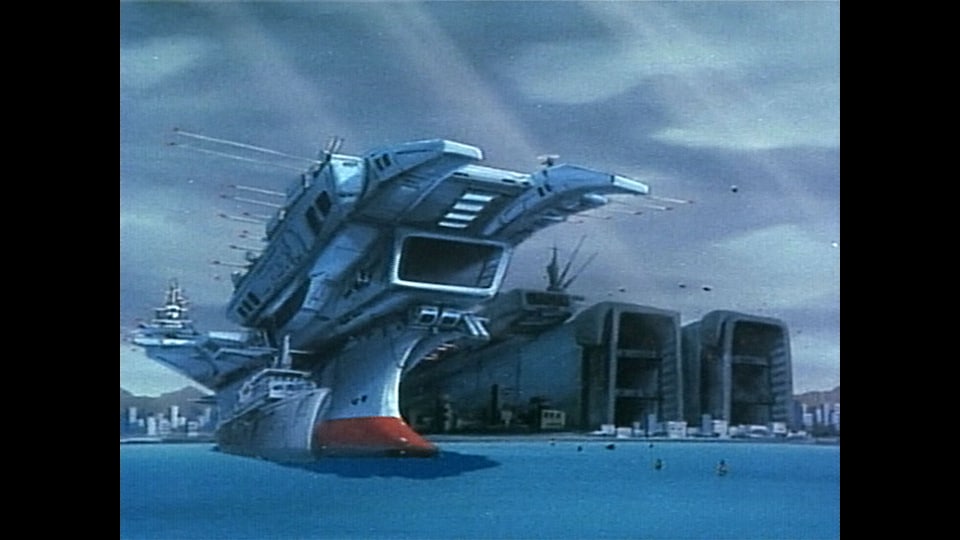
The licensed opening-episode thumbnail below shows the massive spacecraft at a waterfront, with hangar structures, smaller vessels and buildings around it. The setting gives the hull a scale that a blank space background would not. This is the inspected opening reference supplied by Bandai Channel, not a promotional still attributed to an unverified later battle.
Our interpretation treats the surrounding infrastructure as important. The vessel looks like something people have had to work on and build a community around, rather than a machine that appears complete from nowhere. This fits the distributor’s premise of humans repairing a mysterious crashed ship, while the still itself supports only the visible observation about scale, construction and location.
The official promotional visual above emphasizes a transforming fighter’s humanoid form against explosions. Putting these two original images beside the discussion shows two invitations: the excitement of a capable combat machine and the larger, inhabited structure that makes the story’s world feel organized around it. Neither image reveals the television ending or determines the outcome of a later relationship.
Original visual reference
Civilian culture can change what a war story pays attention to
The official Macross introduction places song, mechanical action and a romantic triangle together. Our reading asks how those elements share the audience’s attention. A story that gives a singer and everyday relationships narrative space can make civilian culture matter alongside military objectives, rather than leaving it as decoration between sorties.
That perspective is useful for someone drawn to Macross through the machines but uncertain about the musical material. The question is not whether a song interrupts a battle; it is what the story asks the audience to notice when music enters the same world as organized force. A later scene analysis should identify the performance, listeners and consequences before claiming a specific effect.
The opening ship image supplies a restrained entrance to this idea because an inhabited vessel implies people with lives beyond piloting. It does not prove the role of any particular later concert. The review separates that visible world-building observation from the broader interpretive question, allowing a newcomer to discover the actual answer through the complete route.
Transformation makes machinery adaptable and people less easily sorted
The franchise’s Valkyrie designs connect aircraft and humanoid-machine imagery. The promotional visual shows the humanoid presentation, while the ship reference anchors technology in a physical environment. Our reading asks how a changing machine can encourage a viewer to think about function: a tool’s shape responds to what it needs to do and where it needs to operate.
People are not so easily summarized by one function. A civilian pilot, a performer and military personnel can meet within the same conflict while retaining different priorities. A useful character reading notices the moments when a job description fails to capture a person’s obligations or desires. That gives the mechanical premise a human counterpart without turning every design feature into a forced symbol.
For adaptation comparison, examine how a film condenses that distribution of attention and how a comic chooses page space for it. More spectacle in one presentation does not automatically establish that the other is redundant. A fair comparison names what is gained, what is compressed and how that change affects the viewer’s understanding of a relationship.
A franchise entry is different from a sequel completion checklist
Tatsunoko’s production catalog preserves the original television identity and count. Mikimoto’s publisher listing supplies a separate creator connection for THE FIRST. The official franchise pages then organize later productions under their own titles. These records are more useful for route planning than combining everything with the word Macross into one undifferentiated watch list.
Macross Plus is a later project with a four-installment OVA presentation and a separate Movie Edition. Its guide provides another manageable entrance into a pilot rivalry and music-centered story. It is a later franchise discovery, not a required insertion before completing the original thirty-six episodes.
Flash Back 2012 is described by the official franchise announcement as a music-video presentation combining existing and new material, with a later-story element. Explore it after an original-story presentation if interested in that musical coda. Its different purpose should be named rather than presenting it as an ordinary additional television season or an obligatory prequel.
Macross-versus-related-label confusion needs precise names
The displayed AniList audience score belongs to the original 1982 Japanese television entry. It does not rate the 1984 film, THE FIRST manga or every work associated with internationally familiar reused imagery. The scope label is a practical safeguard for a visitor who encounters several similar search results.
A catalog or community can help identify edition and adaptation questions, but the specific title and production record should come first. Do not assume that a similarly presented international television product has identical episode narration, editing or continuity. This page’s route is explicitly for The Super Dimension Fortress Macross, and it does not certify an equivalence with another brand’s presentation.
The franchise encyclopedia and subreddit can support deeper machinery and music discovery after the first encounter. They may reveal later relationships in a short biography. For an initial viewing, use the official series overview, named provider and episode route, then open the deeper discussions with that spoiler boundary in mind.
A restored film is a new edition of a named presentation
Later restorations and collector products can bring renewed attention to a classic without adding a new story season. When a product advertises Do You Remember Love?, check that film’s contents and specifications rather than assuming it includes the complete television series. A prominent franchise logo alone cannot establish the package’s actual viewing route.
No audited original-title production budget or net-profit account was verified for this guide. Model kits, soundtrack availability and repeated releases show different commercial products, but they cannot be combined into an invented title-level profit figure. A visitor’s useful decision concerns the exact legal edition, region, language and material actually offered.
Complete the television route, compare the film or THE FIRST if their format interests you, and then choose a later franchise guide such as Macross Plus. Mobile Suit Gundam supplies a contrasting civilian-and-military shipboard premise for discovery. That comparison expands the library while keeping the two franchises’ fictional histories separate.
Primary sources and useful navigation
- Macross · original series and official artwork
- Tatsunoko · original television production record
- Bandai Channel · licensed anime and opening imagery
- Macross · dated rollout and distinct film/coda descriptions
- KADOKAWA · Mikimoto’s THE FIRST volume one
- AniList · named anime audience score
Community and catalog routes
- MyAnimeList · named anime catalog
- Macross Wiki · original series, spoilers possible
- Reddit · Macross community
The production and publisher links support project facts. Catalog and community pages are secondary navigation and may reveal later events.
Explore related story guides
Original series imagery is reproduced under permission asserted by the site owner; the source and rights credits are retained. The route diagram is Animeteor’s own explanatory graphic.
Games and live-action adaptations
- Macross Shooting Insight — Japanese PlayStation Edition — Game: Scrolling shooter with story and gallery interfaces