Watch the original 26-episode anime from episode one. Gotsubo’s manga, credited to Manglobe’s original work, is a separate reading presentation beginning at volume one. It is not a verified continuation after the television ending.
Reviewed 3 October 2026 · Opening premise and adaptation relationships. Major endings withheld; linked catalog summaries and discussions may contain spoilers. · Licensed access varies by country.
The source and screen branches

The comic is a related adaptation of the original production, not the anime’s required source or a certified post-finale continuation. Shared creators connect other titles for discovery, not chronology.
- WATCH · main route: Samurai Champloo · episode 1 → Complete television run · 26 episodes
- READ · adaptation: Gotsubo manga · volume 1 → KADOKAWA manga · volume 2
The 26-episode anime is the main starting route
Start Samurai Champloo at television episode one and continue through episode 26. The licensed complete-series product lists that full run. This is an original animated production, not an anime whose ending tells you where to resume a longer source manga. Its search for the samurai associated with sunflowers provides the journey’s organizing question.
Masaru Gotsubo’s manga is a related presentation. KADOKAWA’s two volume records credit him as author and Manglobe as the original-work creator. Begin that manga at volume one if you want the comic version; do not buy volume two expecting a verified continuation after the anime finale. This guide does not certify matching episode and chapter boundaries.
Choose the anime for a finite road story whose swordplay, character friction and music are part of the experience. Choose the manga independently for another treatment of the three travelers. A shared director connects this production with Cowboy Bebop for discovery, but it does not make either series part of the other’s fictional chronology.
Complete-series packaging is different from a new story season
The licensed Blu-ray record identifies episodes 1–26, English and Japanese audio and a Region A disc. Those specifications describe that product. They should not be generalized to every disc sold under the same title, and a Blu-ray package does not promise streaming access in a visitor’s country.
KADOKAWA’s manga listings identify two separately numbered Japanese books. Their author and original-work credits are particularly useful because they prevent a familiar mistake: assuming the presence of a manga means the anime must have adapted it as its original source. Here the publisher explicitly credits Manglobe for the original work.
For a first viewing, retain the complete episode sequence rather than reorganizing it around a list of clues about the destination. The encounters between clues can establish the travelers’ relationship and the production’s rhythm. A later personal rewatch can be selective, but that choice should not be presented as the official narrative’s required route.
| Presentation | Start | What it is not |
|---|---|---|
| Original television anime | Episode 1 → 26 | A chapter shortcut into the comic |
| Gotsubo manga · KADOKAWA | Volume 1 → volume 2 | A verified post-finale sequel |
| Later complete-series edition | Check contents/audio/region | A new narrative season |
The opening fight makes different styles visible in one frame
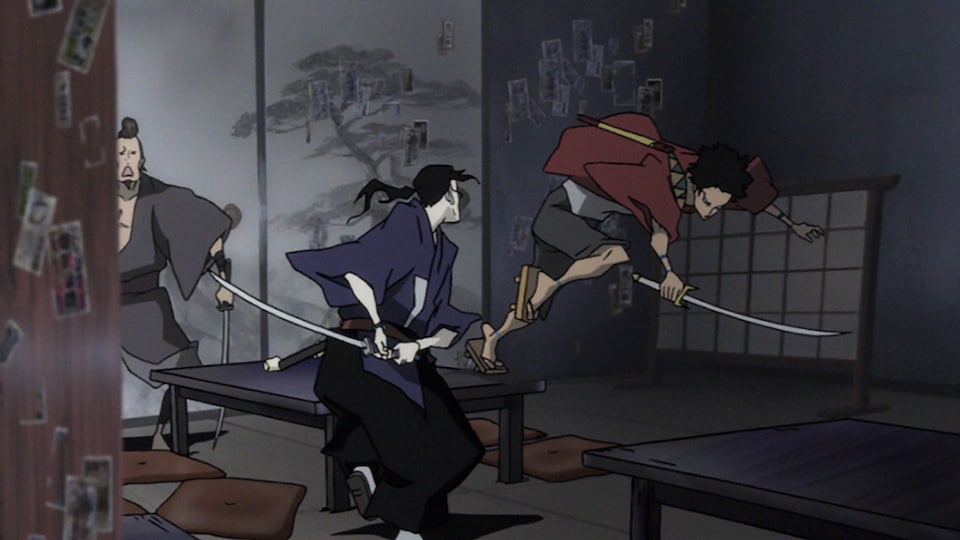
The licensed distributor’s premise brings Fuu, Mugen and Jin together before they share a journey. The episode-one reference image below places Jin in a comparatively grounded stance while Mugen is airborne over the furniture. Their contrasting positions are directly visible in the frame; an entire fight’s choreography cannot be reconstructed from that image alone.
Our interpretation starts with how a shared space accommodates incompatible movement. The seated furniture and enclosed room give the bodies reference points. One figure’s alignment and the other’s extended motion make the contrast readable without an explanatory caption telling the audience who is disciplined and who is improvising.
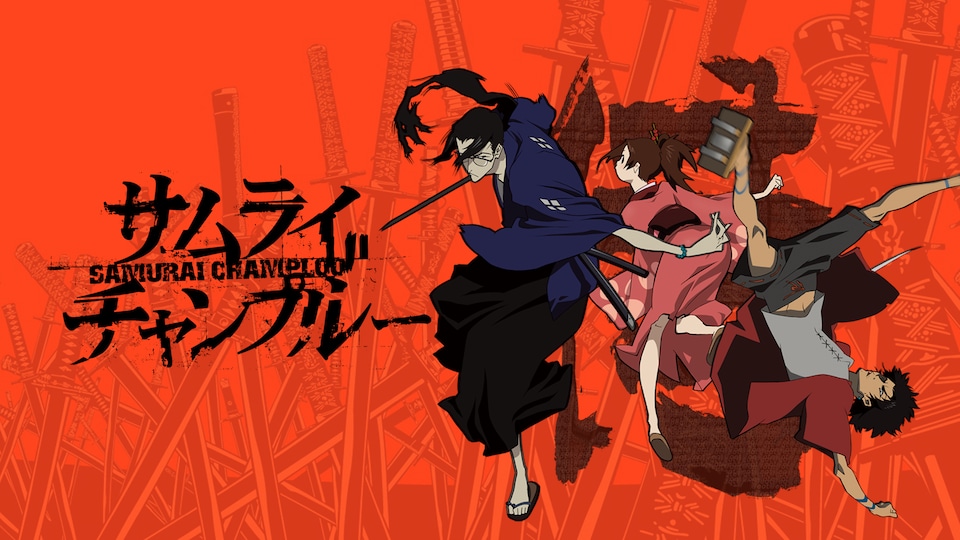
The orange series visual above turns those characters into a more deliberately graphic arrangement. It is promotional artwork, while the lower image is an opening-episode thumbnail. Keeping the distinction clear helps a reader compare the invitation made by the campaign with a concrete screen composition, without mislabeling the poster as a still or revealing the journey’s outcome.
Original visual reference
The historical setting and contemporary rhythm can coexist
Bandai Channel describes the series as a mixture of period drama and modern cultural elements. Our reading treats that mixture as a choice about how the past reaches a contemporary viewer. A musical or stylistic anachronism does not automatically mean a production has forgotten its setting; it can be part of its declared method.
The useful question is how rhythm shapes attention. A movement held briefly, a sudden transition or a pause after an argument can make a sequence feel relaxed, aggressive or playful. These effects should be assessed within the finished episode. A soundtrack’s reputation alone does not prove that every scene uses the same approach or succeeds for the same reason.
That also explains why a manga route cannot reproduce the animated experience simply by retaining the cast. A reader supplies the duration between panels, while animation fixes movement and sound in time. Both can be valuable, but the comparison needs to account for their tools rather than reducing the difference to which version includes more plot information.
A destination can organize a journey without consuming it
Fuu’s search gives the travelers a reason to keep moving. Our interpretation asks what the journey adds beyond the answer being sought. Meeting someone, finding food or surviving a disagreement can change the meaning of arriving, even when an encounter does not produce an immediately usable clue.
This is a helpful lens for viewers accustomed to a mystery structured around regular revelations. A road narrative may distribute its interest differently: the route allows people to discover what they will tolerate, how they respond to strangers and whether an agreement lasts when convenience disappears. Those changes deserve attention alongside the destination.
A first viewer should therefore avoid a summary that reduces the series to only its search-related episodes. Such a route may reveal the answer while removing the experience that made the answer matter. The guide recommends the complete run and keeps the ending out of its introductory analysis; the linked community may not maintain the same spoiler boundary.
Three travelers do not need one shared understanding of their bargain
A group can travel together for a practical reason before it has become a stable friendship. Our reading of the advertised trio begins with that distinction. Fuu’s purpose, Mugen’s responsiveness to a situation and Jin’s more controlled presentation create questions about how an agreement works when the people involved do not behave alike.
Notice who speaks for the group and who acts without consulting it. An argument can reveal a boundary, but an apparent compromise may last only until the next obstacle. The smaller decisions are particularly useful: staying, returning or making room for somebody else can communicate a relationship more precisely than a broad declaration of loyalty.
The first-episode image supplies an early contrast in bodily presentation, not a complete personality diagnosis. A disciplined pose does not certify moral superiority, and energetic movement does not prove that a person has no thought behind an action. Let later choices complicate the introductory impression rather than treating the promotional cast description as the last word.
Watanabe and the music credits explain a creative connection
The licensed Japanese listing credits director Shinichiro Watanabe and original creator Manglobe. It names Tsutchie, fat jon, Nujabes and FORCE OF NATURE in the music credits. Those names identify contributing roles; they do not mean that one musician made every piece or that every title sharing a contributor belongs in the viewing route.
The external audience score is AniList’s named 26-episode television entry, checked on 3 October 2026 and displayed on a ten-point scale. It is not a manga rating or Animeteor’s own score. A collector’s opinion about a particular Blu-ray transfer is also a different question from an audience assessment of the series.
The linked Reddit discussion asks whether material exists beyond the anime. It is a useful doorway into a reader’s actual next-step question, but the manga relationship here rests on KADOKAWA’s credits. Individual comments should not be treated as an announced sequel. Bandai Channel additionally hosts viewer responses; those opinions remain separate from its production and staff information.
A catalog title can have several later editions without a sequel
The complete-series Blu-ray listing documents a specific licensed product with a dated release and named specifications. Later packaging may make the same animated run available to another audience. A different cover, restoration claim or collector label should be checked as an edition change rather than automatically reported as new story material.
No audited production budget or title-level profit account was verified for this guide. Retail price, collector enthusiasm and audience score cannot be added together to calculate profitability. The meaningful practical comparison for a viewer is contents, language, region and the quality information actually supplied for the specific release being considered.
After the complete anime, begin the two-volume comic independently if it interests you. Cowboy Bebop is a useful next discovery through Watanabe’s direction and another traveling ensemble; Rurouni Kenshin supplies a different relationship between period setting and a long-running manga source. These links offer a comparison of approaches, not additional installments of Fuu, Mugen and Jin’s route.
Primary sources and useful navigation
- Crunchyroll licensed product · 26 episodes, audio and disc region
- Bandai Channel · original animation, premise, staff and official imagery
- KADOKAWA · manga volume one, Gotsubo and Manglobe credits
- KADOKAWA · manga volume two
- AniList · named anime audience score
Community and catalog routes
- MyAnimeList · named anime catalog
- Wikipedia · secondary production navigation
- Reddit · question about additional material after the anime
The production and publisher links support project facts. Catalog and community pages are secondary navigation and may reveal later events.
Explore related story guides
- Cowboy Bebop · another Watanabe-directed journey
- Rurouni Kenshin · another period setting, different adaptation routes
Original series imagery is reproduced under permission asserted by the site owner; the source and rights credits are retained. The route diagram is Animeteor’s own explanatory graphic.
Games and live-action adaptations
- Samurai Champloo: Sidetracked — Game: Hip-hop samurai action-adventure · 2006
An original story for PlayStation 2
Grasshopper’s Sidetracked catalog identifies a separate PlayStation 2 action-adventure with an original Hokkaido story. Its listed releases are 23 February 2006 in Japan and 12 April 2006 in North America. Musical tracks alter attack combinations. This optional game is outside the television and manga routes.