Watch the original 167-episode series, then the 26-episode Final Act. Read Takahashi’s manga from the beginning in your selected edition; the four films are an optional branch.
Reviewed 2 October 2026 · Opening premise and format relationships; major ending revelations withheld. Linked publisher summaries and discussions may reveal later events. · Licensed access varies by country.

The source and screen branches

The Final Act continues the main screen route. Films are optional; no exact insertion points are asserted. Collection volume numbers depend on edition.
- READ · source manga: Named manga edition · volume one → VIZBIG · final collection 18
- WATCH · main television: Original TV · 167 episodes → The Final Act · 26 episodes
- WATCH · optional films: Four theatrical works · Release-order exploration
- WATCH · related title: Yashahime · separately cataloged · Not the original TV entry
The television route continues through The Final Act
Begin Inuyasha with the original television series, then continue to Inuyasha: The Final Act. Sunrise records 167 episodes for the first production and twenty-six for the concluding series. The second title is the continuation to select when a streaming menu makes the original run appear to end the entire adventure.
For the source route, begin Rumiko Takahashi’s manga in a named edition. VIZ’s VIZBIG line groups the material differently from single-volume books. A VIZBIG number cannot be used as though it were the same number in every original-volume edition, and this guide does not invent a universal chapter handoff after episode 167.
Four theatrical films are associated screen works. The core television route does not depend on inserting them at an asserted exact episode boundary. Explore them after you know the central group, using release order for a simple optional route. Yashahime is separately identified related material rather than part of the original 167-episode production.
A collected volume count is not the source’s chapter count
VIZ identifies its eighteenth VIZBIG volume as the concluding collection. That tells a reader where that particular English format ends; it does not mean Takahashi wrote an eighteen-volume original series. When comparing a library copy or shop listing, match the format as well as the title.
The original television production ran from 2000 to 2004, while The Final Act began in 2009. The gap is a production interval, not an instruction to place unrelated film stories between the two series to repair the plot. Their titles and studio records already identify the practical screen sequence.
A source-first reading is the most dependable option for someone interested in development across the manga. A selective jump is possible only after matching actual scenes and edition pages. Until that work is demonstrated, a broad recommendation to start the manga is more accurate than a confident but unverified numerical continuation.
The well makes two kinds of everyday life collide
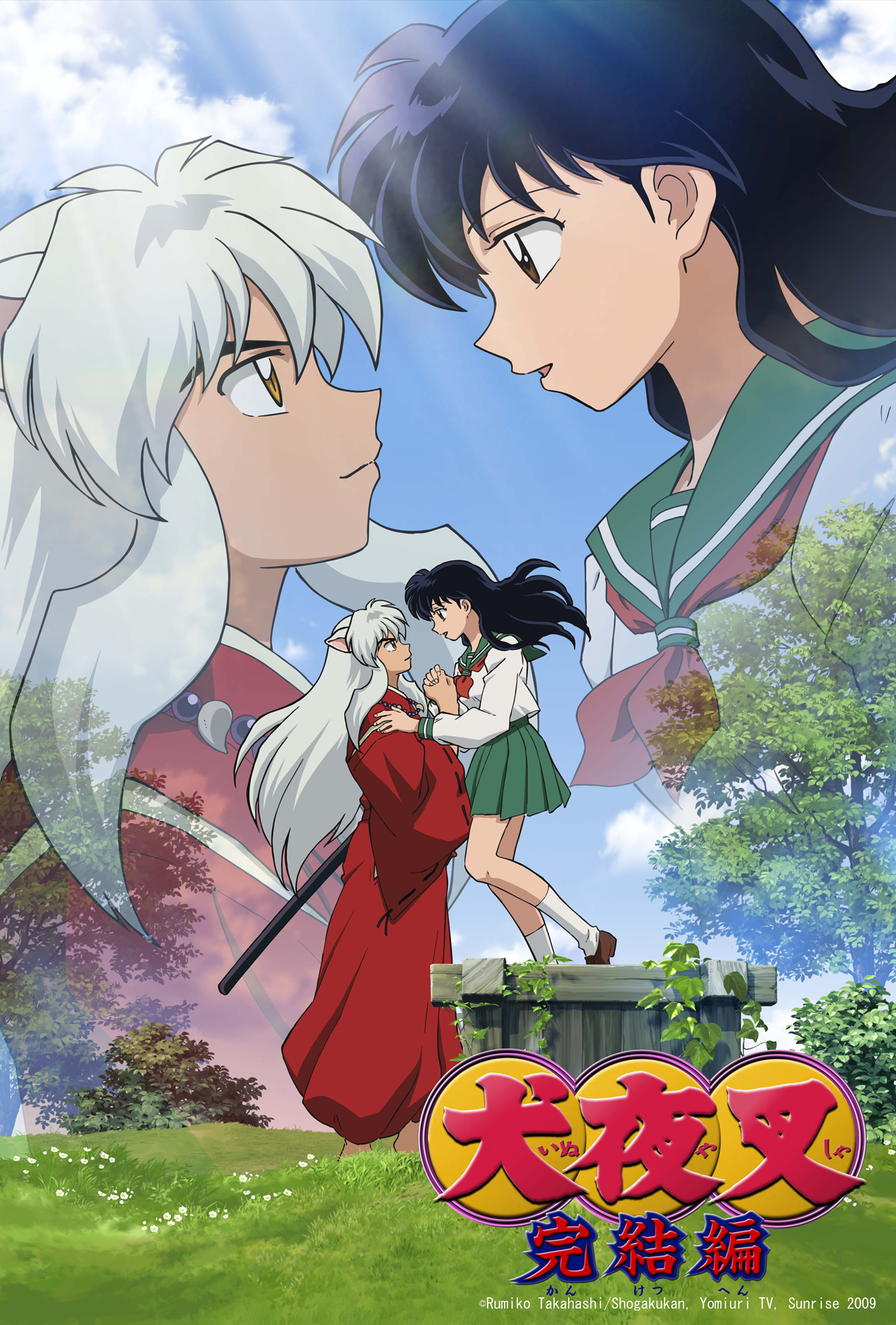
VIZ’s opening description places Kagome’s ordinary life beside a passage into another historical world. The publisher’s original artwork shows Kagome with Inuyasha; the companion image is Sunrise’s named Final Act poster. These are visual references for the property, not mislabeled screenshots of the well encounter.
Our reading of the opening displacement asks what knowledge a visitor carries into a world where it may not be useful. Familiar habits and expectations do not disappear when the setting changes. They can make an encounter comic, but they also expose differences in what each character takes for granted.
The images introduce the central pairing and a later screen production without revealing how the search ends. A visual comparison can examine the presentation of their relationship; it cannot establish a precise manga panel match. The case therefore stays with the opening situation and keeps the final resolution outside this introduction.
Original visual reference
A fragmented goal creates repeated encounters with different desires
The shattered jewel gives the adventure a practical form: progress depends on finding pieces rather than reaching one destination. Our interpretation asks how a recurring objective changes meaning in different hands. An object desired for power can also become a focus for fear, grief or a hope that somebody might recover what was lost.
That structure makes an episode’s local conflict worth examining even when the larger quest continues. What does this person expect a fragment to solve? Does obtaining it address the actual problem, or make that problem harder to face? Those questions distinguish recurring story machinery from an identical emotional situation repeated each time.
A scene-specific review should test that interpretation against what the person says and does. The studio’s premise verifies the fragment search, but it does not certify every proposed symbolic reading. Avoid revealing later explanations of the jewel merely to make an introductory thematic claim seem more complete.
Half-demon identity makes belonging a negotiation
Sunrise’s opening record identifies Inuyasha as born between human and demon categories. Our interpretation asks who benefits from making those categories rigid. Being classified by others can turn an ordinary request for trust into a demand that a person prove what kind of being they are.
A relationship can interrupt that demand without erasing the danger attached to it. Someone may trust an action before understanding a lineage, or defend a person while still disagreeing with them. Watch how trust is built through particular choices instead of assuming that every friendly encounter permanently solves exclusion.
This is a way to analyze the premise rather than a claim that the whole series has one uncomplicated message about identity. Rivalries, loyalties and personal history change the stakes. The source route can be useful for following their development, while a comparison should identify the specific screen sequence being discussed.
Returning home does not automatically restore an earlier life
Kagome’s connection between worlds creates an additional kind of responsibility. Our reading asks what happens when a person remains accountable to two settings whose demands cannot be satisfied simultaneously. Absence from one place may have consequences even if the decision to leave was reasonable elsewhere.
That tension makes ordinary obligations useful dramatic material. A promise, a school routine or an expectation at home can acquire weight because another world interrupts it. The question is not simply whether the adventure is more exciting; it is how repeated departures change the person who must keep explaining them.
The film branch and television route should remain distinguishable when examining that rhythm. An optional movie can emphasize a self-contained crisis, while serial television has more space for repeated returns. This framework does not claim an exact episode placement for every film or describe how Kagome’s final choice is resolved.
Use the first-series score for the first series only
Takahashi is the source manga creator, while Sunrise supplies distinct production records for the original television series and The Final Act. The latter record identifies Yasunao Aoki as director. A final-season credit should not silently replace every staff role across the earlier production.
The displayed AniList score is specifically for the original 2000 television entry, observed on 2 October 2026. It is not a combined rating for 193 episodes, all four films and Yashahime. A future reception comparison would need separately matched entries rather than spreading one number across the franchise.
The linked Reddit discussion considers the concluding adaptation and source reading. Responses may contain spoilers and reflect personal preferences about pacing. They are useful conversation routes, not proof of a chapter boundary. VIZ and Sunrise support the factual route; MyAnimeList and the fan wiki provide secondary navigation.
Theatrical products and collected books do not reveal net earnings
The publisher’s collected editions and the studio’s film catalog show the property offered through multiple products. Each has a particular release and territory. Adding them together without sales figures, costs and licensing terms would not yield a defensible estimate of the franchise’s profitability.
No audited title-level net profit or complete production budget was verified here. The existence of a catalog page also does not guarantee current streaming rights or local book stock. Follow the named official product and confirm the language and region rather than assuming that any familiar cover is the edition this guide describes.
For the clearest first route, watch the original television series and then The Final Act, or read the manga from its beginning. Explore the four films separately and treat Yashahime as another related screen entry. Further precise coverage notes can be added later after edition-level comparison without changing the verified basic sequence.
Primary sources and useful navigation
- VIZ · source manga and VIZBIG editions
- Sunrise · original television episode record
- Sunrise · The Final Act and related film titles
- AniList · named adaptation audience score
Community and catalog routes
- MyAnimeList · named adaptation catalog
- Reddit · source reading and concluding-series discussion
- Inuyasha Wiki · secondary franchise navigation
The production and publisher links support project facts. Catalog and community pages are secondary navigation and may reveal later events.
Explore related story guides
- Fushigi Yugi · a girl’s passage into another world
- The Vision of Escaflowne · another displaced viewpoint
Original series imagery is reproduced under permission asserted by the site owner; the source and rights credits are retained. The route diagram is Animeteor’s own explanatory graphic.
A documented historical PlayStation fighting-game branch
Dimps’ archived official product page identifies the Japanese PlayStation game Inuyasha: Sengoku Otogi Gassen, published by Bandai, as one-to-two-player fighting action. It describes two-on-two tag battles and team attacks. This optional historical game is distinct from the PlayStation 2 products and remains outside the television and manga order. The archive does not provide a precise release day or establish current availability.