Read the twenty-volume manga or watch the 2010, 2011 and 2012 TV productions sequentially. The box set collects the same source run. PCP is optional related prose based on an in-story work, not a continuation of the main creators’ story.
Reviewed 2 October 2026 · Opening premise and format relationships; major ending revelations withheld. Linked publisher summaries and discussions may reveal later events. · Licensed access varies by country.
The source and screen branches

The manga and TV productions form the principal story routes. The box set is a collection, and the PCP book expands a work created inside the story. Live action is excluded from this map.
- READ · main source: Manga · volumes 1–20 → OR complete box set · same source run
- WATCH · sequential adaptation: TV 1 · 2010 → TV 2 · 2011 → TV 3 · 2012
- READ · related in-story fiction: PCP novel · Haru Hatsuno → Optional Japanese book · not main-story sequel
Twenty source volumes or three sequential television productions
Read Bakuman. from manga volume 1 through its twenty-volume source run, or begin the 2010 television production and continue the second and third productions in order. J.C.STAFF’s official work chronology identifies those screen projects in 2010, 2011 and 2012. They belong to one advancing adaptation route, rather than three alternative versions of the opening.
The manga credits Tsugumi Ohba for story and Takeshi Obata for art. VIZ offers individual volumes and a complete box set explicitly collecting volumes 1–20. The box is another purchasing presentation of that run, not an additional narrative installment to read after volume 20.
The related Japanese PCP prose book adapts a fictional work created inside Bakuman., rather than narrating the next stage of the manga-making duo’s main story. Keep that relationship visible. The live-action adaptation likewise belongs in separate adaptation coverage and is excluded from the manga–anime–novel route used for the principal story.
| Item | Relationship | Recommended use |
|---|---|---|
| Original manga | Volumes 1–20 | Read sequentially from volume 1 |
| Complete box set | Alternative collection of volumes 1–20 | Not a sequel |
| TV productions | 2010 → 2011 → 2012 | Watch sequentially |
| PCP prose book | Real publication of an in-story work | Optional related fiction, not main-story continuation |
| Live action | Separate screen adaptation | Excluded from this roadmap |
The final English book and chapter catalog define the source range
VIZ’s final-volume record gives 6 August 2013 for English volume 20, with 176 pages and ISBN 9781421553702. The source catalog’s twenty-volume run and the box set’s explicit collection scope support the source endpoint. A reader should not confuse that book’s page count with the series’ numbered chapter count.
The official Shonen Jump chapter catalog separately lists the source’s numbered chapters through 176. Its availability depends on the service and region, and an index link is not a promise that every chapter is currently free. Use the licensed publisher route for reading access rather than treating a community upload as an equivalent edition.
No exact intermediate TV-to-source chapter handoff is certified in this guide. After the first or second screen production, the next named television production is a clear continuation choice. Readers moving to the source can begin volume 1 for its original arrangement; a later comparison may document a precise transition only after checking the licensed installments.
PCP is a published story within the story
Shueisha’s JUMP j BOOKS product record identifies PCP: Kotou no Kodomotachi as a 2 October 2015 publication, ISBN 9784087033823. It credits Haru Hatsuno as prose author and uses Ashirogi Muto, the fictional creative identity inside Bakuman., for its original-work credit. The publisher explicitly describes it as a novelization of the work within the manga.
That unusual relationship deserves more precision than a generic novel badge. The book is real, but its principal subject is the fictional PCP project, not simply a prose rendering of every event in Bakuman. A reader looking for the duo’s next main-story chapter would therefore be choosing a different question from the one this publication answers.
The inspected record is a Japanese publication and does not establish an English translation. Its release date is historical, not an upcoming anniversary notice. The main manga and TV route remains readable without it; interested readers can approach the book as optional related fiction once they recognize the in-story work and accept its language and spoiler scope.
A first-volume drawing desk makes the practical activity visible
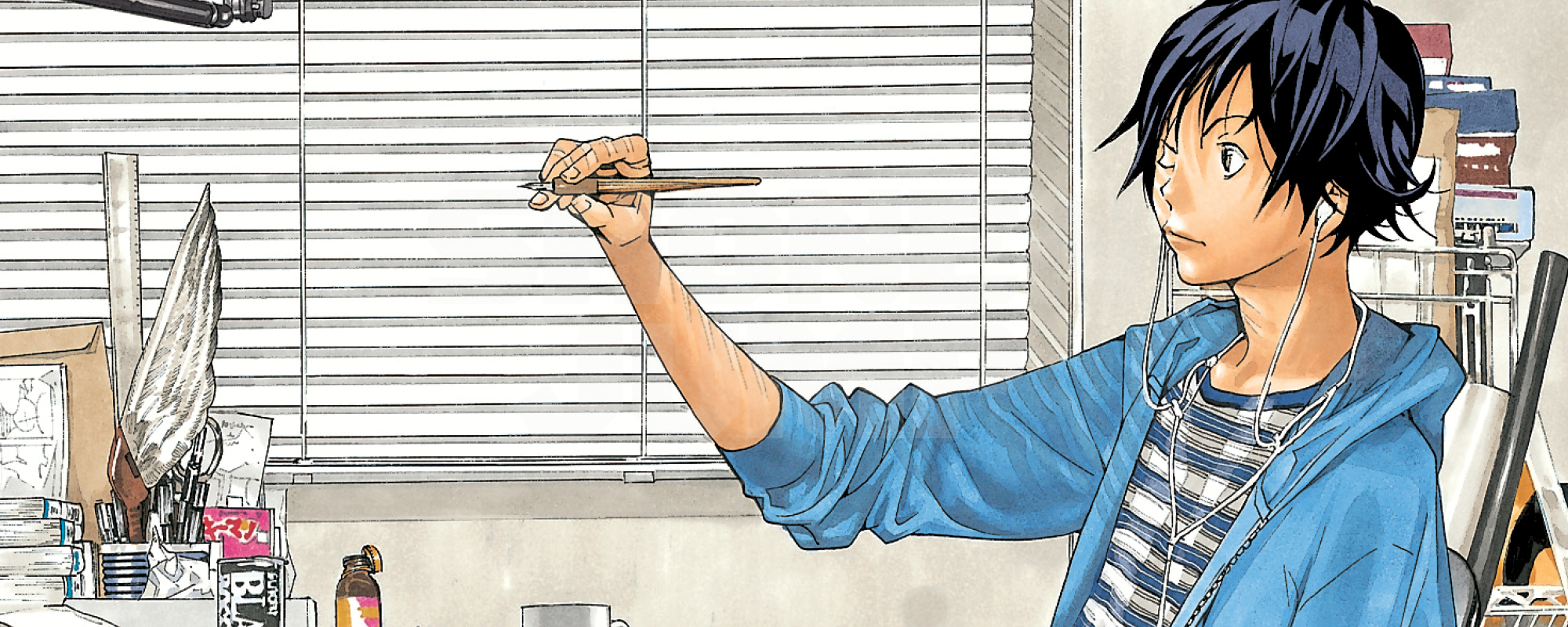
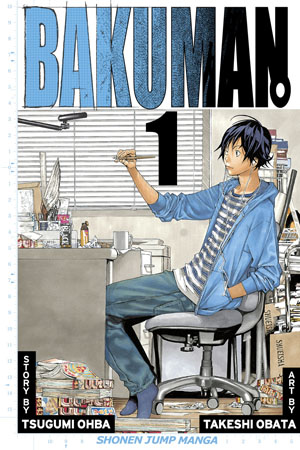
The official English first-volume cover shows a seated young man beside a desk, holding a drawing implement, with books, supplies and a window behind him. The complete title, volume number and separate story/art credits remain visible. It is source-cover artwork, not a frame from the first television episode.
The official distributor’s opening premise describes Mashiro’s drawing interest and Takagi’s proposal that they become a manga-making pair. The image demonstrates a workspace and a person associated with drawing; it does not prove how many hours a real creator works, identify every tool’s use or show the outcome of the duo’s first submission.
Our interpretation is that the cover places an aspiration in a material setting. A creative career begins to look like an activity with a chair, supplies and accumulated books rather than only an abstract dream. That is a useful entry into the analysis: the work can admire ambition while still asking what somebody actually has to do to turn it into pages.
Original visual reference
A shared pen name does not remove the division of creative work
The opening proposal gives one partner writing ambitions and the other drawing ability. Our reading is that collaboration creates a joint project while preserving different tasks inside it. The partners need a shared direction, yet their daily decisions and the kinds of uncertainty they face are not automatically identical.
A useful close analysis asks how an idea becomes a page that another person can use. A writer’s intention must become something drawable, and an artist’s visual choices can change how the intention is understood. Treating either contribution as merely mechanical would miss the feedback loop that makes the partnership creative.
This also invites a comparison with the actual source credits, while keeping fiction and real production separate. Ohba’s story credit and Obata’s art credit identify real contributors. They do not certify that the fictional duo’s conversations reproduce those creators’ private working process. A guide can notice the structural resemblance without inventing behind-the-scenes biography.
An editor and an audience introduce standards beyond personal enthusiasm
Manga publishing gives the creative goal an institutional setting. Our analysis distinguishes wanting a work to exist from finding a place where it can reach readers repeatedly. Submission, editorial judgment and audience response can each ask for a different kind of decision, even when the makers remain committed to their original ambition.
That makes feedback an interpretive problem. A disappointing response may concern communication, fit, execution or a mismatch between the makers’ aims and the audience being addressed. A good reading should identify which problem is actually being discussed rather than make every setback proof that the work has no artistic value.
The competitive setting can also make peers both rivals and sources of understanding. Someone pursuing the same opportunity may recognize a difficulty outsiders cannot see, while still benefiting from a different result. This tension is central to evaluating a career-focused story: competition need not erase respect, and respect need not erase the consequences of competition.
The television credits have their own creative roles
J.C.STAFF’s production chronology names Kenichi Kasai and Noriaki Akitaya as directors, Reiko Yoshida for scripts and composition, and Tomoyuki Shitaya for character design across the listed Bakuman. productions. Ohba and Obata retain the original-source credit. These functions describe the adaptation team rather than a transfer of source authorship to the studio.
The same source creators are associated with Death Note in the official distributor’s introduction. That is a creator connection, not evidence of a shared fictional universe or a prerequisite watch. A reader comparing the properties can investigate how different premises use their collaboration without forcing characters or chronology together.
The linked Bakuman community and Wiki can support interpretation and installment navigation, with ending spoilers possible. They are not the primary proof for the box set’s contents or PCP’s authorship. The AniList rating belongs only to the 2010 twenty-five-episode first television entry, not all three productions, source books, box set or related novel.
A story about rankings is not a disclosure of its own profit
Bakuman. makes publication and audience response part of its fictional subject, while its real products include the source books, box set, television presentations and related PCP prose publication. Those documented products establish distribution choices. They do not provide audited earnings for the source creators, animation production or English publisher.
No verified title-level production budget or net-profit calculation was found for this guide. Fictional readership rankings cannot substitute for real circulation reporting, and a catalog retail price cannot be multiplied by an assumed readership to produce earnings. Any future commercial figure should identify the actual reporter, period, territory and gross-versus-profit definition.
Choose the first manga volume for the original partnership story or the first TV production for the screen route. Continue sequentially, and explore PCP as optional fiction with a clearly different subject. Future updates can add verified editions and adaptation notices while preserving the completed source range and avoiding an invented chapter shortcut.
Primary sources and useful navigation
- VIZ · original source
- VIZ · first manga volume and original cover
- VIZ · all twenty volumes
- VIZ · final English volume
- VIZ · official source chapter catalog
- VIZ · box-set scope
- J.C.STAFF · three productions and credits
- Shueisha · related PCP prose book
- Official distributor · opening premise and creator relationship
- AniList · named adaptation audience score
Community and catalog routes
- MyAnimeList · named adaptation catalog
- Reddit · Bakuman discussion; spoilers possible
- Bakuman Wiki · secondary episode and source navigation
The production and publisher links support project facts. Catalog and community pages are secondary navigation and may reveal later events.
Find this work in our thematic collections
Original series imagery is reproduced under permission asserted by the site owner; the source and rights credits are retained. The route diagram is Animeteor’s own explanatory graphic.
Games and live-action adaptations
- Bakuman — Live action: Film · 2015
- Bakuman. Mangaka e no Michi — Game: Manga-making adventure · single player
A separate manga-making game
The linked Mangaka e no Michi guide identifies Bandai Namco Games’ Japanese Nintendo DS release on 15 December 2011. The official archive describes first-season anime material plus original scenarios and manga-making activities; it does not certify an adaptation of all twenty manga volumes. The existing 2015 live-action film remains separate.