Read Tsubasa Yamaguchi’s manga from volume 1 or watch the twelve-episode 2021 animated series. The English catalog lists seventeen available volumes at review; no exact post-anime chapter handoff is certified. Live action remains a separate adaptation branch.
Reviewed 2 October 2026 · Opening premise and format relationships; major ending revelations withheld. Linked publisher summaries and discussions may reveal later events. · Licensed access varies by country.

The source and screen branches

The source-reading and animated routes share the opening premise but not interchangeable installment numbering. This map excludes live-action and any unverified sequel announcement.
- READ · original source: Manga · volume 1 → Continue in the named publisher edition
- WATCH · animated introduction: 2021 animated series → Twelve episodes · distinct from full source
- COMPARE · opening development: Source pages / screen scenes → Exact handoff not certified
Choose the manga for the continuing source or the 2021 animated introduction
Begin Blue Period with Tsubasa Yamaguchi’s manga volume 1 or the 2021 twelve-episode animated series. The manga is the original reading route, while the screen production provides a performed introduction to Yatora’s encounter with art. Neither route requires a prose novel or a webtoon edition to understand the premise.
The current English Kodansha catalog inspected for this review lists seventeen available volumes. That establishes a published reading range in that catalog, not a promise that every Japanese chapter is collected in English or that volume 17 is a final conclusion. Use the exact publisher edition when comparing a numbered book with somebody else’s chapter recommendation.
The animated entry is cataloged by AniList as ONA, reflecting an online presentation, while the official Japanese project also documents television broadcasting. Here it is called the 2021 animated series rather than using a platform label to imply a different story. Live-action adaptations are separate discovery items and are excluded from the anime–manga–novel route.
| Format | Starting point | Scope |
|---|---|---|
| Manga | Kodansha · volume 1 | Original source and continuing reading route |
| Animated series | 2021 · episodes 1–12 | A screen adaptation of the opening development |
| English editions | Check the named volume product | Available volumes do not certify a final ending |
| Live action | Separate adaptation coverage | Not a required part of this reading map |
Number the source by the edition you actually read
The source catalog credits Tsubasa Yamaguchi and identifies Blue Period as manga. Digital and physical formats can serve the same source-reading route, but their product records and regional availability still matter. A store’s latest stocked paperback is not necessarily the same thing as the publisher’s latest listed digital volume.
An exact post-anime chapter handoff is not certified here. Establishing one requires comparing the licensed screen ending with the named collected edition, including any restructuring of early material. A remembered chapter number from a community discussion cannot demonstrate that every preceding passage was retained in the adaptation.
For readers who want continuity with the author’s presentation, beginning at manga volume 1 is the defensible route. It also allows a comparison of pacing, page composition and interior narration from the opening. That recommendation does not claim the animation is incomplete as a viewing experience; it describes which edition supplies the original arrangement of the source.
Episode one separates a socially successful appearance from inner emptiness
The official opening synopsis describes Yatora as an academically successful high-school student who spends evenings with friends in Shibuya while feeling an emptiness in that routine. An encounter with a painting in the art room gives him a new way to express what he sees. Those are the bounded opening facts used in this case check.
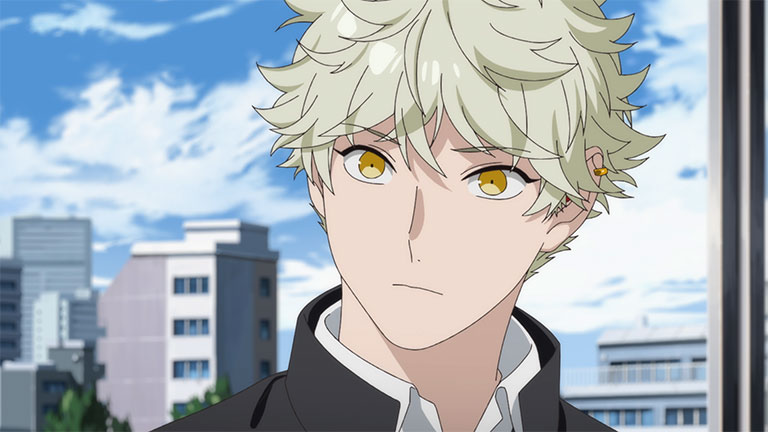
The selected official episode-one image shows the fair-haired Yatora in a dark shirt, with city buildings and a blue sky behind him. It does not depict the painting itself or prove how another person judges his drawing. The frame supplies a character and urban setting; the primary synopsis supplies the change in his relationship to making art.
Our interpretation is that external competence and internal direction are deliberately different questions. Doing well at school and moving comfortably among peers can coexist with uncertainty about what feels personally meaningful. The opening invites a reader to watch what happens when an activity becomes important before the protagonist has learned how to perform it confidently.
Original visual reference
Interest gives a reason to practice, not an exemption from practice
Our analysis treats the discovery of art as the beginning of a learning problem. Finding a subject compelling does not automatically produce control over materials, observation or composition. The important shift is that difficulty now has a reason attached to it: the student wants to make something that ordinary social fluency did not allow him to say.
That distinction prevents talent from becoming a convenient explanation for every result. A close reading can ask how a student responds when effort produces visible shortcomings, or when another person’s apparently effortless work hides years of training. Those questions make practice an encounter with limits, not a montage that exists only to guarantee a later victory.
For the making-art collection, compare this with the division of creative labor in Keep Your Hands Off Eizouken! and the production ambition in Bakuman. Blue Period’s distinctive question is what it means to become a learner when one already knows how to look successful in other settings. Its art matters as an activity and as a different standard of self-understanding.
An artistic voice can be personal while an examination remains comparative
Art-school admission introduces an institutional evaluation alongside individual expression. Our reading is that these pressures can pull in different directions: a work may feel honest to its maker, yet still fail to communicate the intended effect to an assessor. Neither experience automatically invalidates the other.
A useful analysis should distinguish feedback about an observable choice from a verdict about a person’s worth. Composition, material handling and how the viewer’s eye moves can be discussed concretely. If every criticism is treated as proof that the student should abandon art, the reader loses the difference between revising a work and rejecting an identity.
The same distinction applies to praise. A favorable result can support confidence without answering what the artist wants to attempt next. Look for how the story lets institutional goals organize time and effort while leaving personal questions unresolved. The point is not to dismiss examinations, but to recognize that admission and an enduring artistic practice are different achievements.
The manga page and the screen give color different responsibilities
The property’s title makes color an especially useful comparative question. A printed comic can evoke a color through dialogue, value, texture or a reader’s knowledge of the object. An animated production can show a specific hue directly, while also deciding how movement, sound and duration guide attention toward it.
Our adaptation method is to compare the effect of those choices rather than assume that adding visible color makes a scene automatically more faithful. A held shot may emphasize looking; a sequence of panels may allow a reader to pause or move back. Each medium controls attention differently, and a compelling comparison should identify the actual passage and frame being discussed.
This guide’s opening-image case does not provide that complete licensed comparison. It supplies a truthful visual reference and a bounded synopsis analysis. A later focused essay can inspect a named drawing scene in both editions, retaining its specific page and episode context instead of using a promotional key visual as proof of adaptation detail.
Yamaguchi’s source and the screen team are distinct creative contributions
The official staff record names Tsubasa Yamaguchi as original creator, Koji Masunari as chief director, Katsuya Asano as director and Reiko Yoshida for series composition and scripts. Seven Arcs is credited with animation production. The work’s screen identity emerges from these functions in combination, rather than from transferring the manga creator’s credit to every production decision.
The linked Blue Period community is useful for discussing learning, favorite artistic moments and edition questions. Community comments can also reveal later manga developments, so a first-time viewer should approach them with that spoiler scope in mind. No individual post is represented here as a consensus finding about how all artists or all readers respond.
The AniList audience score is matched to the twelve-episode 2021 animated entry and normalized from its 100-point scale to ten. It is not a score for the manga, every collected volume or the separate live-action presentation. The inspected English catalog and episode record support those formats independently of how viewers rate them.
An available catalog measures editions, not net earnings
Kodansha’s listed volumes demonstrate an English publication route, while the official animation pages document the screen project. Those are concrete products readers can identify. Their existence does not establish title-level sales, the animation budget or how revenue is shared among rights holders, retailers and production partners.
No audited profit or complete production-cost figure was verified for this guide. Ranking an audience score or counting available volumes would not produce one. A future commercial section should name the reporting source and period, distinguish units from currency and specify whether a monetary figure is retail value, gross receipts or net profit.
Choose volume 1 for the continuing source or episode 1 for the animated introduction. Keep the manga edition explicit when following later reading advice, and use the official publisher for new-volume availability. Future source or adaptation updates can be added to the existing Work page without inventing an unverified chapter shortcut or a second animated season.
Primary sources and useful navigation
- Kodansha · source and current English catalog
- Kodansha · volume 17
- Official animated production
- Official opening synopsis and episode-one images
- Official staff and cast
- Official broadcast information
- Official characters
- AniList · named adaptation audience score
Community and catalog routes
- MyAnimeList · named adaptation catalog
- Reddit · Blue Period community; manga spoilers possible
- Wikipedia · secondary edition and adaptation navigation
The production and publisher links support project facts. Catalog and community pages are secondary navigation and may reveal later events.
Find this work in our thematic collections
Original series imagery is reproduced under permission asserted by the site owner; the source and rights credits are retained. The route diagram is Animeteor’s own explanatory graphic.
Games and live-action adaptations
- Blue Period — Live action: Film · 2024
Production and edition updates
Blue Period Volume 19 — Japan, 22 May 2026
Kodansha’s Japanese Blue Period catalog identifies Volume 19 as the latest numbered volume and gives 22 May 2026 as its publication date. This Japanese edition must be distinguished from the separately licensed English volumes. A publication listing does not announce a manga conclusion or a second anime season.
See the separate production record →
Blue Period Volume 18 — English, 1 December 2026
The publisher’s distributor lists the English paperback of Blue Period Volume 18, ISBN 9798888779811, for 1 December 2026, with 192 pages. It is a preorder/future English edition at the October review; the date is not transferred to Japanese Volume 19 or to a new animation production.
See the separate production record →
Blue Period The Stage — Tokyo, March–April 2022
Nelke’s official production archive identifies Blue Period The Stage at Tokyo’s Tennozu Galaxy Theatre from 25 March to 3 April 2022. These are historical performance dates; later disc and stream notices require their own edition/window checks.