Watch the 2022 anime in episodes 1–13, or read Kouko Shirakawa’s complete source novels in volumes 1–7. Japanese and English final books have different release dates. No verified full manga series or exact post-anime novel handoff is inserted.
Reviewed 2 October 2026 · Opening premise and format relationships; major ending revelations withheld. Linked publisher summaries and discussions may reveal later events. · Licensed access varies by country.
The source and screen branches

Parallel format routes, not exact book coverage. The final English paperback is cataloged 22 October 2024; the source finale appeared in Japanese in April 2022.
- READ · complete source prose: Novel volume 1 → Continue through final volume 7
- WATCH · 2022 television: Episode 1 · The Jade Earring, Part One → Continue through episode 13
A complete prose route and a thirteen-episode screen introduction
Raven of the Inner Palace comes from Kouko Shirakawa’s novels, illustrated by Ayuko. The anime’s mysterious consort is called Jusetsu in the Seven Seas prose presentation; romanizations in subtitles and community pages may use Shouxue. Check the version’s naming before assuming two listings identify different heroines.
The direct screen route is the thirteen numbered 2022 TV episodes. For the full source route, begin novel volume 1 and continue through volume 7. Shueisha identifies the seventh Japanese book as the conclusion, while the English distributor explicitly describes the seventh English book as the finale.
A palace setting, a supernatural mystery and an illustrated novel cover do not establish a manga source. The primary records inspected here support prose and television; we do not add an unverified manga lane to make the map symmetrical. A brief promotional comic or sample, if encountered, also would not automatically establish a separately published full comic adaptation.
| Route | Entry | Scope |
|---|---|---|
| Anime | Episode 1 → 13 | 2022 television adaptation |
| Source novels | Volume 1 → 7 | Concluded prose sequence |
| English paperback | Seven Seas / Airship edition | Check ISBN and language |
| Manga | No verified full series in this review | No invented map branch |
Japanese and English endings have different publication dates
Shueisha’s Orange Bunko record dates Japanese volume 7 to 21 April 2022 and credits Shirakawa and Ayuko. Penguin Random House’s Airship distribution record dates the English paperback to 22 October 2024, ISBN 9798891602670, with 224 pages. These are distinct edition dates for the concluding book, not two different endings.
The direct Seven Seas book page was restricted during part of this review. Its linked distributor record supplies the English publication details; we retain both routes and identify the evidence used rather than inventing a new date from an inaccessible page. Availability in a retailer’s territory should still be checked before purchase.
The final-volume synopsis contains substantial later-story information. Our source list links it for edition verification but the guide avoids repeating those revelations. For a first-time reader, the series catalog is a better browsing destination than the final book’s description, even when the latter proves that a complete prose route exists.
The novel beginning avoids a guessed after-anime seam
The anime’s thirteen-episode archive does not by itself certify how a reader should jump into a later source book. This guide has not compared the licensed screen ending with all passages of a named English novel edition. Starting the source at volume 1 is therefore the supported route for a complete reading experience.
That option lets the reader follow how requests, court history and the consort’s identity are introduced through narration. A television scene can make a ritual visually immediate while a novel can present information through a different rhythm of explanation. A familiar incident need not carry identical knowledge or emphasis.
If a future comparison establishes a later-book starting point, it should name the edition and identify the last shared event rather than simply print an episode-to-volume arrow. Until then, the map separates the complete prose sequence from the released TV route. It does not treat the latter’s stopping point as the source’s finale.
The Jade Earring, Part One: a flower held between attention and ritual
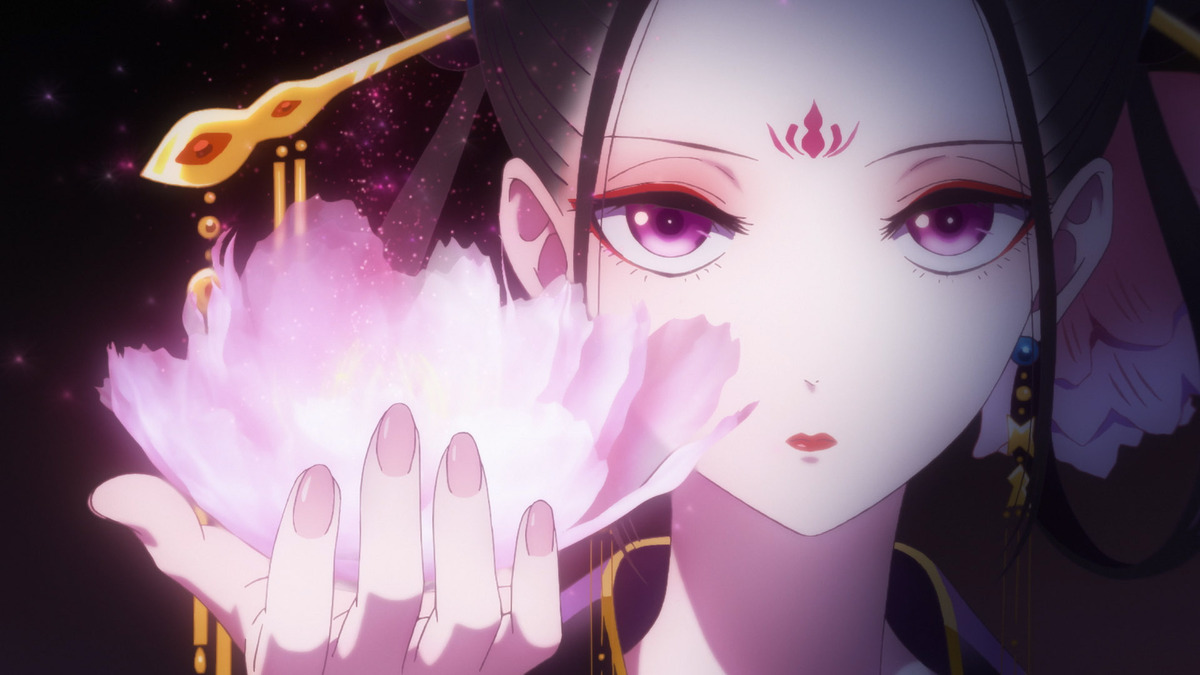
The selected first-episode image shows the Raven Consort in dark clothing, with an ornamented hairstyle and a glowing pink flower cupped near her face. We preserve the full official 1200-by-675 frame. It supplies a specific visual reference for supernatural work rather than a generic palace landscape.
The official opening synopsis identifies a special consort who does not perform the expected nighttime role of a conventional consort. It sends the emperor to her residence and describes her reputation for undertaking unusual requests. Our reading of the flower image is that the careful hand position makes the procedure appear deliberate, even while the luminous effect marks it as supernatural.
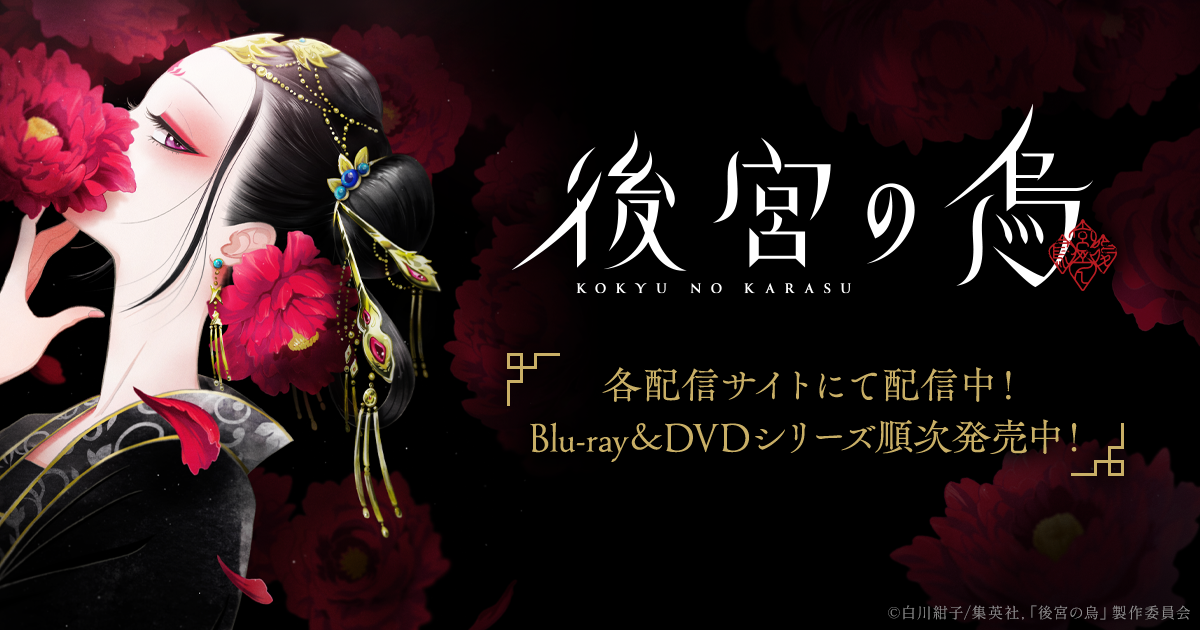
The still does not explain every rule of her power or identify a matching page in the English novel. Nor does it establish the resolution of the earring case. We discuss visible expression, gesture and contrast; the official synopsis supplies the encounter’s context. The promotional lead above remains separately identified from this episode frame.
Original visual reference
A special position can protect a person and isolate her
The heroine’s unusual court role creates an intriguing form of power: people can seek her help without understanding how she lives. Our interpretation is that this combination of usefulness and distance makes the palace’s boundaries personal. Recognition of an office does not necessarily mean recognition of its occupant’s needs.
The premise also complicates what access means. Entering a residence, asking for assistance and forming a relationship are different actions. A ruler may be accustomed to authority in one sphere while still needing to learn what another person will voluntarily share. That tension offers a way to read the opening without reducing it to a familiar courtship formula.
Watch how a request changes the conversation. Is the consort addressed as an individual or as a solution to someone else’s problem? The difference can reveal an imbalance before a major political conflict is explained. Small interactions allow the supernatural mystery to develop alongside a question of dignity.
A ghost story can expose what a court prefers to forget
Our reading of the supernatural premise is that a palace mystery concerns memory as much as detection. An institution can preserve ranks, objects and ceremonies while losing or suppressing the experience of the people who lived within it. A haunting gives that omitted experience a dramatic means of returning.
This makes the earring a useful introductory object. An ornament can be visually small yet socially meaningful: ownership, proximity and what people remember about it can all become questions. The guide does not disclose its solution, but a viewer can still notice how an object changes when it is treated as evidence rather than decoration.
The series’ fantasy should be approached as an invented setting rather than a documentary reconstruction of one historical dynasty. The credited staff describe historical elements within fantasy. That distinction allows discussion of hierarchy, clothing and ritual without asserting that every supernatural rule or court procedure corresponds to actual history.
Author, illustrator and screen contributors have different responsibilities
The official staff record credits Chizuru Miyawaki as director, Satomi Oshima for series composition, Shinji Takeuchi for screen character design, Asami Tachibana for music and BN Pictures for production. Ayuko’s original character concepts remain a separate credit. Those distinctions are useful when comparing a novel cover with a moving character performance.
Miyawaki’s own staff comment describes a research and location visit to Nara; Takeuchi discusses the difficulty of specialized terminology in a novel-based fantasy with historical elements. These are creators’ accounts of their process, not evidence that the fictional palace belongs to one documented real dynasty.
In the linked Reddit review discussion, vanichad remembers the opening song, while reviewer Kinofhera emphasizes the mood of the ending song. Those individual reactions illustrate how music can become part of a reader’s memory of the adaptation. Our AniList score concerns the 2022 thirteen-episode TV entry only, with no novel/anime average.
A complete English set is a reading opportunity, not a sales total
The Airship paperback conclusion supplies a practical difference from properties with an incomplete English prose release: a reader can identify a seven-book source sequence with a cataloged final English volume. That is an access and edition fact, not proof of commercial success in every market.
The official anime archive also preserves home-video and event activity. Such products show how the television project was presented beyond broadcasting, but they do not disclose a title-level production balance sheet. We do not estimate profit from a retailer price, number of disc volumes or a popularity score.
Choose television for a compact introduction to the consort’s presence, or the novels for the complete source route. Our palace-skills collection below compares characters whose expertise operates within unequal institutions. Later revisions can add inspected adaptation concordance while keeping the dated language, edition and access distinctions visible.
Primary sources and useful navigation
- Official anime and rights information
- Thirteen-episode archive
- The Jade Earring · opening synopsis and image
- Staff credits and original creator comments
- Shueisha · Japanese final volume 7
- Shueisha · source series catalog
- English final paperback · distributor record
- Seven Seas · English final volume; access may be restricted
- AniList · named TV audience score
Community and catalog routes
- MyAnimeList · named television catalog
- Reddit · Kinofhera’s source review discussion; major spoilers
- Wikipedia · secondary version navigation
The production and publisher links support project facts. Catalog and community pages are secondary navigation and may reveal later events.
Find this work in our thematic collections
Original series imagery is reproduced under permission asserted by the site owner; the source and rights credits are retained. The route diagram is Animeteor’s own explanatory graphic.