Watch the 2015 anime in episodes 1–12. Shiori Ota’s Japanese novels are the source and have a publisher-confirmed 2021 conclusion; Tou Mizuguchi’s manga is a separate adaptation. Begin the chosen reading version at its own first book.
Reviewed 2 October 2026 · Opening premise and format relationships; major ending revelations withheld. Linked publisher summaries and discussions may reveal later events. · Licensed access varies by country.
The source and screen branches

The main novels conclude with Ouka no Sousou (2021); Side Case Summer (2022) is an optional prose spin-off. Comic numbering remains separate. Fuji live action stays outside the core map; no exact post-anime novel handoff is certified.
- READ · complete source prose: First Japanese novel → Continue to Ouka no Sousou · 2021
- READ · comic adaptation: Tou Mizuguchi · comic volume 1 → Comic volume 2 · separate numbering
- WATCH · 2015 television: Episode 1 · The Princess Who Loves Bones → Continue through episode 12
- READ · optional later prose: Side Case Summer · 2022 → Companion characters · separate side stories
The novels, comic and television are separate routes
Beautiful Bones adapts Shiori Ota’s Japanese mystery fiction, whose title is often rendered as A Corpse Is Buried Under Sakurako’s Feet. Sakurako Kujo’s fascination with bones brings the high-school student Shotaro Tatewaki into investigations around Asahikawa. The 2015 television series is an introduction to that partnership, not the complete novel sequence.
Watch the twelve main TV episodes in numbered order. For prose, begin with the first Japanese novel; KADOKAWA’s series page identifies its ISBN as 9784041006955. For comics, choose the adaptation drawn by Tou Mizuguchi, with Tetsuo credited for the character concepts. It uses its own volume numbering.
Fuji Television also catalogs a live-action version. That is separate coverage and is not inserted between anime episodes or used to fill an unverified prose handoff. The same title can identify several versions of the investigative partnership, so confirm medium and edition before treating a search result as the next installment.
| Version | Begin here | What the route establishes |
|---|---|---|
| 2015 anime | Episode 1 → 12 | One television adaptation |
| Japanese novels | First Shiori Ota book | Read source order |
| Mizuguchi manga | Comic volume 1 | Separate illustrated adaptation |
| Live action | Separate Fuji TV project | Excluded from the core map |
The source has a published conclusion
KADOKAWA’s dedicated source page identifies Ouka no Sousou as the concluding volume, released on 24 March 2021 with ISBN 9784041111499. That directly supports a completed prose route. The promotional synopsis discusses late developments and is linked with a spoiler warning rather than reproduced in this beginner guide.
The comic catalog records volume 1 on 26 November 2015 and volume 2 on 2 February 2018, with distinct ISBNs 9784041036785 and 9784041036792. These are comic editions. Two comic books do not compress the entire source conclusion into two universal reading units, and the first comic’s publication alongside the anime is not evidence that it supplied the original story.
This guide identifies verified Japanese editions instead of sending English-language visitors to an assumed licensed English prose translation. If you buy an import, inspect the language field. A translated retailer description does not translate the book itself; the character names on a cover do not establish its text language.
Why a post-anime volume number needs more evidence
The safest source route after the TV adaptation is to begin the first novel and follow the publisher’s named sequence. That recommendation preserves Shotaro’s perspective and the development of the partnership without promising that all early material matches the screen in the same arrangement.
We have not compared the complete anime ending with each named Japanese source edition. A claimed continuation volume would need to account for which cases the series selects, how it places recurring clues and how much source narration it retains. The fact that the novels conclude in 2021 does not tell us where episode twelve should join them.
The manga is another starting option for readers who prefer panels, but it is not a substitute index for the novels. Compare a specific case title and evidence sequence if you want to study differences. The public map therefore offers parallel media routes, with the prose’s known conclusion separated from the anime’s twelve-episode stopping point.
The Princess Who Loves Bones: a composed face before a disturbing discovery
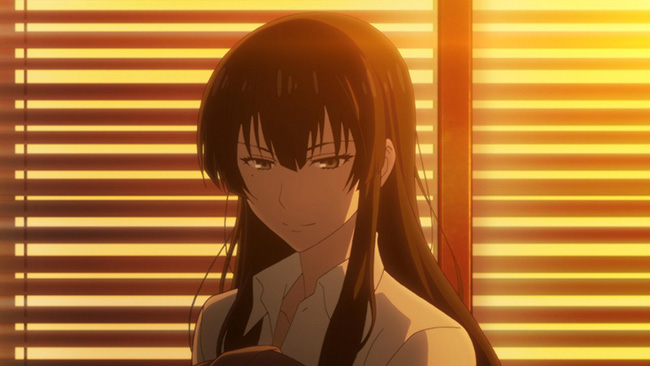
The first official episode synopsis sends Sakurako and Shotaro to the Mashike coast to collect bones and identifies a human-bone discovery as the case’s disruption. The selected image shows Sakurako with dark hair and a restrained expression against warm interior light. It belongs to that episode’s original gallery and is kept as an intact reference rather than recut into a invented crime scene.
Our reading is that the image makes composure an important part of her introduction. A face that appears calm can contrast with another person’s response to the same discovery. That difference invites the viewer to ask whether professional or obsessive attention changes the meaning of something others find frightening.
The frame itself does not establish the victim’s identity, the cause of death or the correctness of an osteological inference. Those require narrative evidence, not a portrait. The official synopsis supplies the opening location and activity; the visual supports expression and presentation. No frame-to-page match with the first novel or manga is certified here.
Original visual reference
A physical trace is a starting point for a story
The premise gives bones two roles: objects Sakurako finds beautiful and traces through which a lost life can become partly knowable. Our interpretation is that the mystery gains tension from the distance between those roles. A collector’s interest and another person’s grief can attach very different meanings to the same remains.
A useful viewing distinction is observation versus inference. The investigator notices a feature, proposes an explanation and then tests it against other circumstances. A confident performance can make those steps feel like one instant, but separating them helps a viewer evaluate how fairly the mystery presents its evidence.
The series is fictional detective drama rather than a forensic training resource. We analyze the narrative use of expertise, not whether a depicted examination would meet a real investigation’s requirements. A satisfying revelation can still compress procedures. The interesting dramatic question is what her special knowledge makes visible to Shotaro, and what it leaves unseen.
Shotaro gives expertise a social cost
Sakurako’s unusual interest would create a different story without somebody who has to live with its consequences. Shotaro’s presence gives the discoveries a social perspective: a case can interrupt an ordinary day, unsettle a relationship or demand care for someone still alive. An explanation does not automatically remove that impact.
Our reading of their partnership is that accompaniment is a form of labor. Going along, asking a question and responding to another person’s distress can be less spectacular than identifying a bone, but those actions determine how the investigation reaches people beyond the specialist. This creates room for tension between competence and consideration.
Rather than measuring growth only by whether Shotaro becomes as knowledgeable as Sakurako, ask what he learns to notice about her conduct and other people’s needs. That approach lets a newcomer discuss the central relationship without revealing late source events. It also clarifies why a short television route need not exhaust a much longer prose partnership.
An identifiable episode team and an identifiable source creator
The opening episode page names Takayo Igami for its script and Makoto Kato for storyboard and direction. The original anime’s official staff page is linked separately so television contributors are not collapsed into the source author’s credit. Shiori Ota’s novels and Mizuguchi’s comics remain distinct creative records.
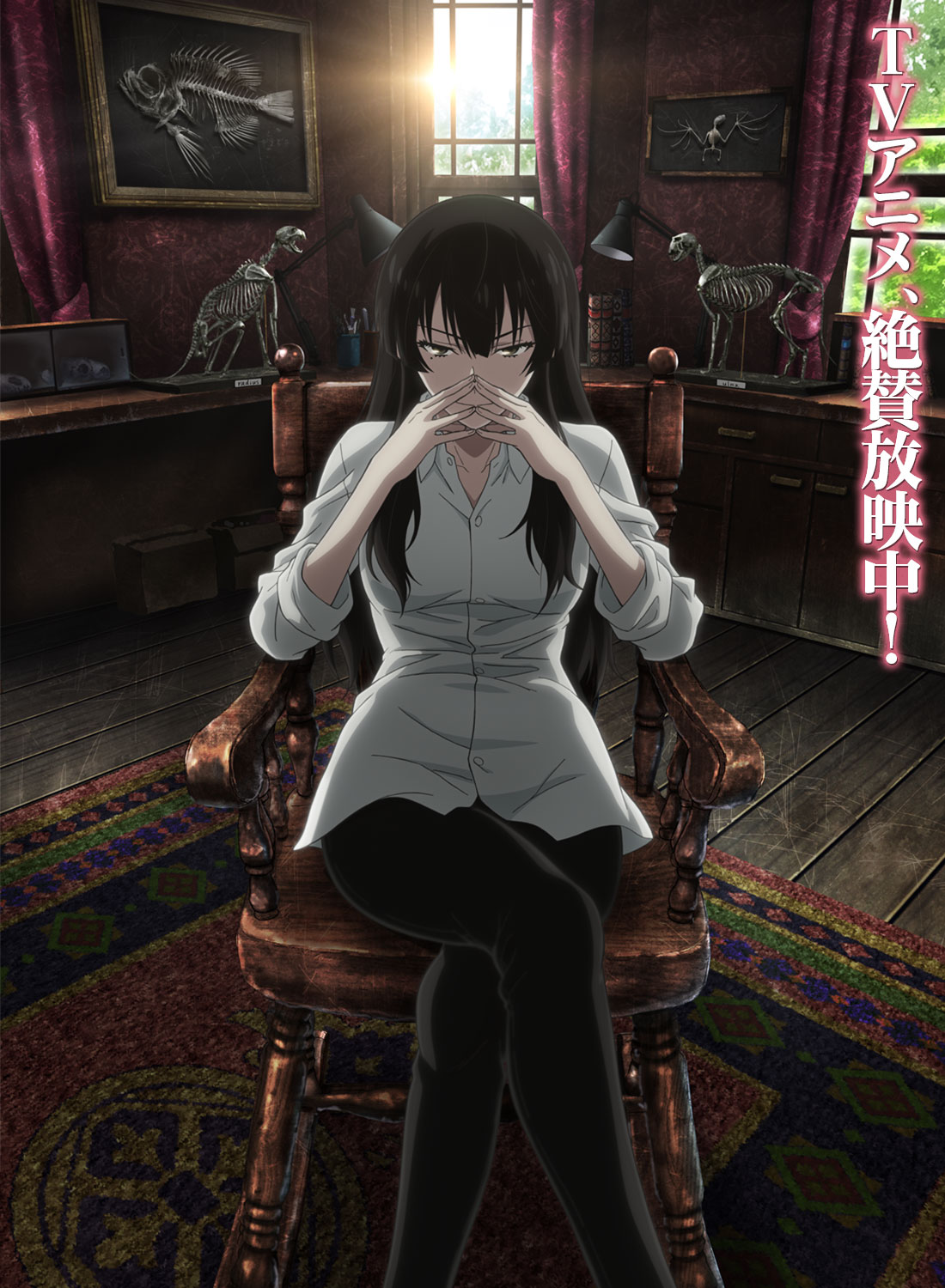
The selected lead visual is promotional artwork, while the smaller inserted reference is an episode-gallery image. That distinction helps readers evaluate what they are seeing: a cast composition sells an identity for the series, whereas the bounded scene supplies evidence for a particular discussion of expression.
The external AniList score above concerns only the 2015 twelve-episode TV adaptation. It does not grade the concluded novels, the two cataloged comic editions or the Fuji live-action project. Community links are supplied for preferences and further discussion; statements about exact reading continuation still need primary edition comparison.
Local promotion is not proof of successful funding
The official anime archive preserves 2016 Asahikawa event and goods notices. It also carries a 24 June 2016 notice that the early-summer Asahikawa project did not materialize. That record makes an important distinction: a campaign announcement is not evidence that its proposed event occurred or reached its target.
These notices document an attempt to connect a location-based fictional property with tourism and merchandise. They do not disclose the production budget, net revenue or the number of source novels sold. We do not infer an anime’s profitability from the presence of local collaborations or from an audience score.
Begin the television series for a compact mystery introduction, or the first novel for the source route through its documented conclusion. The small-clues thematic collection below compares different ways specialist observation drives drama. Future updates can add a properly inspected source handoff without altering the current edition records or silently treating the anime as the complete story.
Primary sources and useful navigation
- Official anime archive and dated local campaign notices
- Opening episode · synopsis and original gallery
- Official anime staff archive
- KADOKAWA · source sequence and 2021 final novel
- KADOKAWA · first Mizuguchi comic
- KADOKAWA · second Mizuguchi comic
- Fuji TV · separate live-action adaptation
- AniList · named TV audience score
Community and catalog routes
- MyAnimeList · named television catalog
- Reddit · source-ending question; community claims require checking
- Wikipedia · secondary version navigation; spoilers
The production and publisher links support project facts. Catalog and community pages are secondary navigation and may reveal later events.
Find this work in our thematic collections
Original series imagery is reproduced under permission asserted by the site owner; the source and rights credits are retained. The route diagram is Animeteor’s own explanatory graphic.
Games and live-action adaptations
- Beautiful Bones: Sakurako's Investigation — Live action: Series · 2017
Optional prose after the concluded main sequence
KADOKAWA separately published Shiori Ota’s Side Case Summer on 24 May 2022, ISBN 9784041125601, 272 pages, with Tetsuo’s illustrations. The publisher identifies it as a spin-off concerning companion characters and their later stories. Ouka no Sousou remains the main sequence’s 2021 conclusion; this optional side book does not increase the anime’s twelve-episode scope or certify an English translation.
Exact Japanese Side Case Summer source record · KADOKAWA — original print edition