Watch TV episodes 1–22; episode 11.5 is an optional manga-bundled extra after 11. Honobu Yonezawa’s Classic Literature Club novels are the source; Taskohna’s manga is a separate adaptation. Start the chosen reading format at its own beginning.
Reviewed 2 October 2026 · Opening premise and format relationships; major ending revelations withheld. Linked publisher summaries and discussions may reveal later events. · Licensed access varies by country.
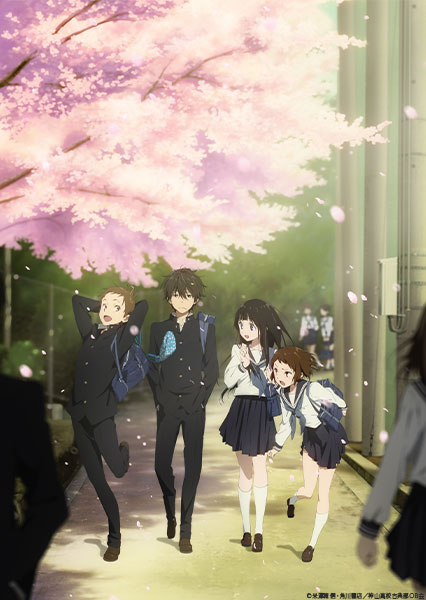
The source and screen branches

The anime can arrange shorter source cases differently. The manga-bundled 11.5 is not a new season. No exact after-anime source chapter is certified.
- READ · source prose: Hyouka · first source book → Continue in named novel order
- READ · manga adaptation: Taskohna · comic volume 1 → Continue in comic numbering
- WATCH · 2012 television: TV episodes 1–11 Optional extra Optional episode 11.5 Continue main TV TV episodes 12–22
A mystery club whose novels are the source
Hyouka begins as Honobu Yonezawa’s Classic Literature Club fiction, not a manga adapted into a novel. The first book lends its title to Kyoto Animation’s 2012 television series. Taskohna’s comic is another presentation of that property, with Futoshi Nishiya credited for the character concepts on KADOKAWA’s project page. Reading a comic volume does not automatically equal reading the same-numbered novel.
The simplest screen introduction is the twenty-two numbered television episodes. The official archive also lists episode 11.5, packaged with the limited edition of manga volume 3. It is an optional animated extra, not evidence that the main season has twenty-three normally numbered broadcast episodes. Watch it after episode 11 if your licensed edition includes it, or return to it after the season.
Choose prose if you enjoy an investigator’s reasoning and the social meaning of a solution; choose television for performances and the visual handling of attention. Neither route requires the manga as a preliminary step. Later books should be identified by their individual Japanese titles, particularly where a retailer uses the umbrella label Classic Literature Club rather than Hyouka.
| Format | Starting point | Numbering caution |
|---|---|---|
| Anime | TV episode 1 → 22 | Optional 11.5 is a manga-bundled extra |
| Novel | Hyouka, the first Classic Literature Club book | Follow named book order |
| Manga | Taskohna’s Hyouka volume 1 | Separate comic numbering |
Follow the named books rather than an anime-volume shortcut
KADOKAWA’s series portal identifies Hyouka, The Credit Roll of the Fool, The Order of Kudryavka, The Doll That Took a Detour and Approximating the Distance Between Two People as successive books, with Even Though I’m Told I Now Have Wings featured separately as the later collection. These English renderings help navigation; they are not a claim that those specific English editions are licensed and available.
The books mix longer mysteries with collections of shorter material. That matters because an adaptation can arrange a short case around a seasonal or character progression rather than simply screen one whole book and move to the next. A blanket claim that an anime episode equals a novel chapter hides those editorial decisions.
The source portal is a useful starting map, but its older promotional wording is not a live guarantee that no later publication exists. Check the individual KADOKAWA record before ordering a paperback, a collected binding or a digital edition. Publication format and language remain part of the route, even when an image of the same characters appears on the cover.
After the anime: begin the source, or make an edition-specific comparison
Starting the first novel is the most reliable reading option for somebody who wants the fullest source experience. It establishes Oreki’s perspective and the club’s relationships through prose rather than asking a reader to reconstruct them from a presumed anime stopping point. The manga can likewise be started at its own first volume as a comic experience.
Fan discussions often recommend a later book after the television ending. Our linked rewatch includes source-reader discussion of material being rearranged between books. Those observations are valuable prompts for comparison, but this guide has not inspected every licensed episode against a named prose edition and does not certify an exact continuation seam.
To investigate a handoff properly, track the specific case title, what Oreki knows, and the timing of the school year in both versions. A numerical shortcut can miss a shorter case moved earlier. That distinction is especially useful in Hyouka, where an apparently modest discovery may also mark a change in how one club member understands another.
Episode one: Oreki among an energetic school crowd
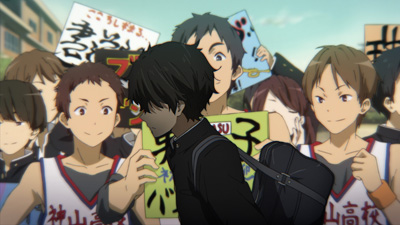
The selected original image comes from the official first-episode gallery. It shows the dark-haired Oreki in the foreground while students and recruitment signs fill the scene behind him. The intact 400-by-225 image provides a concrete contrast between a relatively reserved central figure and the visible activity around him; it is not a generic illustration of a school.
Kyoto Animation’s own story page establishes an energy-conserving first-year student joining the endangered Classic Literature Club and encountering Chitanda’s curiosity. Our interpretation of this frame is that the social world already offers more invitations than Oreki wants to accept. His resistance is legible through the arrangement of people and competing signs, before an audience needs a large criminal mystery.
The episode page credits Shoji Gatoh for the script and Yasuhiro Takemoto for storyboard and direction. The image supports a discussion of framing and social attention, not a certified quotation from the novel or the complete solution of the first case. We leave the mechanism of the opening mystery undisclosed so the scene remains useful to a newcomer.
Original visual reference
Curiosity changes who gets to set the cost of an action
Our reading of the opening premise is that Oreki’s energy policy is a way of deciding which obligations count. Chitanda challenges that policy by making an ordinary uncertainty matter to somebody else. The conflict is therefore about a reason to act as much as it is about the ability to solve a puzzle.
A small mystery can make that conflict unusually clear. If a situation poses little physical danger, the investigator cannot automatically justify involvement through an emergency. He must decide whether another person’s interest, distress or memory merits his effort. That gives everyday clues ethical weight without pretending every forgotten detail is a murder case.
The club also offers several different kinds of participation. Reasoning, remembering, gathering facts and simply refusing to let a question disappear are not interchangeable roles. A useful viewing question is who supplied the observation that made the solution possible, rather than awarding every scene to the person who says the conclusion aloud.
An explanation can be correct and still incomplete
Hyouka’s premise invites a distinction between explaining an event and understanding its significance. A clue may reveal what happened without settling why someone cared about it. Our analysis treats those as separate achievements: reconstruction provides a mechanism, while conversation can disclose the emotion or history that made the question urgent.
This is why the anthology and the club’s inherited identity are promising subjects for an ordinary-school mystery. A record can survive after the experience behind it has become difficult to describe. A beginner does not need the anthology mystery’s answer to appreciate the tension between a public label and the private memories attached to it.
Watch for changes in a character’s confidence when a proposed explanation is accepted. The response can reveal pride, relief, embarrassment or disappointment. Those reactions offer a way to discuss the drama beyond whether a viewer guessed the answer first. The human result of a deduction can matter more than its speed.
Direction and a reader’s interpretation of attraction
The official credits distinguish Yonezawa’s source and composition cooperation from Gatoh’s series composition, Takemoto’s direction, Nishiya’s character design and Kohei Tanaka’s music. These are different creative responsibilities. The moving image does not become the novel simply because it preserves the source characters and central questions.
In the linked 2023 episode-one rewatch, host polaristar reads the opening color contrasts as a challenge to Oreki’s withdrawn approach to school life. Commenter JetsLag singles out the camera work of his meeting with Chitanda. Those are named viewers’ readings, not a production interview or a measured consensus.
They suggest a productive comparison: ask how television makes another person’s attention feel physically difficult to ignore, then compare how a prose narrator describes the same interest. Our external score is scoped only to the 2012 twenty-two-episode TV entry. It is not a score for Yonezawa’s books or a claim that every viewer prefers the screen version.
A historical circulation figure and a practical next choice
KADOKAWA’s November 2016 announcement for Even Though I’m Told I Now Have Wings reported the Classic Literature Club series above 2.05 million copies in circulation. This is the publisher’s dated series figure. It is not a 2026 total, a count of Hyouka-only copies, anime disc sales, or profit.
The optional episode’s manga-bundle placement also documents a connection between different product formats. It does not mean a new reader must purchase that specific historical package to understand the main television season. Availability and the contents of later licensed releases should be checked independently.
Begin the anime for a compact screen route or the first source book for prose investigation. Our small-clues collection below places Hyouka alongside other stories where observation and social context matter. Later revisions can add a directly inspected case comparison while retaining the distinction between a route recommendation and an exact chapter concordance.
Primary sources and useful navigation
- Official episode archive and optional 11.5
- Episode-one gallery and production credits
- Official full staff and cast
- Kyoto Animation · story premise
- Kyoto Animation · work and visual
- KADOKAWA · source books and comic credits
- KADOKAWA · 2016 circulation announcement
- AniList · named TV audience score
Community and catalog routes
- MyAnimeList · named television catalog
- Reddit · named 2023 episode-one rewatch; spoilers
- Hyouka Wiki · secondary navigation; spoilers
- Wikipedia · source and adaptation navigation
The production and publisher links support project facts. Catalog and community pages are secondary navigation and may reveal later events.
Find this work in our thematic collections
Original series imagery is reproduced under permission asserted by the site owner; the source and rights credits are retained. The route diagram is Animeteor’s own explanatory graphic.
Games and live-action adaptations
- Hyouka: Forbidden Secrets — Live action: Film · 2017
Japanese manga edition update
KADOKAWA’s Japanese digital manga volume 17 is dated 26 March 2026, with Taskohna, Honobu Yonezawa and Futoshi Nishiya’s character-concept credit distinguished. This numbered manga edition does not establish a seventh source novel or a new anime season.
Exact Japanese digital manga release record · KADOKAWA — volume 17