Watch the 2015 first season (12 episodes), then the 2016 second season (12; cumulative 13–24). Read Sorata Akiduki’s manga from volume 1; VIZ volume 27 was released in July 2026 and is not labeled as the source finale. No exact anime-to-manga seam is certified.
Reviewed 1 October 2026 · Opening premise and format relationships; major ending revelations withheld. Linked publisher summaries and discussions may reveal later events. · Licensed access varies by country.

The source and screen branches

The manga has a longer publication route than the released screen seasons. Service numbering may restart at season two. No source novel or unverified third-season date is added.
- READ · source manga: Manga volume 1 → Continue in chosen edition numbering
- WATCH · consecutive seasons: 2015 first season · 12 episodes → 2016 second season · 12 episodes
Shirayuki chooses a place through the work she can do
Snow White with the Red Hair follows Shirayuki, a herbalist whose unusual hair draws unwanted attention from Prince Raji. She leaves her home country and encounters Zen in a neighboring kingdom. Sorata Akiduki’s manga is the source. Begin the manga at volume 1, or watch the 2015 first anime season followed by the 2016 second season.
The story’s appeal lies in how romance intersects with an independent ambition. Shirayuki is not only waiting to be admitted to a prince’s world; she has skills through which she can seek a meaningful place of her own. That makes it a useful choice for viewers who like gentle fantasy romance alongside work, trust and questions about social rank.
The opening includes coercive royal attention and danger, while the overall presentation also makes room for warmth and friendship. Choose the anime for performance and the atmosphere of its spaces, or the source manga for Akiduki’s drawings and the longer reading route. No source novel has been established for this guide, so its core format badges remain manga and anime.
The second season follows the first rather than restarting it
BONES identifies the first season’s broadcast as July–September 2015 and the second as January–March 2016. The practical route is the twelve first-season episodes followed by the twelve second-season episodes. Bandai Channel’s second-season record uses cumulative episode numbering, with its twelfth entry identified as episode 24.
A platform may instead present the second season as episodes 1–12 within its own season menu. Those labels describe the same continuation differently. Identify the production year and season as well as the number when comparing catalogs, especially if a discussion references episode 13 while the service offers season-two episode 1.
The verified television sequence does not establish a third-season announcement or completion of the whole manga. No unverified premiere is added here. Supplementary animation should be identified by its own official product record before inclusion; it is not necessary to invent a mandatory extra to make a two-season roadmap look more elaborate.
| Choice | Order | Boundary |
|---|---|---|
| TV anime | 2015 season 1 → 2016 season 2 | Twenty-four main episodes |
| Cumulative numbering | 1–12 → 13–24 | Second-season entries may reset on platforms |
| Source manga | Volume 1 onward | Longer source publication route |
| Further anime | Await an official dated record | No unverified sequel date supplied |
The English volume twenty-seven release is already dated
VIZ’s manga page identifies Akiduki as the creator and describes the source’s publication through Hakusensha’s LaLa magazines. Its English volume-27 catalog records release on 7 July 2026, ISBN 9781974765690. At this October review, that is a published English edition, not a hypothetical translation release still awaiting confirmation.
The existence of volume 27 does not make it the final source volume. The checked series and magazine records support a continuing manga route; we do not infer completion from the largest number visible in one English catalog. Japanese source publication and English translation publication should remain separate when planning a collection.
Read the chosen manga edition numerically from volume 1. A retailer’s image of a later book can reveal more about the story than its title suggests, so beginners can use the series page or first-volume preview instead. Publication facts belong beside an edition’s language and ISBN; a forum comment about stock or delay is a different kind of information.
Manga reading is a source branch, not an automatic episode conversion
After the second season, start the manga at volume 1 for the verified complete source entry. We have not inspected the full licensed episode-24 ending against a specific VIZ volume to certify an exact start-after-the-anime chapter. The route map therefore does not claim that two seasons equal a precise block of books.
The source is valuable even to a viewer who recognizes the broad introduction. A drawn expression, narration and panel sequence can emphasize an interaction differently from actors and timed cuts. A continuation shortcut would need to account for those differences and for any rearrangement, rather than matching only a remembered event to a chapter summary.
For a later detailed comparison, follow Shirayuki’s professional objective as well as the romance. Ask what a version shows about her competence, who is allowed to assess it and how her decisions change access to a place. That provides a concrete adaptation question without revealing later relationship milestones in this beginner guide.
Episode one: the herbalist appears as a person rather than a hair color
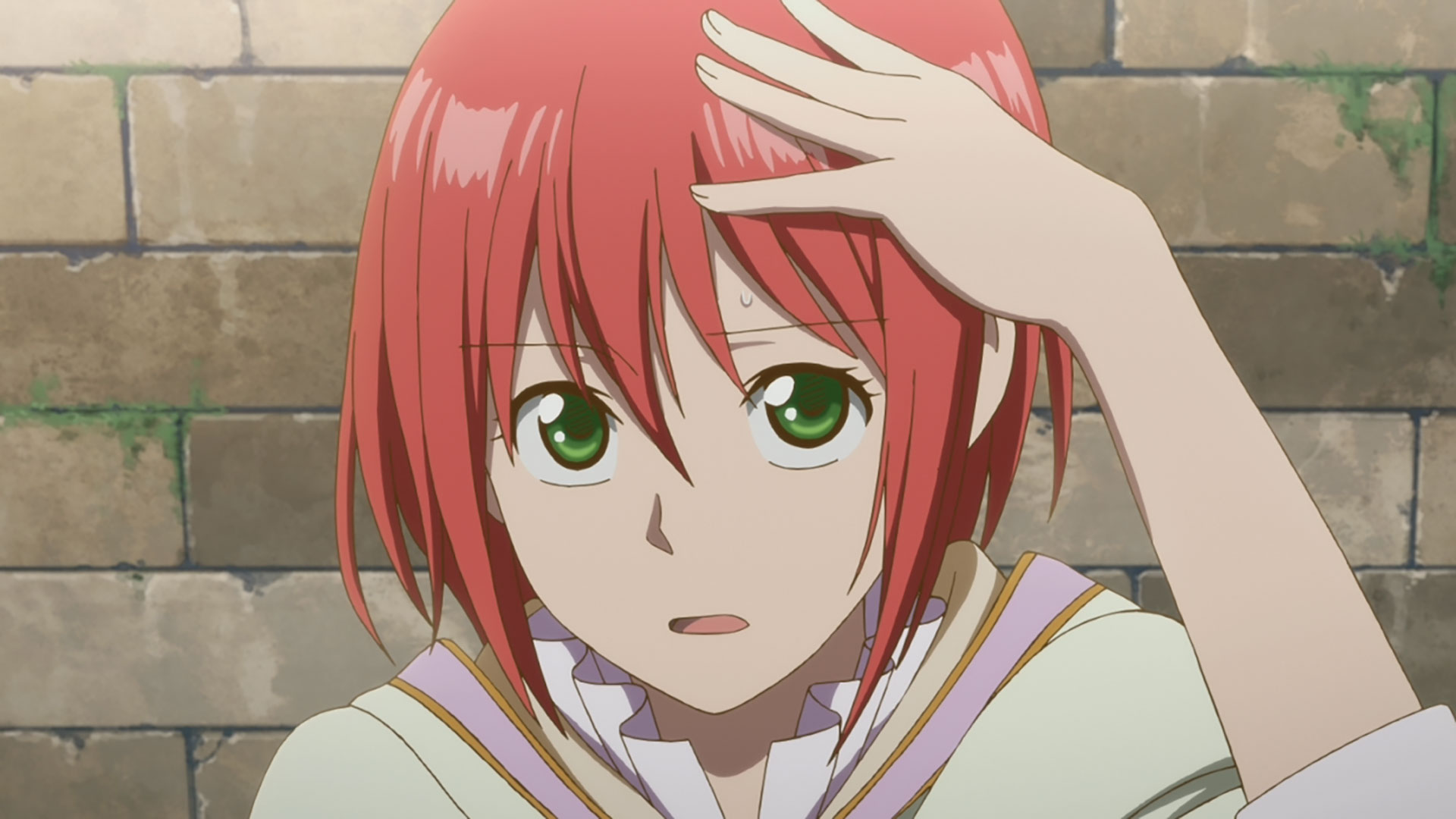
Bandai Channel’s original episode-one image places Shirayuki’s red-haired face against pale stonework. Her eyes and slightly parted mouth direct attention to an expression rather than to an elaborate outfit. The full 1920-by-1080 frame is retained. The wide lead artwork is a separate VIZ manga illustration, labeled as publisher art rather than an episode still.
Our reading is that the episode image helps turn a conspicuous visual trait into an individual viewpoint. The premise makes her hair a reason somebody else tries to choose her future. Seeing an attentive expression invites a different question: what does she choose, and what does she understand about the situation around her?
The episode record confirms her departure from Raji’s unwanted attention and meeting with Zen, including her attempt to demonstrate herbalist competence. The selected image supports color, gaze and framing observations, not an exact account of the surrounding line or a matching manga panel. Its use here is a bounded visual reference alongside the official opening synopsis.
Original visual reference
A profession gives the romance a second axis
Shirayuki’s herbalist identity gives the story an interest beyond whether a prince likes her. Our interpretation is that work offers a way to evaluate belonging through something other than appearance or rank. A person can be welcomed socially and still need to earn recognition for a skill; those are different achievements.
That makes institutional scenes meaningful. An examination, an instruction or an assessment can reveal who has authority and what standard is being applied. When watching, pay attention to whether the story lets her make a professional decision rather than treating competence as a vague flattering description. Such moments help distinguish an active ambition from a decoration attached to a romance lead.
The medical and herbal material remains part of a fictional kingdom. We discuss its role in relationships and professional identity, not the effectiveness of an actual remedy. A successful fictional demonstration does not validate a treatment. That boundary leaves room to appreciate the craft and care themes without giving the story an authority it does not claim.
A kind relationship still takes place inside unequal access
The prince’s status matters even where an encounter feels friendly. Our reading is that personal kindness and structural access are not the same thing: one person can enter a room, make a request or receive an explanation more easily because of their position. Romance becomes more textured when the setting recognizes that difference rather than pretending affection removes it instantly.
Shirayuki’s departure in the opening is important because it is a choice made before she can rely on a new royal connection. It gives her movement a motive of her own. That motive can remain relevant as friendships and work opportunities develop, allowing the viewer to ask whether each later choice extends her agency or merely substitutes one powerful patron for another.
The gentle tone can be an attraction for someone who wants cooperation and gradually built trust. It can also feel less urgent to a viewer looking for constant large conflicts. The opening episode is a useful test of those preferences. A calm scene can still contain an important decision when the characters’ options are unequally distributed.
The staff and viewer responses point to atmosphere and warmth
BONES credits Masahiro Ando as director, Deko Akao for series composition, Kumiko Takahashi for character design and Michiru Oshima for music. The manga remains Akiduki’s work. These are identifiable creative routes for readers interested in the different contributions behind the source artwork and the screen presentation.
On Bandai Channel, reviewer ひろぽん describes the romance as gentle and warming in an August 2019 comment. Another reviewer, リャンピー, finds some dialogue overformal while enjoying the low-stress experience. These are individual reactions, useful for showing that the same atmosphere can be comforting while a particular dialogue style causes friction.
The linked Reddit and reference pages offer further discussion, but old translation complaints should be checked against current VIZ release records. The external score above belongs to AniList’s 2015 twelve-episode first season only. It excludes the second season and the manga, so a first-season audience average is not presented as a rating of every stage of the story.
A long source and two screen seasons have separate release histories
The continuing English manga catalog and the two BONES productions show different routes through which the property reaches readers and viewers. Volume-27 publication is a current edition fact, while the anime production dates remain 2015 and 2016. One does not establish a new broadcast announcement for the other.
We have no audited title-level animation profit or budget in the linked records. Book availability, reviewer counts and a weighted audience score do not supply those numbers. A commercial discussion can still be useful by identifying the licensed English route and the need to distinguish source growth from the screen’s released scope.
Start with the first anime season or the first manga volume. The medicine-and-care and palace-skills collections below compare Shirayuki’s professional route with other protagonists navigating institutions. Future updates can add a documented chapter seam or an official new production, while keeping the existing article address, rights records and first-season rating scope intact.
Primary sources and useful navigation
- VIZ · manga and creator
- VIZ · first English manga preview
- VIZ · volume 27 release and ISBN
- BONES · both anime seasons and staff
- Bandai Channel · first episode and original image
- Bandai Channel · second-season final main entry
- Hakusensha LaLa · source title
- Hakusensha · historical second-season broadcast notice
- AniList · named TV audience score
Community and catalog routes
- MyAnimeList · named television catalog
- Reddit · readers discussing the English manga edition
- Wikipedia · adaptation navigation; spoilers
- Akagami no Shirayukihime Wiki · reference; spoilers
The production and publisher links support project facts. Catalog and community pages are secondary navigation and may reveal later events.
Find this work in our thematic collections
- Medicine and care in anime: five stories about knowledge and responsibility
- Beyond royal titles: five anime about skills, secrets and court pressure
Original series imagery is reproduced under permission asserted by the site owner; the source and rights credits are retained. The route diagram is Animeteor’s own explanatory graphic.