Start with television episodes 1–25, then 26–50. The nine-part digest, Urdr-Hunt side-story film and Wedge of Interposition short are optional separate products. Main manga and Gekko are associated reading, not original source novels.
Reviewed 1 October 2026 · Opening CGS/escort premise and publication records; final outcomes withheld. · Licensed access varies by country.

The source and screen branches

Main TV order comes first. Interseason-context additions are optional; our recommendation to explore them after main TV is editorial. No shared chronology with unrelated Gundam settings or anime-to-comic shortcut is implied.
- WATCH · main television: Season 1 · 2015–16 · episodes 1–25 → Season 2 · 2016–17 · episodes 26–50
- WATCH · optional additions: Nine-part Special Edition · TV digest OR Urdr-Hunt film / Wedge of Interposition short
- READ · associated comics: Kazuma Isobe manga · first 3 books → second 4 OR Gekko · distinct side-story opening
A fifty-episode television route with its own setting
Mobile Suit Gundam: Iron-Blooded Orphans begins with young workers at the Martian security company CGS and an escort assignment for Kudelia Aina Bernstein. An attack exposes how little their employers value their lives. Mikazuki Augus and Orga Itsuka become central to the young group’s effort to gain control of its circumstances.
Begin with the original television first season, episodes one through twenty-five, then the second season, which continues the cumulative numbering from twenty-six through fifty. The official episode indexes preserve this sequence. The later nine-part Special Edition is a digest of selected television material; it is not a third season or a replacement that preserves every episode.
The relevant continuity is the series’ Post Disaster setting. Its official world introduction starts roughly three centuries after the Calamity War. A first viewer can follow this television opening without inserting an unrelated Universal Century film between episodes. Gundam franchise branding does not make all of its differently situated productions one continuous history.
Urdr-Hunt and the anniversary short are separate additions
Urdr-Hunt follows Wistario Afam near Venus in P.D. 323, after news of Tekkadan’s activities has spread. The official project describes a competition offering a huge prize and a protagonist who wants to change conditions in his home colony. It is another cast’s story within this setting, not a renamed episode fifty-one.
The anniversary program pairs the Special Edition film Urdr-Hunt: Path of the Little Challenger with the new short Wedge of Interposition. The latter’s introduction places Tekkadan back on Mars after its escort mission, with Orga adjusting to leadership. Those introductions support an interseason context. For a first viewing, our recommendation is to finish the main television route before exploring the additions; that recommendation is editorial rather than a compulsory official order.
The Japanese theatrical program ran from 31 October 2025, with later regional events and distribution milestones. The maintained project records its limited-edition disc release on 25 September 2026. Keep that date separate from the original cinema opening and from any individual service’s streaming schedule.
| Item | Role | Use in a first viewing |
|---|---|---|
| TV season one | Episodes 1–25 | Begin here |
| TV season two | Episodes 26–50 | Continue main story |
| Nine-part Special Edition | Selected TV digest | Optional recap |
| Urdr-Hunt film | Wistario’s related side story | Optional after main TV |
| Wedge of Interposition | New anniversary Tekkadan short | Optional after main TV |
| Manga / Gekko | Comic adaptation / separate side comic | Independent reading branches |
Manga is an adaptation, not the television source
KADOKAWA’s maintained comic listing identifies Kazuma Isobe as the main manga artist, with Hajime Yatate and Yoshiyuki Tomino credited for the original work. Its first portion has three collected Japanese books. The separately titled second portion, Iron-Blooded Orphans Two, has four; its fourth-book publisher record expressly identifies the conclusion.
This split numbering is worth making visible. A store result for second-series volume three is not the final third volume of the first portion. Likewise, the seven collected books across both portions should not be represented as seven novels. The inspected records establish Japanese comic editions, without confirming an English prose source or a licensed English comic schedule here.
Gekko is a different comic side story. KADOKAWA’s first-book record credits Hirosuke Terama and Dango for manga, Hajime Kamoshida for scenario and the original Gundam creators separately. Its premise involves a conflict over the leadership of Tantotempo, with Argi and Volco pursuing different personal objectives. Follow its own opening rather than treating its first volume as the main television finale’s next chapter.
Original concepts, character designs and mechanics have different authors
The original television staff records Sunrise planning, original credits to Yatate and Tomino, direction by Tatsuyuki Nagai and series composition by Mari Okada. Yu Ito supplies the original character designs and Michinori Chiba the animation character designs. Music is credited to Masaru Yokoyama, while production is recorded as Sunrise and MBS.
The second-season staff page retains those central roles and lists a distinct set of theme artists, including SPYAIR, GRANRODEO, KANA-BOON and Uru. The first-season page records MAN WITH A MISSION, MISIA, BLUE ENCOUNT and TRUE for its opening/ending phases. A song’s association with a season does not make its performer the series composer.
Urdr-Hunt’s Special Edition credits Michihiro Tsuchiya for construction/script and Kamoshida for supervision. Wedge of Interposition credits Okada for its script, with Nagai directing. The different writing roles are concrete distinctions between products. They should not become an unsupported story about a replaced creator, a hidden production conflict or a budget change.
Case check: Barbatos appears as machinery before triumph
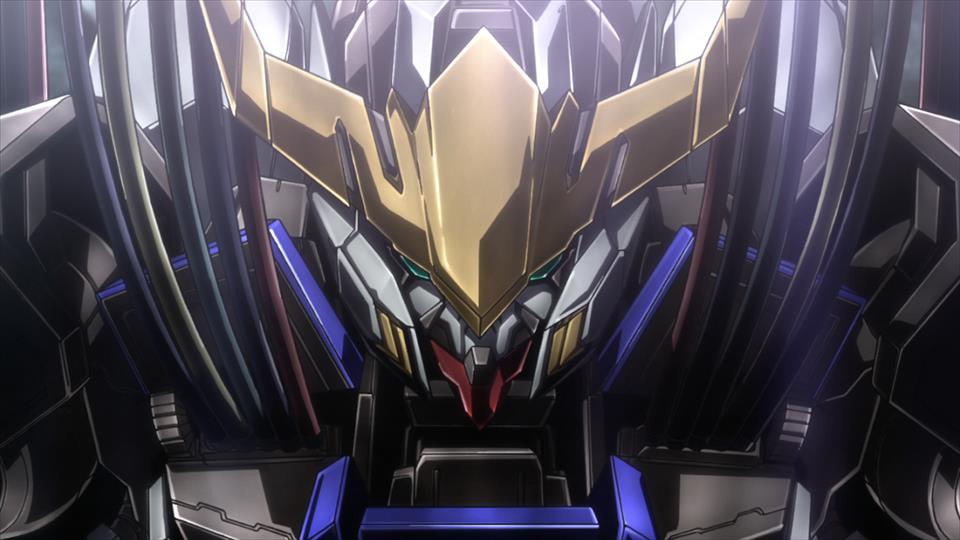
The original premiere image below frames Barbatos frontally, its gold head crest, pale armor, narrow green eyes and surrounding dark industrial structures visible. It is an intact official 960-by-540 episode frame. The mechanical face fills the shot, while vertical hardware crowds the edges and a light source enters from above.
Our reading treats this presentation as a useful way to introduce the machine as a material object. It occupies a physical installation before it becomes an emblem of victory or group identity. The official opening account establishes that the young workers use a Calamity War machine previously serving as CGS’s power source. The frame’s enclosure gives that repurposing a concrete visual setting.
The still cannot show how the interface works, establish a weapon’s force or prove Mikazuki’s skill. Nor does a glowing mechanical eye establish independent consciousness. Those distinctions keep a machine analysis grounded: describe the visible construction first, then connect it to the verified scene context without inventing technical readings from the image alone.
Original visual reference
Dependence between commander and pilot
Orga’s leadership and Mikazuki’s fighting capability create a relationship in which direction and execution are closely connected. Our analytical question is what happens when the person trusted to choose a destination is also someone who lacks safe alternatives. Confidence can help a group act, yet it does not make the available options fair.
In reading an early confrontation, separate the immediate survival problem from the longer decision about what the group should become. Winning an encounter can create new obligations: wages, repairs, provisions and negotiations. A machine’s effectiveness does not automatically provide political independence or a durable employer.
This is why the pilot-burden collection places the work beside other stories of young people operating extraordinary weapons. The relevant comparison is who bears the consequences of a decision, rather than which machine has the highest fictional specification. Preserve the work’s own rules and social circumstances instead of measuring its protagonists on a cross-franchise power chart.
The group needs logistics as well as courage
The official character directory distinguishes the young organization Tekkadan, the Martian city of Chryse, the armed institution Gjallarhorn and the transport/business structure of Teiwaz and Turbines. Those labels are a useful first map of the setting: not every named organization is a unit with the same job or authority.
Our interpretation of that structure focuses on dependence. A small group can win a battle while still relying on someone else for transport, infrastructure or access. Ask what an alliance actually supplies and what it expects in return. That approach makes bargaining and maintenance legible alongside the more spectacular combat.
It also avoids turning every adult into one interchangeable antagonist. An analysis should identify the role a person plays in a particular exchange and the resources they control. The opening’s exploitation matters precisely because a company can treat the young workers as expendable while still demanding their labor; simply calling everyone cruel would explain less.
A war drama involving exploited young people
The opening includes an attack on a workplace and the use of young people as disposable labor. The series belongs in a military-drama recommendation with information about violence, loss and institutional power. A colorful model kit or striking mobile-suit poster does not communicate that tone by itself.
The guide avoids the final outcome while retaining the stakes that make a viewing choice meaningful. Readers looking for a gentle school-club competition may have a different experience here. The presence of friendship does not erase the danger attached to the group’s work or guarantee that each promise of protection will be fulfilled.
For thematic comparison, track a specific decision and its cost rather than announcing that all Gundam works share one moral. Different productions can assign different meanings to service, rebellion and technology. This article’s opening analysis stays with the young workers’ dependence and their attempt to direct their own lives.
Updated anniversary dates matter
A September 2025 Bandai Namco Filmworks announcement initially scheduled the official anniversary setting/art collection for March 2026. The current 25 September 2026 project notice instead records release on 26 September. This guide uses the later dated announcement; an older indexed preorder notice should not override it.
The package contains character, mechanical and art books, with material spanning the television production, Urdr-Hunt, Gekko and MSV, plus new staff discussions. These are reference and art products, not source novels. The same recent notice identifies a Story of the Future motion comic among the limited-disc extras, which needs its own product label rather than being listed as a third television season.
Official model, music and video catalogs show the franchise’s range, but an edition price does not establish sales or profit. Bandai Namco’s group-level business results likewise cannot be allocated to this title without title-specific evidence. No inspected public record here supplies an audited animation budget or net return, so we do not fabricate a financial success percentage.
Viewers disagree about the two-season experience
The reviewed February 2023 Gundam community discussion explicitly asks participants to consider both seasons together. Individual replies praise emotional impact, mechanical designs or the music; others distinguish their enjoyment of the first season from their reservations about the second. This is a set of attributed opinions, not a representative poll of all viewers.
The thread also contains ending spoilers and unverified statements about production drafts. Those statements are not used as creator testimony here. A primary interview would be needed to establish what a director intended at an earlier stage. The distinction lets the discussion contribute contrasting readings without becoming a source of unverified staff history.
The fan wiki and MyAnimeList routes are optional secondary navigation. They can help locate alternate names, machines and installment records, but the official episode, staff and publisher pages anchor our format map. A later close analysis can compare a named scene across the actual anime and manga editions; no uninspected chapter handoff is supplied.
Primary sources and useful navigation
- Official first-season episode index
- Official second-season episode index
- Original premiere account, credits and imagery
- Official original world and premise
- First-season staff/cast/music roles
- Second-season staff/cast/music roles
- Official organization directory; later character spoilers
- Official nine-part selected-episode digest
- Official Urdr-Hunt project and dated distribution notices
- Official English film/short introductions and credits
- KADOKAWA first manga portion: three collected books
- KADOKAWA second manga final volume; ending spoilers
- KADOKAWA Gekko first book and contributors
- Official separate Gekko project
- Current September 2026 setting/art collection and disc release notice
- Historical initial setting-book announcement; superseded March schedule
- Official maintained product catalog
Community and catalog routes
- Reviewed two-season audience discussion; major ending spoilers
- Gundam fan wiki; secondary navigation and ending spoilers
- MyAnimeList first-season catalog
The production and publisher links support project facts. Catalog and community pages are secondary navigation and may reveal later events.
Find this work in our thematic collections
Original series imagery is reproduced under permission asserted by the site owner; the source and rights credits are retained. The route diagram is Animeteor’s own explanatory graphic.
Side-film availability and source scope
The 1 February 2026 official notice announces staggered subscription and rental distribution in Japan from that date for the Urdr-Hunt film and Wedge of Interposition short, following their 31 October 2025 theatrical opening. Check the individual service schedule; this domestic announcement does not establish worldwide streaming access.
Checked 1 October 2026. The existing 25 September disc and 26 September artbook dates remain historical release records. The separate TV-season audience scores above were directly checked; no title-specific audited financial figure was verified. The main television route remains episodes 1–25, then 26–50.
The discontinued game and separate anniversary screen editions
The official franchise record identifies Iron-Blooded Orphans G as a smartphone game whose service ran from 15 November 2022 to 11 January 2024. Its Urdr-Hunt animation and side stories were delivered through that application. This historical product should not be advertised as a presently playable sequel or inserted into the original TV episode numbering.
Official animation conversion announcement and game service period
The existing optional film and short routes now have separate records: Urdr-Hunt: Path of the Little Challenger and Wedge of Interposition. Their Japanese theatrical and domestic streaming dates remain distinct from any worldwide access claim.