Begin the ongoing manga or the twelve-episode 2022 anime. Road to Summer Sonia is a compilation with added performance material; Japanese and English book schedules remain separate.
Reviewed 2 October 2026 · Opening premise and format relationships; major ending revelations withheld. Linked publisher summaries and discussions may reveal later events. · Licensed access varies by country.
The source and screen branches

The compilation is not a sequel season. No source novel or exact post-anime chapter is invented; historical context and live action are outside the core story route.
- READ · original source: Manga · begin book 1 → Japanese and English dates differ
- WATCH · adaptation: 2022 television series → Twelve episodes
- WATCH · alternate presentation: Road to Summer Sonia · 2024 → Compilation + new performance material
- READ · current source: Japanese 26 · August 2026 → 27 · November 2026 forthcoming
A modern music story begins in manga, then becomes twelve animated episodes
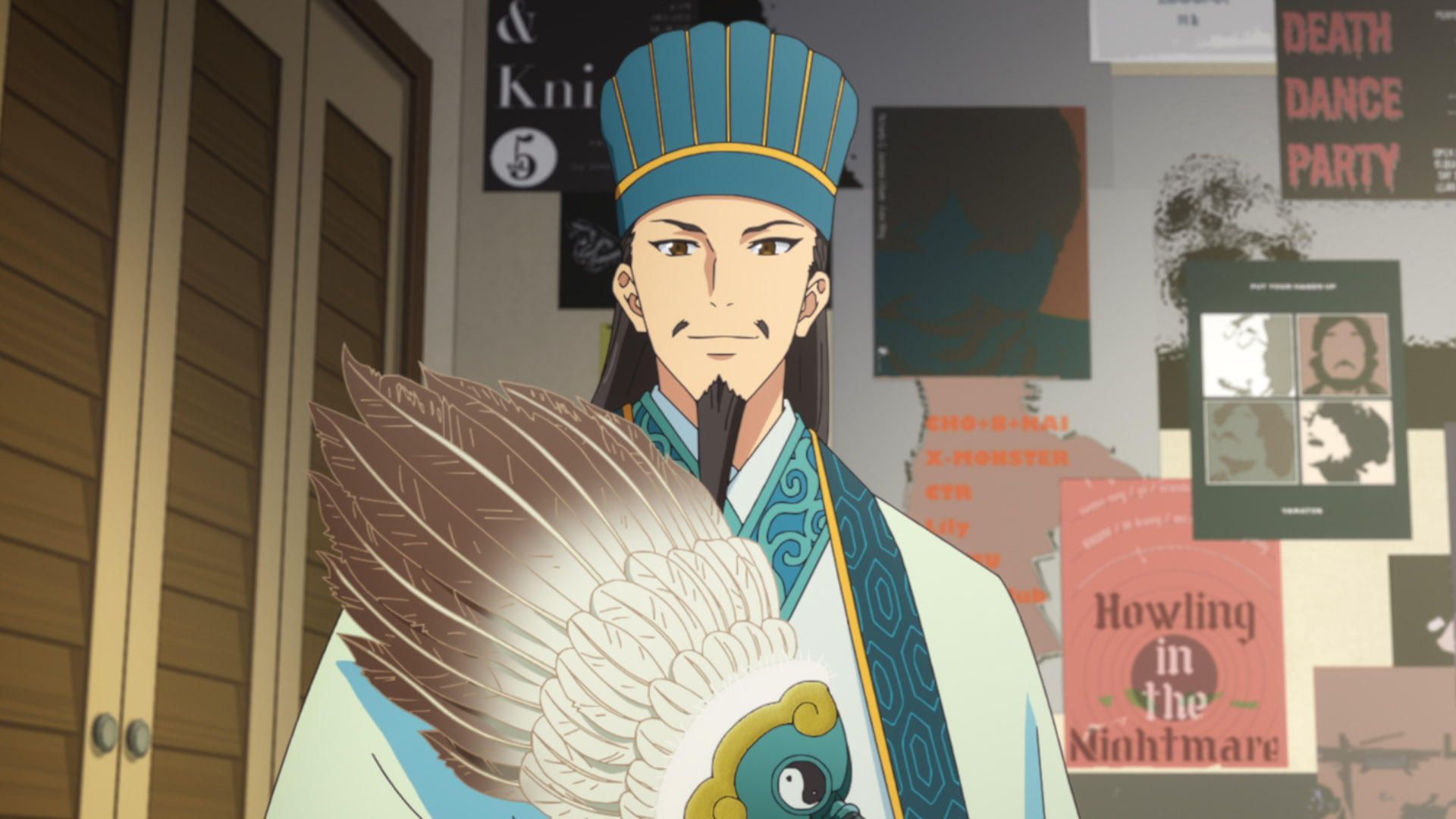
Ya Boy Kongming! begins with the manga by Yuto Yotsuba and Ryo Ogawa. Start its first book or the twelve-episode 2022 anime at episode one. The premise brings Zhuge Kongming into contemporary Shibuya and pairs his strategic imagination with Eiko’s musical ambitions. It is a fictional timeslip comedy, not a biography of the historical strategist.
Road to Summer Sonia is the 2024 animated compilation film. The official page explains that it selects a route from the twelve television episodes and adds new live-performance material. It offers a different presentation of that story; it is not season two or a mandatory continuation after the television ending.
No source novel was verified for this guide. The live-action television and film adaptations remain outside the manga-anime map. Historical writings about the Three Kingdoms are contextual reading, not earlier volumes of Yotsuba and Ogawa’s series. After watching, begin the manga at its opening unless a specific chapter comparison has actually been checked.
| Route | Entry point | Relationship |
|---|---|---|
| Manga | Book 1 | Original ongoing source |
| Television anime | 2022 episode 1 | Twelve-episode adaptation |
| Animated film | Road to Summer Sonia, 2024 | Compilation with added performance material |
| Historical reading | Separately chosen history | Context, not canon prerequisite |
| Live action | Separate adaptation coverage | Excluded from core map |
Current publisher dates override the old anime-site book banner
Kodansha’s Japanese volume twenty-six was released on 6 August 2026, ISBN 9784065444955. Its series page schedules volume twenty-seven for 6 November 2026, which remains forthcoming at this review. The older television website’s ninth-volume promotion is an archived campaign detail, not a reliable statement of the current source’s latest book.
The English publisher labels its edition ongoing and digital. Its volume twenty-five product lists a 15 September 2026 digital release, now past at this review. Japanese twenty-six and forthcoming twenty-seven should not be presented as already available English books merely because the numbering resembles the English list or a search result displays the source cover.
The animated film’s official site dates its Japanese theatrical opening to 1 March 2024 and describes a compilation. The source is not marked complete here, and no second animated season date was verified in the consulted official records. A later publisher book announcement can be added without manufacturing a new animated installment.
An old-world strategist can be surrounded by contemporary costumes
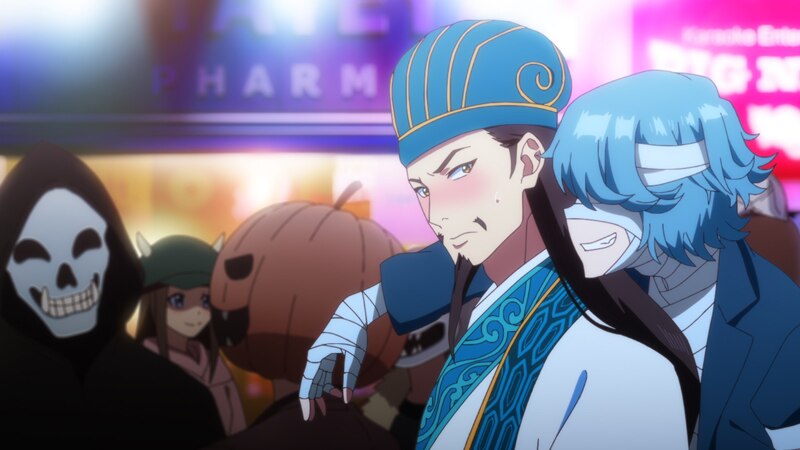
The selected original first-episode frame shows Kongming in his tall blue-and-gold headwear beside a blue-haired, bandaged costumed figure. Other festive figures and brightly lit urban signs fill the scene. The official opening synopsis places his arrival in Halloween Shibuya, establishing the setting for this visual contrast without requiring the episode’s outcome.
Our reading begins with the fact that Kongming’s clothing does not look more out of place than the surrounding costumes. A crowded celebration gives an extraordinary arrival a plausible social cover. The scene can make a historical figure seem accepted before the people around him understand anything about his actual circumstances.
That observation concerns visible design and the licensed opening premise. It does not prove a real historical event, diagnose the surrounding people or identify every background figure. The frame provides a bounded example of how the adaptation connects an unfamiliar visitor with a contemporary setting, rather than an AI rendering of an invented encounter.
Original visual reference
A good song needs circumstances in which someone will hear it
Our central interpretation asks what strategy can supply that musical ability alone cannot. Eiko’s ambition needs opportunities, an audience and conditions in which her work receives attention. Kongming’s role makes planning part of a performance story, connecting creative expression to the practical problem of getting people to listen.
A close reading should distinguish creating an opportunity from substituting a plan for an artist’s own voice. A useful arrangement can make space for the performer, while an overbearing one could reduce her to a piece on someone else’s board. That distinction is more informative than calling every successful tactic proof that talent is irrelevant.
The military vocabulary creates comic displacement, but it also invites a question about the ethics of influence. A crowd is made of people who choose what to attend to. A reviewer can trace how a named tactic changes those choices without treating a fictional success as a guaranteed marketing technique for real musicians.
Encouragement has value when the performer keeps a decision
The official character premise presents Eiko as an aspiring singer who has struggled to find an audience. Our reading examines how another person’s belief can interrupt that discouragement without erasing the difficulty of the work. Support matters because it changes what seems possible, while the singer still has to decide what to express.
A close reading can follow whether encouragement is paired with listening. Does the adviser understand the performer’s goals, or simply recruit her into his own? The relationship gains depth when practical assistance and recognition reinforce one another. That makes a mentor more than a machine for delivering victories in successive competitions.
The fictional premise is not a clinical account of distress, and a motivational scene does not establish a universal remedy. Here the analytical focus is agency: who sets a goal, who supplies resources and whose choice completes the action. Specific scenes can answer those questions more clearly than a blanket assertion that confidence solves every obstacle.
Performance changes what a page can leave to imagination
A manga about music can represent a performance through drawing, text and the reader’s imagined rhythm. An animated adaptation makes decisions about audible voices and duration. Our analysis asks how those decisions give the same premise a different immediate experience, without declaring one medium automatically superior or more authentic.
The official credits distinguish Eiko’s spoken performance by Kaede Hondo from her singing by 96neko, and Nanami’s spoken performance by Hibiku Yamamura from singing by Lezel. This division makes the production’s musical work visible. A viewer should not assume that every audible vocal part belongs to the actor credited for dialogue.
The compilation’s added live-performance material creates another comparison opportunity. A full assessment needs the television and film sequences themselves, not just the announcement. The guide establishes why those versions are related, while avoiding an exhaustive song-by-song claim or reproducing copyrighted lyrics to inflate the apparent depth of its music analysis.
Source collaborators, anime staff and performers retain separate credits
The Japanese publisher distinguishes Yotsuba’s original writing role from Ogawa’s manga work. The animated production credits Osamu Honma directing, Yoko Yonaiyama for series composition and P.A.WORKS for animation. These connections let visitors explore creators and studio work without assigning the manga’s drawings to the director or its source concept to a singer.
The production’s official gallery and studio record supply original visuals and named staff. Community discussion can help visitors compare favorite strategies, performance impressions and adaptation choices, with spoilers possible. The linked wiki is secondary navigation; publisher schedules control current book dates rather than a fan list whose latest number may lag behind an announcement.
AniList’s displayed 7.9 out of 10 concerns only the twelve-episode 2022 television entry. The manga, compilation film, live action and individual performers do not inherit it. The visible audience score remains a dated snapshot of that named adaptation, with no Animeteor voting system or invented cross-format average attached to the property.
A historic circulation claim should stay attached to its campaign
The animated film’s 2024 promotional text states that cumulative manga circulation had passed two million. This guide preserves it as a dated campaign claim. It is not automatically the current October 2026 total, a count of copies sold to readers, or a measure of profits earned by the animation studio.
No audited Ya Boy Kongming-specific net profit or complete production budget was verified. Manga distribution, licensed streaming, recordings and film exhibition concern different commercial activity. A song’s visibility or a performance clip’s view count does not establish the revenue allocated to the source creators, cast or production committee without reliable reporting.
Start the manga or the television anime, then choose the compilation for an alternate presentation. Future updates should check the forthcoming Japanese twenty-seventh book and current English digital products separately. New animated announcements can extend the route when verified; until then, neither the old ninth-volume banner nor live-action activity fills a nonexistent second-season date.
Primary sources and useful navigation
- Kodansha Japan · source collaborators and forthcoming book
- Kodansha Japan · volume twenty-six, August 2026
- Kodansha English · digital source edition
- Kodansha English · volume twenty-five, September 2026
- Official television archive
- Official first-episode gallery and synopsis
- Official credits · spoken and singing performers
- Official animated compilation · scope and historical circulation claim
- P.A.WORKS · production record
- AniList · named adaptation audience score
Community and catalog routes
- MyAnimeList · named adaptation catalog
- Reddit · anime discussion, spoilers possible
- Fandom · secondary volume reference, spoilers
The production and publisher links support project facts. Catalog and community pages are secondary navigation and may reveal later events.
Find this work in our thematic collections
Original series imagery is reproduced under permission asserted by the site owner; the source and rights credits are retained. The route diagram is Animeteor’s own explanatory graphic.
Games and live-action adaptations
- Ya Boy Kongming! The Movie — Live action: Film · 2025
- Ya Boy Kongming! (2023 drama) — Live action: Series · 2023