Start CLAMP’s main nineteen-volume comic or the 2006 anime, then Kei. Rei and AnotherHOLiC are separate reading branches. Japanese Rei 6 and English Rei 5 are forthcoming; stale completion labels do not establish the current source status.
Reviewed 2 October 2026 · Opening premise and format relationships; major ending revelations withheld. Linked publisher summaries and discussions may reveal later events. · Licensed access varies by country.
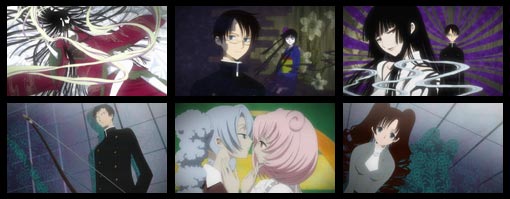
The source and screen branches

The main comic is the root. The map is a first-entry and release route, not a certified chapter synchronization with Tsubasa. Rei publication and optional prose are separate branches; live action and games are excluded.
- READ · main / return: Main standard manga · 1–19 → Then separately titled Rei
- WATCH · television: 2006 series · 24 episodes → 2008 Kei · 13 episodes
- WATCH · optional branches: Film · separate companion → Shunmuki → Rou → Rou Adayume
- READ · optional prose: Nisio Isin · AnotherHOLiC → CLAMP source · no exact crossover seam certified
Begin the main comic before its return series or connected-world research
xxxHOLiC begins with CLAMP’s main nineteen-volume comic. Choose a standard edition or a collected binding and retain that edition’s numbering. Rei is a separately titled return series, not an alternative name for the first television season. A first reader can begin the main comic without starting from a list of later crossover revelations.
For animation, begin the twenty-four-episode 2006 series, then the thirteen-episode 2008 Kei. The named disc animations Shunmuki, Rou and Rou Adayume belong to later branches. Their products are separate from the numbered television seasons. This guide uses broad release order for first viewing and does not claim a complete chapter-by-chapter synchronization with Tsubasa.
The 2005 film A Midsummer Night’s Dream is an optional film branch. Nisio Isin’s AnotherHOLiC is prose based on CLAMP’s property, not the source of the manga. Live-action versions and games stay outside this core roadmap. A connected-world analysis needs named scenes and editions; familiar characters alone cannot certify that every screen version preserves the same links.
| Route | Begin | Optional continuation |
|---|---|---|
| Manga | Main comic volume 1 | Standard main sequence 1–19, then Rei |
| Anime | 2006 television series | Then Kei, 2008 |
| Disc animation | After television introduction | Shunmuki → Rou → Rou Adayume |
| Film | A Midsummer Night’s Dream | Separate optional film |
| Prose | AnotherHOLiC | Companion, not the original source |
Current product records override a stale regional completion label
CLAMP’s official special site lists the main Premium Collection through nineteen books and separately identifies Rei volume five. Kodansha dates Japanese Rei five to 29 November 2025, ISBN 9784065414224. The Japanese publisher now schedules Rei six for 6 November 2026. That is forthcoming at this guide’s October review, not an already published sixth book.
The English distributor lists Rei five for 19 January 2027. It remains forthcoming even though Kodansha’s English series page still carries a complete label and lists four available volumes. The guide records that mismatch explicitly instead of treating a broad catalog badge as proof that the continuing Japanese source ended at English volume four.
The special Japanese Rei-five edition includes a recording of a 2017 sound-theatre performance. It is not a newly animated television season. Buying a disc-bundled comic can provide a different kind of extra, so check whether the product contains animation, theatrical performance or another supplement before adding it to a watch list.
An original television visual presents the shop’s unequal relationship
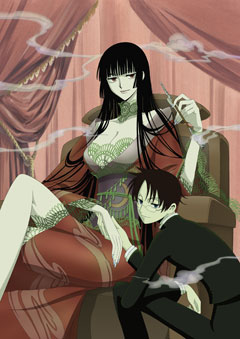
The selected original Production I.G television illustration shows Yuko seated above Watanuki, with red fabric, a pipe and drifting smoke organizing the composition. Watanuki sits lower in dark clothing. This is promotional key artwork from the television production, not an isolated frame from a transaction whose outcome the picture reveals.
The broadcaster’s premise identifies Watanuki as a young person troubled by seeing supernatural beings. Yuko offers to change his condition for a corresponding price, and he begins working in the shop. The opening relationship therefore joins a request for relief with an obligation whose meaning has to be learned.
Our visual interpretation is that the difference in height and posture makes unequal knowledge legible before a viewer knows the shop’s rules. The smoke adds an obscured atmosphere without proving that Yuko lies or that Watanuki understands the exchange. The image and premise support a bounded question about authority rather than a spoiler-filled account of the later resolution.
Original visual reference
A wish can conceal the consequences of receiving exactly what was requested
Our central reading treats the shop’s price as more than a fantasy fee. A request describes what somebody currently believes would solve a problem. The dramatic question is whether that description contains the whole need, and whether the requester understands what changing one condition might cost elsewhere in their life.
A close reading can compare the words of the request with the result of the transaction. What was promised, what was assumed and what was never discussed? That distinction lets an encounter expose a character’s habits without reducing every customer to a simple moral lesson about greed or foolishness.
The shop also makes explanation a form of power. Someone who knows the terms can guide a person who only knows their distress. Analysis should preserve the difference between a technically stated condition and a fully understood bargain, rather than declaring every consequence fair simply because a mysterious rule has been announced.
The supernatural encounter can make an ordinary attachment visible
The property’s title invites attention to habits and dependencies. Our interpretation asks how a repeated act becomes something a person cannot easily set aside, even when it causes discomfort. A supernatural situation can exaggerate that attachment so the audience sees a pattern that an ordinary explanation would make easy to dismiss.
This does not require turning every guest into a clinical diagnosis. The narrative concerns desire, avoidance and consequence through fictional rules. A useful scene analysis describes observable action and what the person says they want, leaving medical claims outside the evidence supplied by a comic or animated episode.
Watanuki’s work can also make routine meaningful. Repeated visits, preparation and small services establish relationships over time. The shop is therefore both a place of exceptional bargains and a setting in which ordinary responsibilities accumulate. The contrast gives quiet activity analytical value alongside the most conspicuous supernatural event.
A connected world needs an explicit scope before a combined chronology
CLAMP’s official site identifies shared material with Tsubasa, including the Soel and Larg picture book and its named characters. Those are verifiable connections. They do not automatically establish one universal viewing order across every comic, film and television production using the same property names.
Our recommendation for a new reader is to keep the main xxxHOLiC introduction coherent before pursuing a detailed crossover comparison. A later research article can identify the named Tsubasa edition and the exact scenes being aligned. That narrower method makes a connection checkable without demanding that a first-time visitor understand every later revelation before opening book one.
The same discipline applies to chronology. Release order, a character’s experienced sequence and an adaptation’s presentation are different organizing principles. This guide does not force them into one branching diagram whose apparent precision exceeds the evidence. Its map shows access routes and named companions, with unverified exact seams left unasserted.
CLAMP’s source and Nisio Isin’s prose contribution are distinct
CLAMP created the main comic. Production I.G’s named film and disc records credit Tsutomu Mizushima directing and Kazuya Kise for character design, with Nanase Ohkawa involved in specified later scripts. Credits should remain attached to the actual production rather than being assigned to every adaptation by association.
Kodansha identifies AnotherHOLiC as Nisio Isin’s prose treatment of CLAMP’s comic. This is an additional authorial contribution, not a claim that Isin wrote the source manga. The special-site sound-theatre record similarly identifies an Ohkawa script and a staged performance, preserving the medium instead of presenting every recorded release as animation.
The displayed AniList 7.6 out of 10 is scoped to the twenty-four-episode 2006 television entry. It excludes Kei, the film, Rei manga and companion prose. Fandom and Reddit provide discussion and navigation with major spoilers possible; current publisher and production records control edition and release assertions.
A new binding, a returning series and a performance disc are different releases
Premium comic editions, continuing Rei products and a recorded performance demonstrate several ways the property reaches an audience. Their product dates and media types are meaningful commercial context. They do not identify how many copies were actually sold, how licensing income was divided or whether every regional edition is available today.
No audited title-level net profit or complete television budget was verified. Retail prices for a special comic-and-disc package are not equivalent to creator income, and a group’s general business results cannot be allocated to this title without a reporting basis. Future numerical coverage should identify the territory, period and financial measure.
Begin the main comic or first television series, then choose the named companions for their specific purpose. Later updates can revise the forthcoming Rei dates and regional access while retaining the catalog discrepancy in the maintenance record. This avoids converting a stale complete label, a stage recording or an anniversary product into an invented new animated season.
Primary sources and useful navigation
- CLAMP · official main editions and related-media distinctions
- Kodansha · Japanese Rei five, date and ISBN
- Kodansha · Japanese Rei six forthcoming
- English distributor · Rei five forthcoming January 2027
- Kodansha US · regional Rei catalog with conflicting complete label
- TBS · first television story and episode archive
- TBS · Kei episode archive
- Production I.G · original television artwork
- Production I.G · optional film
- Production I.G · two-part Shunmuki
- Production I.G · Rou disc product
- Kodansha · AnotherHOLiC prose author and source relationship
- AniList · named adaptation audience score
Community and catalog routes
- MyAnimeList · named adaptation catalog
- Fandom · secondary connected-world navigation, spoilers possible
- Reddit · CLAMP discussion
The production and publisher links support project facts. Catalog and community pages are secondary navigation and may reveal later events.
Find this work in our thematic collections
Original series imagery is reproduced under permission asserted by the site owner; the source and rights credits are retained. The route diagram is Animeteor’s own explanatory graphic.
Games and live-action adaptations
- xxxHOLiC — Live action: Film · 2022
- xxxHOLiC: Watanuki no Izayoi Souwa — Game: Supernatural adventure
A television drama distinct from the film
CLAMP’s 30 September 2013 notice confirms a WOWOW live-action television drama broadcast in spring 2013, with Blu-ray/DVD boxes released on 6 November 2013 by WOWOW and Amuse Soft. It is distinct from Mika Ninagawa’s already linked 2022 feature film. The historical disc notice does not establish present streaming availability or turn either production into another anime season.
CLAMP — exact television and disc notice · WOWOW — 2013 production discussion record