Watch the original 2009 anime in episodes 1–11. A 2010 Japanese film comic and Natsuko Takahashi’s Yuki to Hoshi no Suna prose adaptation are optional alternatives after the screen story. They are derived works, not source novels or sequels.
Reviewed 1 October 2026 · Opening premise and format relationships; major ending revelations withheld. Linked publisher summaries and discussions may reveal later events. · Licensed access varies by country.
The source and screen branches

The anime is the original. The film comic and restructured prose book follow it in publication; no frame-to-page equivalence is claimed. Disc-five booklet fiction is a separate optional extra.
- WATCH · original story: Episode 1 · Odaiba outing → Continue through episode 11
- READ · optional print versions: 2010 film comic · one book Alternate presentations OR Yuki to Hoshi no Suna · novel
A short journey whose destination becomes everything
Tokyo Magnitude 8.0 is an original eleven-episode anime about Mirai and her younger brother Yuki trying to return home after a fictional earthquake in Tokyo. Begin with episode 1 and continue through episode 11. Its later film comic and prose adaptations are optional reading branches; neither is the source from which the 2009 television story was adapted.
The premise begins with an ordinary disagreement about how to spend a summer day. Mirai accompanies Yuki to an Odaiba robot exhibition, then the earthquake changes what familiar places mean. Mari, a motorcycle courier with a child of her own to worry about, becomes an important adult companion. Home in Setagaya is a destination with emotional as well as physical importance.
Choose this if you want a compact family drama shaped by damaged infrastructure and dependence on strangers. Its appeal is different from a power fantasy about an invulnerable rescuer. Expect distress, injuries, death and bereavement; this beginner guide does not disclose the major late revelation. The complete television run offers the strongest first encounter because its progression of information matters to the experience.
The eleven television episodes are the core route
The original production site maintains episode records from Odaiba Sinks through the eleventh episode. BONES dates the project July–September 2009, and Fuji TV records the broadcast’s end on 17 September 2009. Follow these numbered episodes in release order rather than searching for a hypothetical first-season prequel or a later sequel to finish the main drama.
The story’s chronology is a journey through a disrupted city, but the audience’s access to that journey is deliberately structured. Moving memories and explanations into an absolute timeline would change the first-viewing experience. Our diagram therefore shows the television sequence as the main branch and the print adaptations as alternatives, rather than combining every depiction into a new invented master timeline.
A catalog can describe the first home-video disc as forty-five minutes because it holds two episodes. That is not the runtime of the entire series. The distributor’s product details and the episode archive serve different purposes: one identifies a physical release, while the other establishes the narrative run. Check the label before buying a single disc advertised beside a series title.
| Medium | Verified route | Relationship |
|---|---|---|
| Anime | Episodes 1–11, 2009 | Original main production |
| Film comic | One Japanese collected adaptation | Derived from screen presentation |
| Novel | Yuki to Hoshi no Suna, 2010 | Reconstructed prose adaptation |
| Disc booklet fiction | Volume-five limited-edition bonus | Separate supplementary text |
A film comic and a novel follow the anime
Japan’s National Diet Library catalogs Tokyo Magnitude 8.0: Film Comic as a Fusosha publication from February 2010, ISBN 9784594061272, with 391 pages. The old production site advertises a 21 January sale date and a 392-page specification. We preserve that distinction between catalog publication month and promotional sale information instead of silently treating the two records as identical.
The production site also announces Natsuko Takahashi’s novel Tokyo Magnitude 8.0: Yuki to Hoshi no Suna as a newly restructured version of the story. The publisher-supplied Books.or.jp record confirms Takeshobo, ISBN 9784812441183, 298 pages and release on 18 May 2010. That completed book record is more precise than the old announcement’s late-April-to-early-May planned window.
Asmik Ace additionally lists a Takahashi-written novel in the thirty-six-page setting booklet for the fifth limited-edition disc. That bonus is not automatically the same text as the standalone 298-page book. The map separates the main prose adaptation from disc supplementary material, and this guide does not claim a licensed English print edition or an exact point at which the bonus should interrupt the television episodes.
Episode one: Mirai’s interrupted ordinary day
The original project’s episode-one image shows Mirai gripping a rail with an open-mouthed expression, cloudy sky and diagonal structural lines behind her. A narrow yellow rule appears at the bottom of the supplied 320-by-184 image. We preserve the original composition and identify its modest native size rather than presenting an enlarged reconstruction as a higher-resolution episode frame.
Our reading is that the visible hand matters as much as the facial reaction. Mirai is responding to a physical environment that has stopped behaving as expected; the rail becomes something to hold rather than a background decoration. Diagonal lines give the frame instability without requiring this guide to reveal the consequences of the later journey.
The official synopsis confirms that an unremarkable outing becomes the earthquake’s starting point for the siblings. It does not establish every action immediately before and after this selected image, or prove that a film-comic page reproduces precisely this composition. The case check is therefore a bounded reading of an actual first-episode visual alongside the verified premise, not a claim of a complete adaptation comparison.
Original visual reference

Mirai’s frustration is part of the point of view
The opening’s dissatisfaction gives Mirai a viewpoint rather than presenting her only as a disaster victim. Our interpretation is that the ordinary irritations matter because the emergency changes their scale. A complaint about a sibling can coexist with concern for him; the story does not need to make her flawless before the audience is allowed to care about her.
Yuki’s interest in the robot exhibition also gives their outing a specific purpose. The destination has been chosen before catastrophe, so the disrupted day feels lived rather than constructed purely to display damage. Mari enters the premise with her own family concern. She is not simply a convenient helper without a life beyond the children’s immediate problem.
For a first viewing, notice when Mirai describes what she feels and when somebody else interprets it. An adolescent’s point of view can make an adult seem distant without making that impression the whole truth. That distinction is useful when discussing her behavior online: disliking an impatient response is different from showing that the story has no interest in how the response was produced.
Infrastructure turns emotional distance into physical distance
Home is normally something reached through routines: a train, a road, a familiar phone call. The premise removes that easy access. Our reading is that the city then becomes a chain of dependencies, with movement and information shaped by systems people usually barely notice. A damaged route changes a relationship because reaching the person at its end becomes uncertain.
This gives small choices dramatic weight. Waiting, changing direction or relying on another person can matter more than spectacular action. When watching, track what the characters know about their destination at each stage. Information can be incomplete, delayed or misunderstood; the difference between a confirmed fact and a fear is part of the emotional experience.
The anime depicts a fictional catastrophe, not a prediction of a particular earthquake or a usable emergency plan. Its value as drama can lie in making dependence visible, while real preparedness requires current official guidance for an actual location. That boundary matters especially when a plausible-looking animated action is exciting but would be unsafe to imitate.
The staff record anchors the emotional interpretation
BONES and Fuji TV credit Masaki Tachibana as director, Natsuko Takahashi for series composition, Atsuko Nozaki for character design and Kow Otani for music. Animation production is shared by BONES and Kinema Citrus. The credits identify the actual project and give readers routes to explore contributors without assigning every visual or narrative decision to a single studio name.
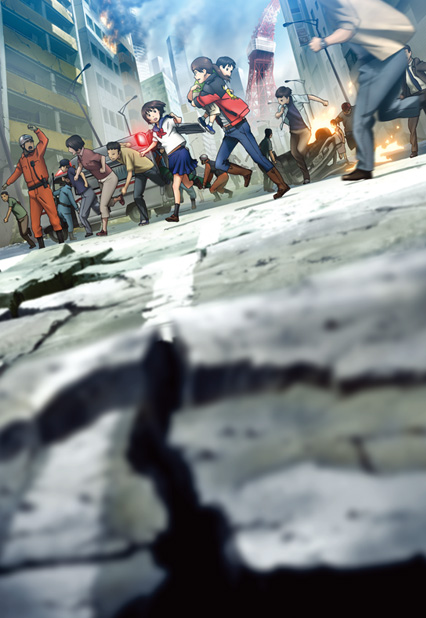
Our interpretation of the premise is that recognizable ordinary behavior and recognizable urban space need to support each other. A ruined landmark alone can communicate scale, but the siblings’ prior connection to the outing supplies a reason that the scale hurts. The first-episode image and the promotional poster provide two different views: an individual response and a broader composition of movement through damage.
The music credits also lead to the opening Kimi no Uta by abingdon boys school and ending M/elody by Shion Tsuji. Sony Music’s original notices are historical release records. They support the relationship between music and production, rather than proving that an old purchase link or campaign remains active today.
Two opening episodes provoke a useful pacing disagreement
In the linked 2025 r/anime rewatch, host RetroCrush_Matt pairs episodes one and two because the first establishes characters before the disaster aftermath develops. Mecanno-man likewise distinguishes an opening dominated by Mirai’s family dissatisfaction from a second episode more closely matching their expectations of a disaster story. These are individual viewing responses, not a survey of all audiences.
Mecanno-man also questions whether an early rescue decision sends an unsuitable safety message. That is a productive critical distinction: an event can make a compelling drama while raising doubts as a model for conduct. Our guide evaluates the fiction’s point of view and does not endorse a character’s action as emergency advice.
The discussion’s streaming recommendations belong to its posting date and territory. They should be checked against a provider’s current catalog before subscribing. The score above is AniList’s audience average for the original eleven-episode 2009 television entry; neither the novel nor a disc set inherits that score. The full-series rewatch below has substantial ending spoilers.
Physical editions document distribution, not profitability
Asmik Ace lists the first Japanese Blu-ray’s release on 28 October 2009, product code ACXA-10725, and the series’ five physical volumes. Its historical prices and limited-edition extras describe those products at release. They do not establish current availability, secondhand value or the profit of the animated production.
The film comic, standalone novel and booklet fiction demonstrate that the original screen story moved into several print forms. That is a more precise commercial observation than guessing that a short television run must have been cheap or unsuccessful. We have no audited title-level budget or revenue in the linked records, so no financial total is invented.
Begin with the complete eleven-episode anime. Afterwards, the Japanese prose version offers a different construction, while the film comic offers a book presentation of the screen material. For related works, use the dangerous-rescue collection below and compare their treatment of ordinary people under pressure. Any future adaptation study can expand this guide while preserving the source direction: this property began as an original anime.
Primary sources and useful navigation
- BONES · original production and staff
- Fuji TV · broadcast record and premise
- Original project · all eleven episodes and image
- Original project · print adaptation announcements
- Asmik Ace · physical editions and booklet fiction
- National Diet Library · film-comic edition
- Publisher-supplied Books catalog · standalone novel
- Sony Music · original DVD announcement
- Sony Music · opening song catalog
- AniList · named TV audience score
Community and catalog routes
- MyAnimeList · named television catalog
- Reddit · episodes one and two rewatch
- Reddit · full-series discussion; major spoilers
- Wikipedia · reference navigation; spoilers
The production and publisher links support project facts. Catalog and community pages are secondary navigation and may reveal later events.
Find this work in our thematic collections
Original series imagery is reproduced under permission asserted by the site owner; the source and rights credits are retained. The route diagram is Animeteor’s own explanatory graphic.