Start the 2008 first TV season, then Zoku, San, Shi, Go, Roku and Shichi, or read Yuki Midorikawa’s manga from volume 1. Films and extra animation remain separate options. English volume 32 is an edition record, not a certified final book.
Reviewed 2 October 2026 · Opening premise and format relationships; major ending revelations withheld. Linked publisher summaries and discussions may reveal later events. · Licensed access varies by country.

The source and screen branches

Seven numbered seasons form the main TV route. Additional stories do not become season 8. No exact manga handoff is certified.
- READ · source manga: Manga volume 1 Later English volume · forthcoming English volume 33 · 1 June 2027 · forthcoming
- WATCH · numbered television: Season 1 · 2008 → Zoku → San → Shi → Go → Roku → Shichi
- WATCH · optional additional stories: Ephemeral Bond Separate extras; after familiarity Waking Rock / Strange Visitor
Begin with the inherited book, then follow the numbered seasons
Natsume’s Book of Friends begins with a young person who can see beings others cannot and inherits his grandmother Reiko’s book of names. Yuki Midorikawa’s manga is the source. For television, start the 2008 first season, then follow Zoku, San, Shi, Go, Roku and Shichi as seasons 2 through 7.
The seven titles can look like unrelated installments in a search result. They are clearer when displayed with their season numbers. Start at the first encounter rather than at the newest promotional page; later episodes can assume an established household, friendships and the meaning of the inherited names.
The official portal lists theatrical and additional animation separately from the numbered series. Ephemeral Bond and The Waking Rock and the Strange Visitor can be treated as extra screen encounters after you know the central cast. They should not displace the first TV season or masquerade as required source volumes.
| Route | Start or sequence | Distinction |
|---|---|---|
| Source manga | Midorikawa · volume 1 | Original reading route |
| Numbered TV | 1 → Zoku → San → Shi → Go → Roku → Shichi | Seven seasons; Shichi is season 7 |
| Film | Ephemeral Bond | Additional screen story, after familiarity |
| Extra screen stories | The Waking Rock and the Strange Visitor | Separate listing; not season 8 |
An English volume record is an edition, not an ending
VIZ’s English catalog lists volume 32 for 5 May 2026, ISBN 9781974763375, with 168 pages. That is a specific verified publication record. It is not labeled the final source volume in the material inspected for this guide, so the series should not be presented as a completed thirty-two-book story.
Begin at the first VIZ volume if you want the manga’s original introduction. A later volume’s description may assume character relationships and reveal developments far beyond the first television encounter. Use the catalog to check availability and edition details without copying its late-story plot into a beginner overview.
No verified source novel route was established here. The central book inside the story is an inherited object with narrative significance, not evidence that the property originated as prose. The adaptation map therefore connects source manga with animation and keeps other creator works outside this property’s chronological lanes.
VIZ’s distributor separately lists English volume 33 for 1 June 2027, ISBN 9781974772162, with 168 pages. It is forthcoming at this review, not an already released next volume. The later listed book also makes it inappropriate to interpret volume 32 as a source-ending declaration.
The safest manga return point preserves how trust accumulates
This guide does not certify a precise manga chapter after season 7. An accurate handoff would require matching the chosen season’s final adapted material to the licensed collection and checking earlier rearranged or omitted stories. A simple season-to-volume equation would hide those differences.
For a reliable source entry, start at manga volume 1. That choice revisits familiar incidents, but it also lets you observe how Midorikawa distributes quiet responses, introductions and emotional perspective on the page. Episodic stories can establish lasting habits even when they do not look like a conventional advancing plot.
If you have watched only an early season, resist using a latest-season continuation shortcut. Specify the exact screen endpoint before seeking a source match. The purpose is to preserve what a character knows and how a friendship feels at that point, not merely to avoid repeating an event you recognize.
The first-season image is an encounter at a shrine structure
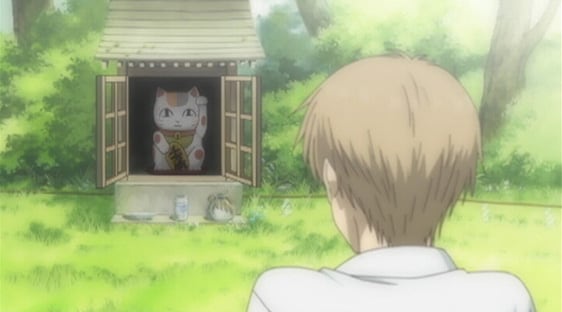
The official first-season introduction supplies an opening frame showing Natsume from behind near a wooden shrine structure, with a catlike figure visible ahead. The image is kept intact. It is not described as a modern pet-carrier scene or as a later season’s new encounter.
The source introduction explains the significance of Reiko’s collected names and Natsume’s contact with the beings connected to them. Those facts support the opening premise. The frame itself mainly establishes a meeting: the human figure faces something contained within a structure, while greenery surrounds the encounter.
Our interpretation is that this composition makes attention the first meaningful action. Before deciding whether an unfamiliar being is a threat, a nuisance or a companion, somebody has to notice it. The wider premise turns that capacity to see into an obligation to understand, while keeping the individual outcome of the scene unspoiled.
Original visual reference
Returning a name changes what inherited power is for
The book offers a useful way to analyze authority without reducing the series to stronger and weaker opponents. Our reading is that an inherited ability to control others can instead become a responsibility to reconsider the relationship. A name is personal information and a connection, as well as a tool within the story’s supernatural rules.
This changes what a successful encounter looks like. Victory need not mean keeping everything a previous generation acquired. Letting something return to its owner can express a more considered use of power, particularly when the protagonist did not choose the circumstances that created the obligation.
That reading does not mean every unfamiliar being is harmless or every claim deserves automatic trust. The series’ premise allows uncertainty about motives. The analytical question is how Natsume reaches a judgment, and whether the judgment acknowledges somebody’s history rather than treating an inherited record as the whole truth about them.
Being able to see is not the same as being believed
Our interpretation of the everyday-wonder theme is that perception can create loneliness when it cannot easily be shared. Seeing a presence others miss may provide knowledge, yet leave the observer without a straightforward way to explain a reaction. An ordinary social situation can become difficult before a supernatural confrontation begins.
The recurring household and familiar faces therefore matter as much as the unusual visitor of the week. Trust changes how much explanation a person feels required to supply. A conversation that seems small can demonstrate a shift from anticipating disbelief toward expecting somebody to listen.
This makes episodic structure useful rather than disposable. Different encounters can revisit the same emotional problem under different conditions: fear, gratitude, obligation or remembrance. Watch for changes in the protagonist’s willingness to approach others and ask for help, instead of judging progress only by whether a large antagonist has appeared.
Read production credits season by season
The official first-season record credits director Takahiro Omori, series composition Kenichi Kanemaki, character designer Akira Takata, composer Makoto Yoshimori and Brain’s Base. Those are first-season credits. The presence of seven seasons does not authorize copying that studio line into every later production without checking its own record.
Midorikawa’s authorship supplies another way to explore her catalog, but a different work by the same creator is not a Natsume sequel. The linked Reddit discussion and dedicated community are offered as places to examine personal viewing experiences and revisit older episodes, rather than as authority for release dates or source completion.
The displayed AniList audience score concerns the 2008 thirteen-episode first television season. VIZ’s manga artwork and the wider seven-season navigation do not turn it into a combined franchise rating. A visitor who wants a later-season opinion should inspect the catalog entry for that season instead.
Long-running availability needs careful maintenance
The official portal documents multiple television seasons and additional screen stories; VIZ documents a continuing localized manga catalog. Those records establish several published routes into the property. They do not disclose a title-level production budget, net profit or a measurable financial return on any particular season.
A prospective reader should check language, volume and territory before buying. A visitor planning to watch should separately check their legal local service, because an official Japanese portal’s installment list does not promise streaming availability in every country. Old event notices should remain historical records rather than be republished as imminent releases.
Begin with the first manga volume or the first numbered TV season and follow the route that suits your pace. On the next maintenance pass, verify newly announced source editions and screen projects while preserving the distinction between regular seasons and additional stories. The guide’s value is the relationship map, not an inflated count of supposedly mandatory installments.
Primary sources and useful navigation
- Official project portal
- First-season introduction, story and credits
- Seventh-season record
- Series and additional animation directory
- Ephemeral Bond · separate film
- The Waking Rock and the Strange Visitor · additional stories
- VIZ · source series
- VIZ · first English manga volume
- VIZ · English volume 32 edition
- AniList · named TV audience score
- VIZ distributor · forthcoming English volume 33, 1 June 2027
Community and catalog routes
- MyAnimeList · named television catalog
- Reddit · dedicated discussion community
- Reddit · personal rewatch discussion
- Wikipedia · secondary catalog navigation
The production and publisher links support project facts. Catalog and community pages are secondary navigation and may reveal later events.
Find this work in our thematic collections
Original series imagery is reproduced under permission asserted by the site owner; the source and rights credits are retained. The route diagram is Animeteor’s own explanatory graphic.
Games and live-action adaptations
- Natsume Yūjin-chō: Hazuki no Shirushi — Game: Summer-life adventure
Limited game collaboration alongside the standalone adventure
LINE Yahoo’s 25 September 2026 announcement identifies a Natsume collaboration inside LINE POP2, scheduled from 25 September at 11:00 through 23 October at 10:59 in the Japanese campaign notice. This is a limited event in an existing puzzle game, separate from Bushiroad’s standalone summer adventure and from the anime’s numbered seasons. The company’s 31 October anniversary date is not the event start. Individual promotions have their own dates; a notice does not establish every reward as currently obtainable in every territory.