Watch the complete standalone feature in its released order. Revisit memory and screen-role transitions afterward; the soundtrack and production interviews are optional study material.
Reviewed 3 October 2026 · Opening premise and adaptation relationships. Major endings withheld; linked catalog summaries and discussions may contain spoilers. · Licensed access varies by country.
The source and screen branches

These are viewing and study choices, not separate story installments. The official archive identifies production as 2001 and the studio records Japanese theatrical context in 2002. Remasters retain the same film.
- WATCH · complete feature: Standalone film · 90 minutes · No prerequisite or sequel route
- REWATCH · narrative layers: Present interview and remembered life · Screen roles · compare transitions
- OPTIONAL · study and listening: Named edition production interviews · Hirasawa’s official soundtrack
An interview becomes a journey through an actress’s memories and screen roles
Documentary filmmaker Genya Tachibana visits the retired actress Chiyoko Fujiwara with his cameraman. The closure of her former studio gives the interview a public purpose, while an old key opens a more personal history. As she remembers, the interviewers appear within scenes that mix her life with the films in which she performed.
Millennium Actress is an original animated feature conceived and directed by Satoshi Kon, not a manga or novel adaptation requiring preliminary reading. The story is complete in one film. A first viewing works best in its released order: the transitions are part of how Chiyoko tells and experiences the past, rather than errors a timeline must correct.
The official New Chitose festival archive identifies a 2001 Japanese production running 90 minutes, while Madhouse lists its theatrical work under September 2002. These records describe production and Japanese theatrical contexts rather than two different installments. A restoration, subtitle track or new dub likewise does not create a sequel.
The source is an original film concept, not a hidden numbered book series
Madhouse credits Kon for original concept and direction, with the screenplay shared by Kon and Sadayuki Murai. This anchors the guide’s format classification: Anime. References to Japanese cinema and changes of genre within Chiyoko’s screen career are not evidence that every film seen inside this feature has a separately published source that must be read.
The actress is a fictional character whose life is mediated through an interview and through her roles. A resemblance to a historical performer should invite contextual comparison, not an assertion that the film is a complete documentary biography of that person. Likewise, audience lists of possible movie references are interpretations unless a named creator or production source establishes a particular connection.
The verified companion route here is Susumu Hirasawa’s official soundtrack, with a September 6, 2002 release and twelve listed tracks plus a bonus video. It is music associated with the feature, not a novelization or additional narrative season. Soundtrack discovery can deepen a rewatch without creating a new canon sequence.
Follow the feature’s sequence before trying to separate its time layers
Watch the single feature from beginning to end. No earlier Kon film is a prerequisite, and the library should not invent a next manga chapter. Perfect Blue is an optional director comparison with a different story, not a prequel explaining Chiyoko. Other films by the same filmmaker should receive the same treatment unless a verified narrative link exists.
On a second viewing, distinguish the interview’s present, remembered personal events and screen roles. These are useful attention guides, not three independently released series. A transition can connect emotion, movement or composition across them without proving that the events happen simultaneously or that the interviewers literally traveled into history.
A chronological reconstruction may clarify a remembered event, but it should follow the first viewing rather than replace it. Sorting every scene into a rigid calendar can remove the film’s central experience: another person’s life arriving through selection, performance and the listener’s participation. The roadmap therefore maps viewing and study options, not an invented branching franchise.
Original visual reference
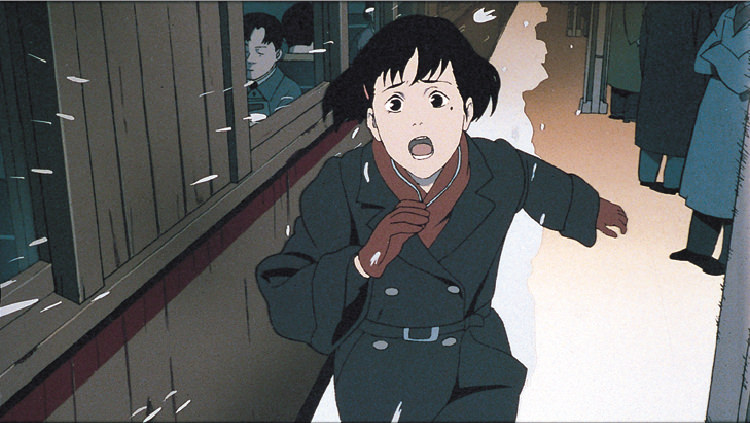
The listener becomes visible inside the life he wants to document
Our analysis begins with the documentary frame. Genya approaches Chiyoko as someone who wants to preserve a career, but his admiration means he is already involved in the material. He is not a neutral container into which facts simply fall. When the feature lets him enter remembered scenes, it gives visual form to the distance between recording a story and imagining your own place within it.
The cameraman supplies another position. His practical reactions can interrupt the intensity of Genya’s enthusiasm, reminding the viewer that the interview is also a job with equipment and a present-day setting. This difference keeps the film from reducing spectatorship to one ideal response. A listener can be absorbed, skeptical, amused or concerned while encountering the same account.
Chiyoko’s pursuit gives movement continuity even when the setting changes. Running, reaching and traveling can carry an intention across a cut into a different era or genre. The viewer may briefly need to reconsider where a scene belongs, yet the emotional action remains legible. That is why a transition can feel fluent while refusing ordinary calendar order.
A useful rewatch exercise is to notice what stays constant at each cut. Sometimes it is a gesture; sometimes a direction, a desire or the position of a figure within the frame. Rather than asking only which period has replaced which, ask why those two moments were placed together. The connection may explain the person remembering more than the literal chronology does.
Performance complicates the idea of an authentic self hidden behind every role. Chiyoko’s acting does not merely obscure her life: roles also give her ways to express or reshape it. A fictional scene can carry a personal urgency even when its costume and historical setting are not biographical facts. The film asks the viewer to hold that distinction without discarding either level.
The old key is especially effective because it is both a concrete object and a prompt for association. It can be held, lost or returned, yet its emotional significance exceeds its immediate practical use. The guide leaves later revelations unstated. On a first viewing, observe how the object changes the interview’s rhythm rather than treating it as a puzzle with only one technical solution.
Music can support continuity where visual settings refuse it. A recurring pulse or theme can make a journey feel ongoing across changes of place and age. Compare moments where the soundtrack encourages momentum with quieter passages where speech or hesitation takes over. A film about remembered pursuit needs both forward motion and pauses in which the account becomes vulnerable.
The demolished studio adds another scale of loss. Personal memory survives while a workplace and an institution disappear. Preserving images does not preserve every building, relationship or circumstance that made them possible. That tension gives the interview stakes beyond celebrity admiration: the act of listening may retain an experience while also revealing what cannot be restored simply by replaying it.
Different collaborators shape the film’s continuity across styles and ages
Madhouse identifies Kon and Takeshi Honda as character designers, Nobutaka Ike as art director, Hisao Shirai for photography, Satoshi Terauchi for editing and Susumu Hirasawa for music. The production credits name Genco and Madhouse. These roles help locate the work behind the seamless impression: design, backgrounds, photographed images, cuts and sound contribute in different ways.
The Japanese cast distinguishes Chiyoko’s ages, crediting Miyoko Shoji, Mami Koyama and Fumiko Orikasa. Continuity of character therefore does not require a single performer for every period. Genya and the cameraman are credited to Shozo Iizuka and Masaya Onosaka. A new English dub is another performance version of the same feature rather than an extra story.
The festival’s 2022 program documents a 4K remaster presentation for the twentieth anniversary of the Japanese theatrical release. Its enhanced-sound screening description concerns the exhibition setup, not a newly written soundtrack or plot. The archive is retained as historical evidence; it should not be displayed as an upcoming screening in the current release calendar.
Warmth and melancholy can arise from the same remembered pursuit
The linked discussion begins with a viewer describing difficulty separating personal memories from Chiyoko’s screen roles and uncertainty over whether the result feels happy or sad. Replies praise transitions and music, while others read the pursuit as an image of dreams or of romantic imagination. These are distinct responses to how the film frames a life.
The thread also contains detailed ending analysis, reference lists and claims about alternative translations. It is linked with a spoiler expectation, but those claims are not adopted here as verified production facts. Personal recognition can generate a productive interpretation without proving that every viewer shares it or that the interpretation is the creator’s stated intention.
AniList’s named entry was checked on October 3, 2026. Its weighted audience average was 81 out of 100, normalized to 8.1 out of 10 for Millennium Actress alone. The provider labels its season year 2002; that metadata is retained alongside the official festival’s 2001 production identification. Neither label adds another film to the route.
Check presentation, extras and territory before comparing editions
Anime Limited’s standard 4K edition lists the feature on 4K SDR UHD and Blu-ray, with Japanese and English audio and English subtitles. Its Blu-ray region is B, while the UHD region field is listed as not applicable. SDR matters: a 4K label should not automatically be described as an HDR presentation.
The checked release also lists interviews with performers Abby Trott and Laura Post and producers Masao Maruyama and Taro Maki. These can make an edition useful for performance and production study, but they do not become canon installments. The catalog date belongs to the disc edition, and availability or price should be checked at purchase rather than copied into a timeless recommendation.
The primary material used here does not supply an audited film budget and net-profit statement. A production committee credit indicates participating organizations, not their investment shares or eventual returns. Remaster exhibition, soundtrack sales and disc editions are separate commercial activities; estimating a profit by adding public retail prices would ignore costs, territories and revenue allocation.
One complete viewing supports several focused return routes
Begin with the feature in released order. Return to the interview frame, motion across cuts or the changes between personal events and screen roles according to your interest. Listen to Hirasawa’s official soundtrack for a music comparison, and use named edition extras for production context without treating them as further episodes.
Madhouse supplies the concept and staff credits, the festival archive supplies historical exhibition context and original stills, Anime Limited supplies the checked edition specifications and the composer’s shop identifies the soundtrack. The external catalog and discussion are separate audience-navigation tools. Each source is used for the kind of information it can actually establish.
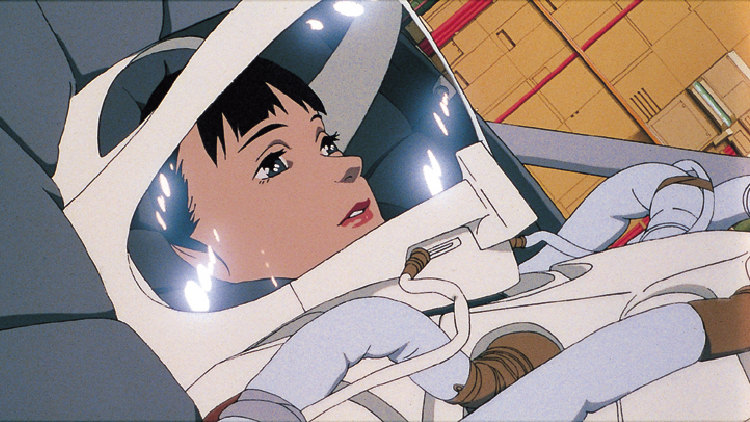
Both images reproduced here retain the original production-committee attribution and official festival provenance. They illustrate the feature rather than an imagined source comic. Updated licensed access information can be added later without changing the core guide: a standalone original film whose meaning emerges through the interaction of memory, performance and the people who listen.
Primary sources and useful navigation
- Madhouse · original concept, staff and Japanese theatrical context
- New Chitose festival · 2022 remaster program, original stills and full credits
- Anime Limited · named 4K SDR edition, region and supplements
- TESLAKITE · composer’s official soundtrack and track list
- AniList · named anime audience score
Community and catalog routes
- MyAnimeList · named anime catalog
- Reddit · memory, music and mixed emotional reactions; major spoilers
The production and publisher links support project facts. Catalog and community pages are secondary navigation and may reveal later events.
Explore related story guides
Original series imagery is reproduced under permission asserted by the site owner; the source and rights credits are retained. The route diagram is Animeteor’s own explanatory graphic.
United States streaming licensing record
Warner Bros. Discovery’s 13 August 2025 announcement includes Millennium Actress in the expanded HBO Max–GKIDS film agreement for the United States. This is a distribution record for the existing film, not a new story installment or remake. It does not establish Turkish or worldwide availability; consult the authorized catalog in your own territory for current access.
Warner Bros. Discovery — HBO Max and GKIDS United States agreement