Begin main TV season I, then II, III, both parts of IV and V (15 episodes). VI was announced on 7 February 2026; the checked notice gives no premiere date. Fujino Omori’s novels are the source. Sword Oratoria and Arrow of the Orion are optional separate routes.
Reviewed 2 October 2026 · Opening premise and format relationships; major ending revelations withheld. Linked publisher summaries and discussions may reveal later events. · Licensed access varies by country.
The source and screen branches

Sword Oratoria adds another perspective; Arrow of the Orion is an optional film. Side books have separate numbering. Games are excluded. The core map is not an exact episode-to-book concordance.
- READ · main source prose: Main novel volume 1 → Continue in main source numbering
- READ · main comic editions: Kunieda · original comic volume 1 Different comic sequence Yamachi · II has separate numbering
- WATCH · main television: Season I → II → III Continue main TV IV · include both parts Continue main TV V · 15 episodes Await premiere details VI · production announced
Bell’s main route and Aiz’s side route are different choices
DanMachi begins with Fujino Omori’s light novels, with original illustrations by Suzuhito Yasuda. Bell Cranel’s main story is the starting point for the title Is It Wrong to Try to Pick Up Girls in a Dungeon? Sword Oratoria follows another perspective within the property and has its own prose, comic and screen versions.
For the main anime, begin the first season and continue II, III, IV and V in that sequence. Include both parts of IV as one season’s continuing story. V’s official archive contains fifteen numbered episodes. VI is announced, not another already released viewing block at this review.
Begin the main novel at volume 1 for prose. For comics, distinguish Kunieda’s original adaptation from the separately titled II drawn by Taisei Yamachi. The numeral II on a comic cover is not a promise that it equals anime season II episode 1 or novel volume 2.
| Route | Start | Important distinction |
|---|---|---|
| Main TV | Season I → II → III → IV → V | VI announced; await date |
| Source prose | Main novel volume 1 | Bell’s source sequence |
| Main comic | Kunieda volume 1 | II/Yamachi has separate numbering |
| Sword Oratoria | Its own volume 1 / first episode | Optional alternate perspective |
| Arrow of the Orion | Optional separate film after an introduction | Not a required main-TV bridge |
Season VI production is confirmed; a premiere is not supplied
The official portal’s 7 February 2026 notice confirms production of season VI, announced at the anime’s tenth-anniversary event. The reviewed notice does not state a premiere day. A future-season label should therefore lead readers to production status, not an invented date or a list of unaired episodes.
The same notice contains dates for paid event archives that ended in February 2026 and domestic-only distribution language. Those event-stream dates are not the anime’s release window. We do not advertise that expired archive sale as current access, even though it remains on an official page.
V’s fifteen-episode story archive is a clearer record for the completed preceding screen block than a search result that stops at a midseason broadcast interruption. The portal also maintains older project pages. Check which season a synopsis or character design belongs to before importing it into the latest schedule.
Main novels, comics and side books have their own identities
Yen Press’s first main novel record credits Omori and Yasuda, with Andrew Gaippe for translation. The first comic credits Kunieda for its illustrated presentation. A prose book and a comic with the same number provide different amounts and arrangements of story, even where their premise overlaps.
Yamachi’s II comic has an independently numbered volume 1; its English paperback is cataloged for 16 November 2021, ISBN 9781975338077. The publisher synopsis places it in the pleasure-quarter storyline, so it should not be presented as a clean new-reader replacement for the original beginning.
Related reading includes Sword Oratoria, Familia Chronicle and Minor Myths and Legends. The latter is cataloged as smaller stories within the property, not a replacement first main novel. Select a side book for its stated characters and spoiler scope. A publisher’s related-series list is a discovery tool, not a mandatory chronological reading checklist.
Main release order is easier than a guessed cross-format handoff
For a first screen viewing, the successive main seasons provide a coherent route without constant interruption by side products. Sword Oratoria can be explored after you understand the main opening if you want Aiz and Loki Familia’s perspective. Arrow of the Orion is an optional film route, not a required bridge asserted between every television block.
The official portal offers its own broad chronology, which is valuable for identifying related stories. That record does not replace a direct comparison of a licensed season ending with the exact language edition a visitor intends to read. We have not made that complete comparison and do not certify an exact after-V chapter here.
For the fullest verified prose entry, begin main volume 1. If a later comparison supports a shortcut, it should name the source edition and explain omitted or rearranged material. Games stay outside this roadmap, even when a game event or character appears prominently on the franchise portal.
Adventurer: an inviting city before the dungeon
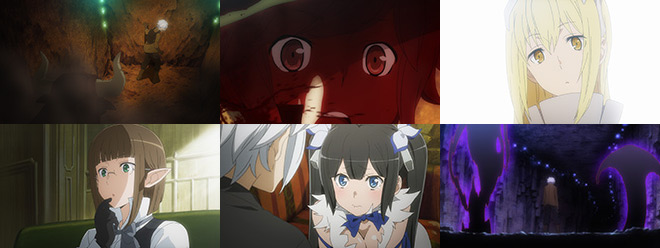
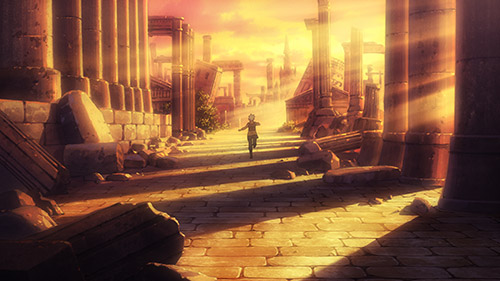
The selected original opening-episode image is a wide, warm-lit city scene: a small figure sits within an architectural setting with paving, columns and a long perspective into the street. It is the official episode-one preview image, preserved at its native 500-by-281 size. The lead above is a separate official montage of opening-episode scenes.
The first source synopsis situates Bell’s ambitions in Orario, a city whose dungeon promises fame and fortune while his own experience remains limited. Our interpretation of the scene is that the built environment makes adventuring part of a lived city. The story has institutions and daily spaces around the dungeon, not only a sequence of rooms to clear.
The frame does not prove the city’s whole economic organization or a precise corresponding comic panel. Nor should a preview image be used to reconstruct unseen dialogue. We discuss the visible setting and relate it to the publisher-established premise, keeping the first encounter’s complete outcome outside the case check.
Original visual reference
A familia is an institution as well as a team
The source premise gives Bell a goddess sponsor and a place within a familia. Our reading is that this creates a social layer around individual advancement. Skill and reputation develop inside relationships that can offer protection, expectation, belonging and obligations.
That makes the dungeon’s apparent merit system less simple. A person may improve through effort while still depending on who supplies information, resources or support. Ask whether a scene acknowledges that help or represents success entirely as the hero’s private achievement.
The main and side perspectives can illuminate different parts of this structure. Bell’s beginning and an established group’s expedition need not pose the same questions about risk or responsibility. Exploring a side series is most useful when it adds a perspective, rather than because a completist chart labels it another compulsory box.
Admiration can motivate action without guaranteeing sound judgment
Bell’s opening goal mixes heroic aspiration with attraction and embarrassment. Our interpretation is that the title’s provocative wording introduces a mismatch between an imagined role and the position he actually occupies. Being rescued can reveal that mismatch more clearly than a speech about his ambition.
A useful distinction is wanting to be impressive versus deciding what another person needs. The former can prompt effort, but it can also make a newcomer overestimate what he should attempt. A scene becomes more interesting when the story lets those motivations diverge instead of treating every daring action as automatically generous.
This reading does not require a list of later romantic outcomes. It offers a way to follow growth through changes in judgment, who Bell listens to and what he is prepared to risk for others. The dungeon’s dangers can then serve a character question rather than only an escalating scale of enemies.
The film has an identifiable script and its own bonus fiction
The official Arrow of the Orion credits name Omori for the script, Katsushi Sakurabi as director and J.C.STAFF for animation production. That is a specific film team, not a universal set of credits to paste onto every TV season. Its source-author involvement is documented independently of a canon claim.
The film’s theater-gift page identifies original prose by Omori, including an additional story about a gap within the film journey. This proves the existence and intended supplementary role of those historical extras. It does not mean an old promotional booklet is necessary before starting the main novel sequence.
The external score above is scoped to the original 2015 thirteen-episode TV entry. It is not a combined ranking of five seasons, several manga adaptations and side stories. Community pages are useful for discussing preferred routes, but the production notice and edition catalogs remain the evidence for dates and contributor roles.
A tenth-anniversary event is activity, not a profit statement
The 2026 season-VI notice and anniversary event document continued project activity. Paid archive tickets, related books, film extras and games are different products with different availability conditions. Their presence cannot be added together into an audited franchise-revenue estimate without actual financial reporting.
The practical commercial detail for a reader is what they are buying: one completed book, an independently numbered side series, a film or a temporarily available event stream. A retailer price is not a production budget, and an event archive’s expiration is not an anime cancellation.
Start main TV season one or novel volume 1, then choose a side perspective if it interests you. The dungeon-teamwork collection below compares this institutional fantasy with smaller and less secure adventuring parties. Future maintenance should check VI’s specific release announcements and verify a requested source handoff while preserving the distinctions between all of these routes.
Primary sources and useful navigation
- Official series portal
- Official original TV story archive
- Opening episode and original preview image
- V · fifteen numbered episodes
- VI · 7 February 2026 production announcement
- Official broad chronology
- Yen Press · first main source novel
- Yen Press · Kunieda original comic
- Yen Press · Yamachi II comic
- Yen Press · optional Sword Oratoria prose
- Arrow of the Orion · specific film credits
- Film · historical original bonus prose
- AniList · named TV audience score
Community and catalog routes
- MyAnimeList · named television catalog
- DanMachi Wiki · secondary franchise navigation; spoilers
- Reddit · source and anime discussion community
- Wikipedia · version navigation
The production and publisher links support project facts. Catalog and community pages are secondary navigation and may reveal later events.
Find this work in our thematic collections
Original series imagery is reproduced under permission asserted by the site owner; the source and rights credits are retained. The route diagram is Animeteor’s own explanatory graphic.
Games and live-action adaptations
- DanMachi: Fullland of Water and Light — Game: Side-scrolling action RPG
- DanMachi: Infinite Combate — Game: Dungeon RPG · story-reading scenes
- Is It Wrong to Try to Shoot ’em Up Girls in a Dungeon? — Game: Side-scrolling shoot ’em up
Distinct games and mobile service status
The three separate game guides linked here cover Fullland of Water and Light, Infinite Combate and the free Shoot ’Em Up. They have distinct developers, dates and gameplay formats; none is television season VI. Aiming’s Japanese Google Play listing states that Battle Chronicle’s online service ended on 29 September 2025 and now offers a version playable offline without a connection. That edition-specific notice is not a promise of continued online events or availability on every former platform.
Aiming — Japanese Android service-end and offline-version notice
The anime portal’s 26 April 2024 notice separately scheduled Memoria Freese service distribution to end on 24 June 2024. Its memorial crowdfunding project preserves franchise material; it is not proof that the original online game remains in service. This historical notice is distinct from Battle Chronicle and its later Japanese Android offline edition.