Watch episodes 1–49 or read the original manga from volume 1 to its final volume 39. No exact chapter shortcut after the television ending is certified.
Reviewed 3 October 2026 · Opening premise and adaptation relationships. Major endings withheld; linked catalog summaries and discussions may contain spoilers. · Licensed access varies by country.
The source and screen branches

The manga and television routes begin separately. The full book sequence is not certified as covered by the anime; no exact post-anime chapter handoff is claimed.
- READ · original source: Original manga · volume 1 → Final original volume · 39
- WATCH · television adaptation: TBS anime · episode 1 → Complete broadcast route · episode 49
The 49-episode anime and 39-volume manga are separate starting routes
GetBackers follows Ban Mido and Ginji Amano, partners whose business is recovering what clients have lost. Start the television anime at episode one and follow its numbered run through episode 49. TBS’s original archive supplies that episode sequence and dates. For the source manga by Yuya Aoki and Rando Ayamine, begin at volume one; Kodansha’s volume 39 listing identifies the final volume.
The television sequence is a complete broadcast route, not a promise that every event in all 39 books has been animated. This guide does not certify a precise chapter to read after the anime ending. If the anime makes you interested in the longer comic, restarting the source presentation is the clearest recommendation supported here.
Choose the anime for a finite viewing project built around a partner dynamic and changing recovery jobs. Choose the manga when you want to follow the source’s own presentation and complete book sequence. Sharing the premise does not make the numbering systems interchangeable, and an online claim that a particular episode is skippable needs more evidence than a bare list.
A Japanese complete set is not automatically a complete English set
Kodansha’s Japanese series listing links the original first volume, and its final-volume record supplies the end of the numbered book sequence. Those are useful anchors when checking a Japanese collection. They do not establish that every language edition released the same number of books, nor that a listing for one translated volume represents a complete collection.
Before buying a used set, check language, publisher, individual volume numbers and whether special compilations have been mixed into the sequence. A separately packaged compilation can gather material without becoming the next regular volume. This guide links the original series and final book rather than filling a gap with an assumed translation history.
The anime’s TBS page explicitly says its broadcast has ended. Its schedule records are historical documentation, not a current weekly release calendar. Similarly, an old disc advertisement on that archive is evidence of the advertised product at the time; it cannot establish present inventory, region compatibility or a current subscription service in a reader’s country.
| Record | Useful conclusion | Boundary |
|---|---|---|
| TBS episode archive | Watch the numbered 1–49 sequence | Historical broadcast, not current streaming |
| Kodansha volume one | Begin the original manga here | Japanese edition record |
| Kodansha volume 39 | Final numbered original volume | Not proof of every translation’s completeness |
| Compilation or used set | Inspect exact contents and language | Do not infer a new story volume |
The opening makes a small lost object matter
TBS’s first-episode synopsis begins with Natsumi, an encounter in a dark alley and the loss of a cat mascot attached to her bag. That modest personal loss is what leads her toward the recovery service. The official reference thumbnail below shows her holding the small object against an urban background; it is retained at its original 160-by-90 resolution.
Our reading starts with the scale of the problem. A mascot is not a world-threatening treasure, but a person can still attach value to it. The composition gives her face and the object the foreground while the street recedes behind them. This provides a concrete way to discuss emotional stakes before the series asks a newcomer to learn a large cast or an elaborate hierarchy of powers.
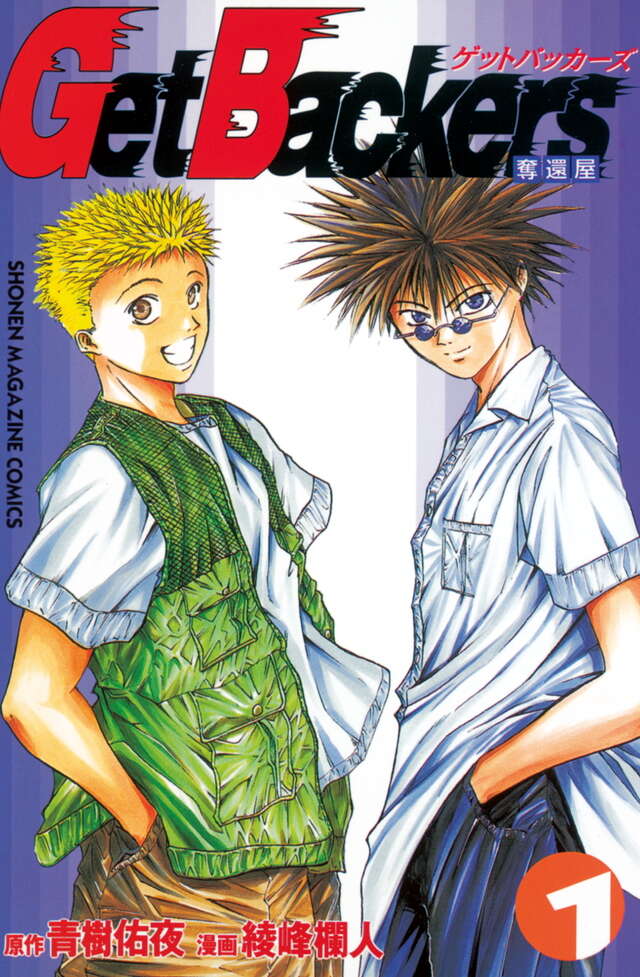
The first-volume cover does something different: it presents the two partners side by side, with Ginji’s open expression contrasting with Ban’s more guarded look. That is a promotional introduction to the partnership, not a still of the opening incident. Comparing the cover and the episode thumbnail separates the advertised protagonists from the client whose need gives their work a purpose.
Original visual reference

Recovery jobs turn supernatural action into a service relationship
A recovery business gives an action story a built-in question beyond who wins a fight: what exactly is the client asking to recover, and why does it matter? That question can bring personal attachment, payment and risk into the same scene. A stronger technique does not necessarily resolve a misunderstanding about the job itself.
Our interpretation therefore tracks the contract as well as the confrontation. Notice when a client describes an object in practical terms and when that object carries a memory or obligation. A mission can become more interesting when the value assigned by the client differs from the value assigned by an opponent. The opening mascot premise gives a restrained example without disclosing a later arc’s outcome.
This framework is also useful for choosing whether the series suits you. Viewers who enjoy a recurring pair meeting different clients have a reason to try the opening run. Viewers seeking an immediate single-war epic should know that the service premise invites a different rhythm, even when longer conflicts eventually occupy more of the story.
The partnership can carry scenes before the wider cast arrives
Ban and Ginji’s contrast is part of the manga cover’s first impression. One figure’s easy smile and the other’s glasses and more reserved expression make two personalities readable within a shared composition. The difference does not need to mean they are opposites in every situation; it offers a starting point for watching how they negotiate a problem together.
Our reading asks which partner reassures a client, which one challenges a claim and how the other reacts. Those small exchanges can establish the practical relationship more effectively than a summary of special abilities. A pair can be appealing because cooperation requires adjustment, not because both characters always respond in the same way.
To compare the comic and anime fairly, select a matching opening interaction and examine how dialogue space, timing and reactions are distributed. This page does not claim that every interaction is preserved exactly. It gives readers a method for a later close comparison while keeping the initial guide useful for someone who has not seen the entire series.
The official credits distinguish original writing from animation direction
The TBS staff page credits Yuya Aoki for the original story and Rando Ayamine for the manga. It identifies Kazuhiro Furuhashi and Keitaro Motonaga as directors, Akemi Omode for series composition, Atsuko Nakajima for character design and Studio DEEN for animation production. These are distinct contributions, rather than interchangeable author labels.
The first-episode archive also lists episode-specific staff. Such credits help a reader investigate an opening sequence without attributing every staging decision to the manga writer or to a studio name. A studio credit identifies the production organization; it is not a complete explanation of the individuals who shaped a particular scene.
Furuhashi’s involvement offers a useful creator-led discovery route toward Rurouni Kenshin, while the urban ensemble can invite comparisons with other supernatural action series. Those are connections through craft and subject matter. They do not join GetBackers to another work’s chronology, and they do not require readers to watch an unrelated production before starting Ban and Ginji’s story.
The audience number describes this television entry only
The AniList figure on this page names the 2002 television adaptation and its 49-episode entry. It does not rate all manga volumes or a hypothetical complete animated adaptation of them. The normalized number out of ten is a presentation of that external source’s weighted audience score, not a local poll and not our editorial verdict.
Community conversations are most useful here when they identify a practical uncertainty: which language edition a collector owns, whether a proposed set is complete or why two catalogs show different packaging. Publisher records and the original episode archive should settle the underlying book and broadcast facts. A confident forum reply alone cannot verify a chapter handoff.
The manga encyclopedia and community links are optional discovery tools. Character pages and episode discussions can reveal later identities or outcomes, while a marketplace thread can describe only a dated seller’s offer. Use the primary links first when planning your route, then open those discussions with the expectation that they may go beyond the opening premise.
Separate the story’s money problems from actual production finances
The early TBS summaries describe the partners’ difficulty obtaining clients and covering expenses. That financial pressure belongs to the fiction and helps explain why a job offer can shape their decisions. It is not evidence about the anime’s production budget, the publisher’s revenue or the profitability of an individual release.
No audited title-level budget or net-profit figure was verified for this guide. For an actual purchase, the useful checks are the specific product’s language, contents, condition and legitimate availability. A rare used volume’s asking price may reveal a seller’s expectation, but it does not establish franchise-wide sales or the cost of completing a translated edition.
After the 49-episode anime, choose the original manga from volume one if you want the source’s longer route. Yu Yu Hakusho is another useful discovery for supernatural ensemble action, and Samurai Champloo offers a different traveling partnership rhythm. These links expand the reading and viewing library while preserving GetBackers as its own work with its own starting points.
Primary sources and useful navigation
- TBS · official archived series page
- TBS · episode sequence and dates
- TBS · opening episodes and reference image
- TBS · staff and cast
- Kodansha · original manga series
- Kodansha · final original manga volume
- AniList · named anime audience score
Community and catalog routes
- MyAnimeList · named anime catalog
- GetBackers Wiki · later-story spoilers possible
- Reddit · dated collector discussion, not availability proof
The production and publisher links support project facts. Catalog and community pages are secondary navigation and may reveal later events.
Explore related story guides
Original series imagery is reproduced under permission asserted by the site owner; the source and rights credits are retained. The route diagram is Animeteor’s own explanatory graphic.
Three separately documented historical games
TBS’s official product archive identifies Konami’s PlayStation 2 action game Dakkan da yo! Zen’in Shūgō!!, dated 16 January 2003, and two separate Game Boy Advance RPGs: Metropolis Dakkan Sakusen!, dated 20 March 2003, and Jagan Fūin!, dated 4 September 2003. The listed Metropolis edition is GBA; it should not be labeled a verified PC release. These historical products are distinct from the manga’s volume numbers and the 49-episode television route.