Begin the 2016 twelve-episode J.C.Staff anime or Chihiro Ishizuka’s manga at volume 1. US English volume 14 was released on 7 July 2026; the Australian date for the same ISBN is 28 July. These are regional edition dates, not a certified source ending.
Reviewed 2 October 2026 · Opening premise and format relationships; major ending revelations withheld. Linked publisher summaries and discussions may reveal later events. · Licensed access varies by country.

The source and screen branches

English volume 14 is a verified US edition, not a source conclusion. The Australian record has a different regional date. No exact manga continuation or further TV season is certified.
- READ · source manga: Manga volume 1 → US English volume 14 · 7 July 2026
- WATCH · verified television: 2016 episode 1 → 2016 episode 12
A witch’s training begins inside an ordinary household
Flying Witch begins with Chihiro Ishizuka’s manga or the twelve-episode 2016 television adaptation. Makoto Kowata leaves Yokohama with her black cat Chito to live with relatives in Aomori while training as a witch. The countryside setting and family arrangement are central to the premise, rather than a waiting room before a much larger battle story.
Start television at episode 1 and follow its numbered order. For the source, begin at manga volume 1 in the licensed English edition. The broadcaster’s program catalog identifies J.C.Staff as the animation production and confirms the twelve-episode television package; those facts are more useful than guessing extra seasons from old disc notices.
No source novel or further main television season was verified in the records inspected for this guide. The roadmap therefore has a manga route and one documented TV route. It leaves room for future verified additions without inventing a prose original or a sequel merely because the manga continues beyond the adapted introduction.
| Format | Start | What is verified |
|---|---|---|
| Source manga | Ishizuka · volume 1 | Licensed English manga route |
| Television | 2016 episode 1 → episode 12 | Twelve episodes; J.C.Staff |
| Later manga editions | Check individual publisher records | A later volume is not proof of source completion |
| Other source formats | No verified novel route | Do not infer from related books |
A dated twelfth book does not define the latest source position
The English distributor catalogs Flying Witch volume 12 for 26 March 2024, ISBN 9781647292300, with 176 pages under the Vertical Comics imprint. It supplies a concrete edition record and demonstrates that the English manga route extends beyond a single book.
That dated record is not a declaration that volume 12 is the newest book on 2 October 2026, or that the source concludes there. Later-book availability should be checked through the current publisher catalog. A useful source note identifies what was verified instead of stretching an older product page into a current series total.
When comparing reading options, distinguish the collected comic from other books featuring the characters or illustrations. Physical format alone does not establish prose authorship. Our guide keeps the original creator and manga medium beside the reading route so that a new edition can be added without changing the source relationship by accident.
The newer US distributor record lists English volume 14 for 7 July 2026, ISBN 9781647295882, with 176 pages under Vertical Comics. This is a released US edition date, not a final-volume claim. A separate Australian publisher record uses 28 July for the same ISBN, illustrating why territory should accompany a release date.
The source beginning preserves the household’s introduction
This review does not certify an exact manga chapter to read immediately after television episode 12. Such a recommendation would require comparing the finale with the licensed collection and identifying any earlier material the adaptation omitted or moved. A short television run does not guarantee a simple linear source cutoff.
Volume 1 is the supported reading beginning. It lets the introduction of Makoto’s relatives and familiar surroundings unfold through Ishizuka’s page arrangement. Repetition of the broad arrival premise can still produce a different sense of timing when a pause occupies a panel instead of a stretch of screen time.
If you want a shorter transition later, name the final screen episode and the source edition in the handoff note. That makes the recommendation maintainable when catalog numbering or language availability changes. It also allows a future editor to explain why an earlier chapter is worth returning to rather than treating repeated material as automatically unnecessary.
The first frame shows travel before a settled magical routine
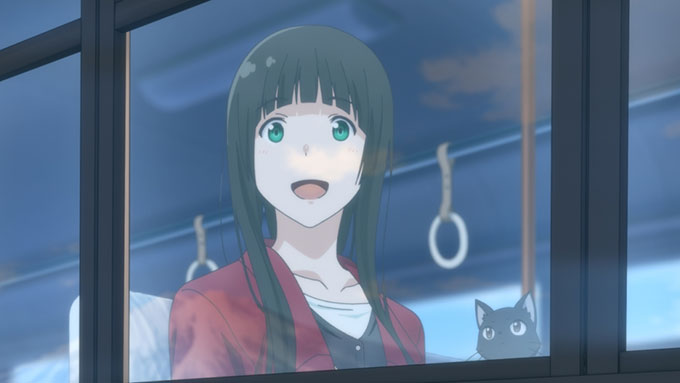
The selected official episode-one image shows Makoto in a red coat on a train, with the black cat beside her. The window and doorway frame the arrival journey. The complete official image is retained, without relabeling it as a flight scene or replacing its ordinary transport with an imagined magical spectacle.
The first episode’s official synopsis introduces the move for high school and training, and Chinatsu’s uncertainty after overhearing Makoto apparently communicating with the cat. These details locate the unfamiliar inside a family’s everyday life. The still alone cannot show that conversation or certify a later improvement in Makoto’s abilities.
Our interpretation is that ordinary transport makes the supernatural newcomer approachable before she has demonstrated anything extraordinary. She has luggage, a destination and a companion, like another person beginning a new household routine. The premise’s magic changes what happens after arrival without removing the practical circumstances of leaving one home for another.
Original visual reference
Limited ability gives learning a daily scale
The broadcaster’s premise presents Makoto as a witch beginning training, with limited powers. Our reading is that this gives learning a manageable everyday scale. The story can examine a small new experience without requiring it to function as a step toward defeating a final enemy.
A trainee’s uncertainty also makes ordinary knowledge matter. Knowing the place, understanding somebody’s response or noticing a local condition can be useful alongside a magical ability. The character does not need to be incompetent at everything for a new environment to provide a credible lesson.
Watch for how the household responds to an unfamiliar practice. A cautious question and a matter-of-fact explanation can create comedy while also establishing trust. The analytical interest lies in how knowledge becomes shareable: somebody has to make a strange event understandable to a person who did not grow up treating it as normal.
Domestic space changes the meaning of wonder
Our interpretation is that the home setting gives unusual events an intimate audience. A phenomenon can be extraordinary in abstract terms but become a question about conversation, hospitality or how to spend the afternoon when relatives encounter it together. The scale of the response matters as much as the scale of the magic.
Chinatsu’s initial uncertainty provides a useful viewpoint because she has reason to notice a difference without needing to become a constant antagonist. Familiarity can develop through repeated encounters. A person’s curiosity is a dramatic resource even when the episode is not built around immediate danger.
This is the guide’s reason for placing Flying Witch in everyday wonder. The countryside is not simply decorative relief from plot. It offers a setting in which training, family life and unusual perception can share the same day. Look for the point where an odd experience becomes something people can discuss together instead of something only the witch understands.
Source authorship and screen production describe different contributions
The broadcaster credits Ishizuka’s manga and identifies its original magazine and publisher relationship. J.C.Staff’s production role belongs to the television adaptation. A detailed creator record should preserve those distinctions rather than credit the animation studio as the source author or assume every later related publication used the same creative team.
The linked episode-one rewatch provides a discussion space for the arrival premise and Makoto’s early relationship with the household. Rewatchers may already know later encounters, so a first-time visitor should expect potential spoilers. The link is a place to compare personal reactions, not a substitute for primary catalog or episode records.
The displayed AniList audience score belongs specifically to the 2016 twelve-episode TV adaptation. It does not rate the ongoing source manga or prove that a particular viewer will find the atmosphere relaxing. A format choice should consider whether you want performed dialogue and screen timing or the source’s own panel rhythm.
A television catalog and a manga catalog answer different questions
The English broadcaster’s twelve-episode program listing describes a screen package available for licensing, while the English book record describes a localized collected manga edition. Those records demonstrate distribution in different media. They do not give a title-level net profit, an audited production budget or the creator’s personal income.
A physical anime collection or an archived promotional notice is also not evidence of a newly announced second season. Dates should retain the product they describe. For reading, check the actual edition and current availability rather than assuming that a two-year-old volume page establishes the complete modern catalog.
Begin the first television episode or source volume and let the household premise establish the pace. Future maintenance should look for verified new manga editions and genuine screen-production announcements. The route can then grow without losing its supported beginning, original visual evidence or distinction between a dated book example and a current source endpoint.
Primary sources and useful navigation
- Official television project
- Official first episode · arrival and original scene
- Official episode directory
- Nippon TV · twelve-episode production and source credits
- Kodansha · licensed source manga catalog
- English distributor · volume 12 dated edition
- AniList · named TV audience score
- PRH Comics Retail · US English volume 14, 7 July 2026
- Penguin Australia · regional volume 14 date
Community and catalog routes
- MyAnimeList · named television catalog
- Reddit · first-episode rewatch; spoilers possible
- Wikipedia · secondary publication navigation
The production and publisher links support project facts. Catalog and community pages are secondary navigation and may reveal later events.
Find this work in our thematic collections
Original series imagery is reproduced under permission asserted by the site owner; the source and rights credits are retained. The route diagram is Animeteor’s own explanatory graphic.
Production and edition updates
Flying Witch Volume 15 — Japan, 9 June 2026
Kodansha’s Japanese series catalog lists Flying Witch Volume 15 with a 9 June 2026 publication date. This Japanese edition is distinct from the licensed English Volume 14 and its attributed US/Australian release dates. No manga conclusion or second television season is stated by this book listing.