Watch first season (24 episodes) → second season (24) → the concluding third season (25). Read the complete source manga in volumes 1–34. Games and creator-related titles are separate coverage.
Reviewed 1 October 2026 · Opening premise and format relationships; major ending revelations withheld. Linked publisher summaries and discussions may reveal later events. · Licensed access varies by country.

The source and screen branches

Season three is a concluded 25-episode run at this review. These are format routes, not an exact episode-to-chapter concordance. Supplementary games remain outside the map.
- READ · complete source: Manga volume 1 → Continue through volume 34
- WATCH · screen release order: First season · 24 episodes → Second season · 24 episodes → Third season · 25 episodes
A rescue uniform with a frightening reputation
Fire Force begins with Shinra Kusakabe joining Special Fire Force Company 8. His fire-producing feet can make him a rescuer, but his unnerving smile and past also make him easy to misunderstand. Atsushi Ohkubo’s manga is the source. The central attraction is the tension between a visible, spectacular ability and the harder task of earning somebody’s trust.
Choose the manga for Ohkubo’s complete thirty-four-volume source story. Choose the animated route for the sound, movement and lighting of the firefighting world: the 2019 first season, the second season, then the third and concluding season. No other Ohkubo work is required before starting. The early Company 8 material provides the cast and institutional context the later conflicts build on.
This is a good fit for viewers who want action organized around a squad, a mystery about the world and an outsider seeking recognition. The rescue premise includes horrifying transformations, casualties and ritual responses to death; the series also has sexualized comedy. Those elements can pull the mood in different directions, so an opening episode is a better personal test than assuming the uniforms make it a straightforward workplace drama.
Three seasons, with the third season checked through its finale
The first television season contains twenty-four episodes. The second season continues the screen story and also contains twenty-four. The official project maintains separate archives for those productions; a streaming service’s grouping or language availability should not be mistaken for a different story branch. Follow the first season before the second rather than using a later promotional trailer as the entry point.
The current third-season story archive lists episodes 01 through 25 and presents episode 25, Hero’s Story, as the conclusion. Its two-part release across 2025 and 2026 is one continuing third-season project. At this 1 October 2026 review, we therefore describe a released concluding run with twenty-five numbered episodes, rather than repeating an earlier assumed twenty-four-episode count or advertising its second part as still upcoming.
Release order is the useful first-viewing order here. The story’s recollections are information revealed to you at particular moments; moving every flashback to the start would remove that deliberate discovery. Our map connects seasons, not an artificial chronology of every historical event, and keeps any supplementary game outside the reading and viewing lanes.
| Choice | Order | Scope |
|---|---|---|
| Anime | 2019 TV 24 → second season 24 → third season 25 | Consecutive animated story |
| Manga | Volumes 1–34 | Complete source route |
| Other Ohkubo manga | Explore separately | Creator connection; no prerequisite |
The final English book is a specific edition
Kodansha USA identifies volume 34 as the final Fire Force manga installment. The English print and digital editions were released on 3 October 2023, with ISBN 9781646518005 for print and 9798889332190 for digital. Those dates identify the licensed English books; they are not the first Japanese publication date or a new season release date.
Read numbered volumes in order within the edition you buy. A promotional description of the final volume inevitably reveals more than a beginner needs, so this guide uses the catalog for its completion and edition information without reproducing the final conflict. The full source route is available independently of whether all three television seasons are licensed in your country.
The source and animation share a premise, but they use different tools. A manga reader controls how long a panel remains in view and can return immediately to a clue. An anime viewer receives a sequence shaped by duration, performance and sound. That difference offers a useful reason to try both formats without claiming that one automatically replaces the other or that their page and episode boundaries are identical.
After a season: choose continuation or a source reread
After the first season, continue with the second; after the second, continue with the third. A viewer who wants to read Ohkubo’s version alongside the screen adaptation can start at manga volume 1. That route includes the original presentation of Company 8’s introduction and avoids inheriting a chapter recommendation derived from another service’s episode numbering.
We have not inspected the full licensed screen endings against a named manga edition to certify an exact start-after-the-anime chapter. A claim that an adaptation reaches a broad arc is weaker than proof that all preceding material has been covered in the same order. The diagram therefore provides dependable format branches while leaving a precise chapter concordance for a separately documented update.
For a reader interested in the mystery, a reread is particularly useful for tracking when a character knows something compared with when the audience knows it. Keep those two timelines separate. It prevents a later revelation from being used as if it were already obvious in an opening scene, and makes discussions of foreshadowing more precise without requiring this beginner guide to reveal the answer.
Episode one: Shinra’s salute is a social entrance
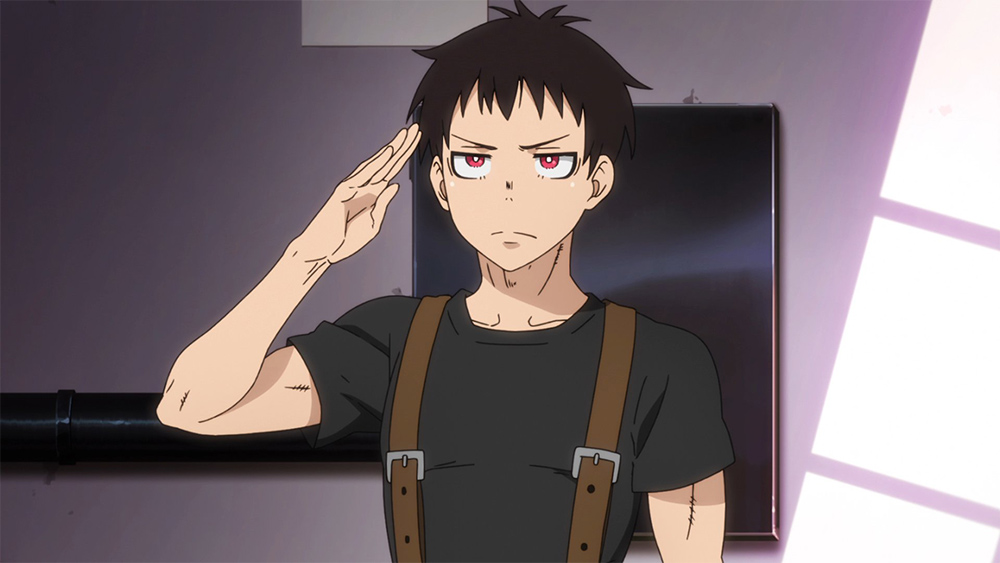
The official first-season episode-one image shows Shinra saluting in dark work clothes and shoulder equipment. The full horizontal frame retains both his raised hand and the brighter, angled background on the right. This is an original episode image from the production archive, distinct from the third-season promotional artwork used near the top of the guide.
Our reading of the image is that it introduces a role before displaying a power. A salute is a request to be recognized inside an organization: the gesture depends on other people seeing and accepting it. His expression and relatively plain clothing make the opening feel more personal than a poster composed entirely of flames and weapons.
The verified opening premise establishes his entry into Company 8. The still supports a discussion of posture, framing and institutional identity; it does not, by itself, prove a manga-panel match or the surrounding dialogue. Keeping that boundary allows the visual analysis to remain concrete. We preserve the 1000-by-563 composition so the scene’s gesture is not reduced to an isolated face.
Original visual reference
Power is visible; responsibility has to be demonstrated
The contrast between fire and rescue makes the premise productive. A familiar danger becomes the means by which Shinra attempts to help. Our interpretation is that this reverses the usual reassurance of an emergency uniform: an observer can see the uniform and still fear what the person inside it can do. Trust has to emerge through conduct rather than through an instantly readable symbol.
A squad structure adds another level to that problem. Skill belongs to individuals, while a rescue depends on coordination, timing and recognition of somebody else’s task. When watching the opening, notice who issues instructions, who follows them and who can explain what is happening. These are observable relationships that give an action scene a social shape beyond a comparison of power levels.
The frightening transformation premise also changes what victory means. Stopping a threat can coincide with acknowledging a person’s death. That is why ritual language and grief are relevant to the setting rather than merely ornamental worldbuilding. This interpretation concerns the rescue premise and opening presentation; it does not assert that a fictional institution provides a realistic model of emergency work.
Read the movement through space, then the pauses around it
Shinra’s foot-based ability makes direction and balance interesting questions. Rather than judging an action sequence only by how many bright effects it contains, follow the starting position, the path through space and the moment another character responds. Clear relationships between those stages can make a complicated ability readable even before the viewer knows all the setting’s terminology.
Quiet introductions matter for a different reason. A posture such as the salute creates an expectation about belonging; comedy can interrupt that expectation, while a frightening event can test it. The alternation offers energy, but it can also be a point of friction for somebody who wants an uninterrupted solemn rescue story. That is a useful taste distinction to acknowledge without treating dislike as a failure to understand the series.
The newer lead visual is labeled as third-season promotion. It gives a sense of the franchise’s dramatic scale, while the early episode image grounds the discussion in Shinra’s introduction. Promotional composition is evidence of how a project presents itself, not proof of every event occurring together in a scene. Keeping those images separate helps new visitors understand what they are looking at.
An opening discussion can reveal different reasons to keep watching
In the linked first-episode r/anime discussion, TheOneGriffith praises the fluid action and Koolsman points to the satisfying movement of the camera with Shinra. DimmuHS instead focuses on the unfamiliar city, technology and religious language. These are identifiable individual responses, showing that movement and setting can be different entry points into the same episode.
Our own reading of the salute adds another question: does the introduction make you curious about Shinra’s place among people? That question is complementary to an animation appraisal. A visually energetic series can still depend on the audience wanting to return to its team, and a discussion of technical strengths does not settle whether its humor or tonal changes suit every viewer.
Episode discussion tables contain small episode polls and historical streaming links. Those should not be averaged into a whole-franchise rating or copied as current availability. The score displayed above is AniList’s audience score for the original 2019 twenty-four-episode season only. The catalog and wiki links below help navigation, while community replies remain opinions and may contain later-story hints.
Complete publication is clearer evidence than an invented budget
The licensed final volume, three television productions and official game announcement document different commercial uses of the property. They establish that the manga reached a book conclusion and that its characters were adapted into other products. They do not establish animation profit, a production budget or the number of people who paid for each format.
The second-season official archive’s 17 May 2022 game announcement is a historical announcement. A reader should check the game’s current official service record before treating it as a present-day download recommendation. Game coverage remains separate from the main roadmap; a launch or collaboration does not add an episode to the television route.
For the next step, choose either the complete manga sequence or the consecutive television seasons according to your preferred medium. Ohkubo’s other works can then be explored through a creator connection, with major ending links left for spoiler-aware analysis. Future updates can refine an edition-specific chapter seam without changing this guide’s address or the distinction between the first-season rating and later productions.
Primary sources and useful navigation
- Official first-season archive
- Official opening episodes and image
- Official second-season archive
- Official concluding-season episode archive
- Kodansha USA · source manga
- Kodansha USA · final volume 34 and edition dates
- Penguin Random House · final print book
- Kodansha · licensing record
- AniList · named TV audience score
Community and catalog routes
- MyAnimeList · named television catalog
- Reddit · individual first-episode reactions
- Wikipedia · franchise navigation; spoilers
- Fire Force Wiki · reference navigation; spoilers
The production and publisher links support project facts. Catalog and community pages are secondary navigation and may reveal later events.
Find this work in our thematic collections
Original series imagery is reproduced under permission asserted by the site owner; the source and rights credits are retained. The route diagram is Animeteor’s own explanatory graphic.
The historical mobile game’s service closure
The official Fire Force Enbu no Sho account announced that its mobile service ended on 29 August 2025 at 15:00 JST. Historical game announcements and collaboration pages do not establish current playability. This closure is separate from the completed television series.