Begin Farming Life in Another World with the original TV opening or the licensed English manga’s first volume. The prose source is another route, including its original Japanese web serialization and published books. Read the numbered sequel anime after the first series; manga, prose and television numbers are not interchangeable.
Reviewed 1 October 2026 · Reincarnation and farming premise; later village milestones withheld. · Licensed access varies by country.
One provider, one identified television edition. Other seasons, manga and games are not included.
Checked 4 October 2026
The source and screen branches

The manga and television are adaptation branches. The printed prose and web serialization have different presentation units; this map does not assert identical chapter coverage.
- PROSE · original source editions: Japanese web serialization → Published prose with Yasumo illustrations → Follow the chosen edition; web episodes are not book volumes
- MANGA · illustrated adaptation: Yasuyuki Tsurugi’s manga → One Peace Books English volume 1 → Continue in the manga’s own sequence
- ANIME · screen route: Original TV series: 2023 opening → Farming Life in Another World 2: 2026 project → Read from the start for source detail; exact continuation jump unverified
Choose prose, panels or the television route
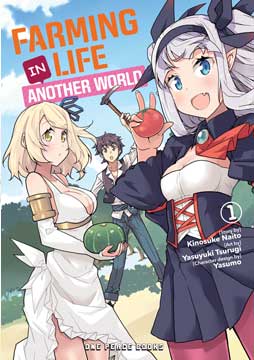
The English manga is a clearly identified reading entry: One Peace Books lists its first volume under manga, credits Kinosuke Naito for story, Yasuyuki Tsurugi for art and Yasumo for character design. This is not an English edition of the prose merely because the same story title appears on the cover. Match the format before using its volume numbers.
For the source prose, the author’s original Japanese serialization record provides a direct starting route and identifies the published books separately. The original portal also distinguishes the prose, main manga and a separately titled daily-life comic. A web installment count, printed book number and manga volume are different measures of presentation. We do not claim a licensed English prose edition from the existence of the English manga.
The anime begins with the original television project. TV Tokyo’s first-series record identifies its January 2023 start, while the numbered sequel’s broadcast page identifies its 2026 project. These season labels give a screen sequence; they do not supply an exact point at which to enter the source. If continuing in reading after watching, starting your selected edition at its beginning preserves details without relying on an uninspected jump.
Case check: a farming tool turns the second chance toward making a place
One Peace Books’ first-volume premise confirms that Hiraku’s death through illness is followed by renewed health, another-world life and an extraordinary farming tool. The licensed Japanese comic opening also centers a second life and that tool. These descriptions establish a farming-oriented reincarnation setup without requiring a later village outcome.
The official first-series promotional visual reproduced in this guide shows an ensemble around the project’s rural fantasy identity; the licensed volume-one cover below identifies the comic edition. A promotional arrangement is not a frame-by-frame record of the first episode. Neither image proves how many residents occupy the village at a particular point or which prose installment a scene adapts.
Our interpretation is that the tool shifts the viewer’s attention from finding shelter to making a place workable. That is a useful question to carry into the opening: when a task becomes easier, does the story use the saved effort to expand independence, hospitality or responsibility? The question is our analysis. Exact adaptation coverage, real agricultural feasibility and fictional settlement profitability remain outside the evidence supplied by these introductory sources.
Original visual reference
What settlement-building adds to a slow-life premise
A new life can be understood as a break from obligations or as a chance to choose different ones. Our preferred lens is the movement between those possibilities. The attraction of making a place is not only gaining a stronger ability; it is seeing what that ability lets someone maintain. Ask whether a new task changes the home’s practical needs or the protagonist’s relationship with other people.
That also separates this choice from Silver Spoon. Both appear in our farming-and-countryside collection, but agricultural school places a newcomer inside an institution with existing practices. Hiraku’s opening has a fantastical second chance and an extraordinary tool. The shared rural subject therefore supports a comparison, not a claim that the works have the same degree of practical realism or the same emotional pressure.
A useful third question is whether growth remains compatible with the promised quiet life. More connections can offer companionship while adding expectations. This is an interpretive tension, not an assertion that a particular later arc resolves it. Our opening-level recommendation preserves the discovery of who arrives and how the settlement changes.
Keep the first series and the numbered sequel together
Watch the original TV series before Farming Life in Another World 2. The second project’s maintained streaming page lists an April 2026 Japanese start. A broadcast listing establishes the named project and its advertised local schedule; it does not promise that the same service carries it in every country or that a date is a manga endpoint.
The original studio’s project record was posted on its maintained site in September 2025, while the broadcaster’s first-series notice gives the 2023 premiere context. Those are different dates. A later studio catalog entry is not a second announcement of an unaired first season. When using news or search results, distinguish the record’s update from the event it describes.
Who contributes to each branch?
Kinosuke Naito is the source writer. One Peace Books separately identifies Yasuyuki Tsurugi’s comic art and Yasumo’s character design. The source-book navigation names Yasumo for prose illustrations. Keeping those labels distinct helps a reader understand why a manga panel and a book illustration can share characters without being the same credited contribution.
Zero-G’s original project page credits animation production to Zero-G, Ryoichi Kuraya for direction and Toko Machida for series composition. These are the original-project credits, not a claim about every later related release. For new seasonal staff, use that project’s own credited record. The studio catalog and licensed publisher links below are direct routes to production and edition information.
A quieter setting still has fantasy and relationship boundaries
Choose this for reincarnation, useful activity and the possibility of a growing rural community. Do not expect a documentary about crop yields or an ordinary farming apprenticeship. The extraordinary tool is part of the premise, and the setting contains fantasy species and powers.
The author’s serialization record includes harem and mature-audience-related tags. That matters when deciding whether the rural-life label matches your preferences. A relaxed presentation does not guarantee the absence of romantic or sexual implications. The guide avoids later relationship milestones, which are extensively exposed in publisher summaries of subsequent volumes.
Village economics and publication economics are different analyses
The idea of producing something useful can invite discussion of resources, effort and exchange inside the fiction. We recommend distinguishing those questions from a real accounting claim. A convenient fantasy tool changes a fictional constraint; it does not prove that a comparable farm would be profitable.
The publisher’s catalog identifies editions and retail information, while the anime records identify production and distribution projects. None of the sources used here supplies a verified anime budget or profit statement. This guide therefore gives no invented margin or earnings estimate. A future commercial analysis would need a named reporter, date, territory and clear distinction between copies, retail value, gross revenue and profit.
Discussion routes and useful questions
The community links locate title-specific discussion and edition navigation. We do not turn uninspected comments into a consensus about whether the series is relaxing, realistic or suitable for every viewer. Later episode threads and character biographies can reveal arrivals, relationships and changes the opening route deliberately preserves.
After watching, a useful prompt is whether each new ability changes a task or mainly removes its difficulty. Another is when the place begins to require cooperation rather than only one person’s work. Those questions let readers compare the settlement experience without converting a personal preference into a measured judgment about every audience.
Before choosing the next volume or episode
Is the English manga the original novel? No: its licensed catalog identifies manga and separate art credits. Can a web episode number locate an English comic volume? Not without comparing the actual editions. Is the numbered sequel the starting anime? Use the original TV series first.
Can this guide grow later? Yes. A verified edition link, a new project record or an inspected source-continuation comparison can update it in place. The published diagram, image provenance and section links are maintained; uncertainty can be replaced with a sourced answer when the necessary comparison has actually been made.
Primary sources and useful navigation
- Original Japanese serialization and author record
- Licensed English manga catalog and opening
- Japanese licensed manga opening
- First anime broadcaster record
- Original animation studio credits
- Numbered sequel broadcast and distribution record
- Published prose and manga edition navigation
Community and catalog routes
- Reddit: title-specific discussions
- MyAnimeList: anime lookup
- Fandom: manga edition navigation (secondary, spoilers)
- Wikipedia: format overview (secondary)
The production and publisher links support project facts. Catalog and community pages are secondary navigation and may reveal later events.
Find this work in our thematic collections
Original series imagery is reproduced under permission asserted by the site owner; the source and rights credits are retained. The route diagram is Animeteor’s own explanatory graphic.
The released second season and a separately announced browser game
The official second-season story archive contains episodes 1–12. Its Japanese schedule begins on 6 April 2026; AT-X, TV Tokyo’s late-night slot and domestic streaming have different times. Watch this released season after the original 2023 series. The existing 2026 screen branch refers to this season; it is not an unannounced future third season.
2026 second-season adaptation record · Exact edition / event record
CTW’s G123 identifies the separate browser game Farming Life in Another World: Dreamy Life. Its 24 August 2025 notice opened preregistration; the current product page remains in the preregistration category. No confirmed commercial launch date is inferred from that announcement. The game remains outside the anime and reading order.