Watch the original 24 TV episodes, then ×2 Shou, Ten and Ketsu. Extras are optional. Read main novels 1–13 before SH; keep main, Saika, Yellow Scarves and RE;DOLLARS manga numbering separate.
Reviewed 3 October 2026 · Opening premise and adaptation relationships. Major endings withheld; linked catalog summaries and discussions may contain spoilers. · Licensed access varies by country.

The source and screen branches

Extras remain optional and retain their own episode labels. SH and Side Stories?! are separately named prose routes; manga arc numbering resets.
- WATCH · TV: Original TV · 24 episodes → ×2 Shou · 1–12 → ×2 Ten · 13–24 → ×2 Ketsu · 25–36
- WATCH · extras: Original · 12.5 / 25 · ×2 · 4.5 / 13.5 / 19.5
- READ · prose: Main novels · 1–13 → Optional SH · own volume order · Side Stories?! · optional collection
- READ · manga: Main · 1–4 → Saika · 1–3 → Yellow Scarves · 1–3 → RE;DOLLARS · catalog through 8
An Ikebukuro ensemble, with two different episode-numbering systems
Durarara!! begins with a young newcomer discovering that Ikebukuro has stranger inhabitants and connections than an ordinary city introduction might suggest. A rider with a conspicuous helmet, school friends, information brokers and volatile strangers inhabit overlapping social spaces. Our first-entry recommendation is to follow the anime’s presentation order. Trying to identify the secret behind every person before watching can reveal precisely the connections the story wants to uncover gradually.
Watch the original twenty-four television episodes, then Durarara!! ×2 Shou, Ten and Ketsu in that order. The second production has thirty-six main television installments: Shou numbers one through twelve, Ten thirteen through twenty-four and Ketsu twenty-five through thirty-six. Its numbering starts again after the original series. The original season’s additional episode twenty-five is therefore not the same installment as Ketsu episode twenty-five.
The original extras, numbered 12.5 and 25, and the ×2 supplements numbered 4.5, 13.5 and 19.5 are optional. For a straightforward first route, we recommend watching each production’s extras after its main television run. That is a spoiler-conscious editorial viewing choice rather than an assertion that every decimal label establishes an exact place in the story’s calendar.
| Route | Recommended progression | Keep separate |
|---|---|---|
| Main television | Original 24 → ×2 Shou 12 → Ten 12 → Ketsu 12 | ×2 numbering restarts at 1 |
| Supplementary anime | Original 12.5 / 25; ×2 4.5 / 13.5 / 19.5 | Optional extras, not five additional TV seasons |
| Source prose | Main novels 1–13 → optional SH | Side Stories?! is a collection, not volume 14 |
| Manga | Main → Saika → Yellow Scarves → RE;DOLLARS | Named arcs reset their own volume numbers |
Start with the novels; a manga arc is not the entire source series
Ryohgo Narita writes the source novels, with illustrations by Suzuhito Yasuda. Yen Press’s main prose catalog lists thirteen numbered novels and the separate Side Stories?! collection. The thirteenth novel is identified as the conclusion of that main series. The collection contains nine additional tales, including material involving other works, and should be treated as an optional companion rather than a fourteenth numbered continuation.
Durarara!! SH is a separately named prose sequel. Its official English introduction places its opening a year and a half after the earlier major events and introduces a new central trio. The reviewed English catalog contains four SH volumes. Read the main thirteen first if you want a source route that establishes the original ensemble; then begin SH at its own volume one. A calendar gap does not make SH a prequel.
After watching the anime, starting at source novel one is our recommendation for examining narration and characterization without assuming that screen coverage reproduces every explanation. We have not verified a universal episode-to-chapter conversion against the publishers’ records. The manga’s final available numbered book is also not a reliable shortcut to the next prose volume, because the manga is divided into named adaptations with its own pacing and numbering.
Visual case: city collage versus a white field full of competing directions
The original television homepage artwork combines a cluster of ordinary-looking young people with an oversized yellow, cat-eared helmet and fragments of a nighttime city. A school-uniform figure stands near the foreground, while glasses, fur trim and a blond figure introduce different silhouettes behind him. Japanese promotional lettering occupies a substantial darker area. We retain that lettering because this is an original promotional composition, not a newly reconstructed scene.
Our reading is that the collage makes the city feel like a network of partly visible people rather than a backdrop owned by one hero. The helmet supplies an unusually strong identifying shape among human faces. This is a compositional interpretation of the artwork; it does not prove which character knows a particular secret or that everyone pictured shares one corresponding moment in an episode.
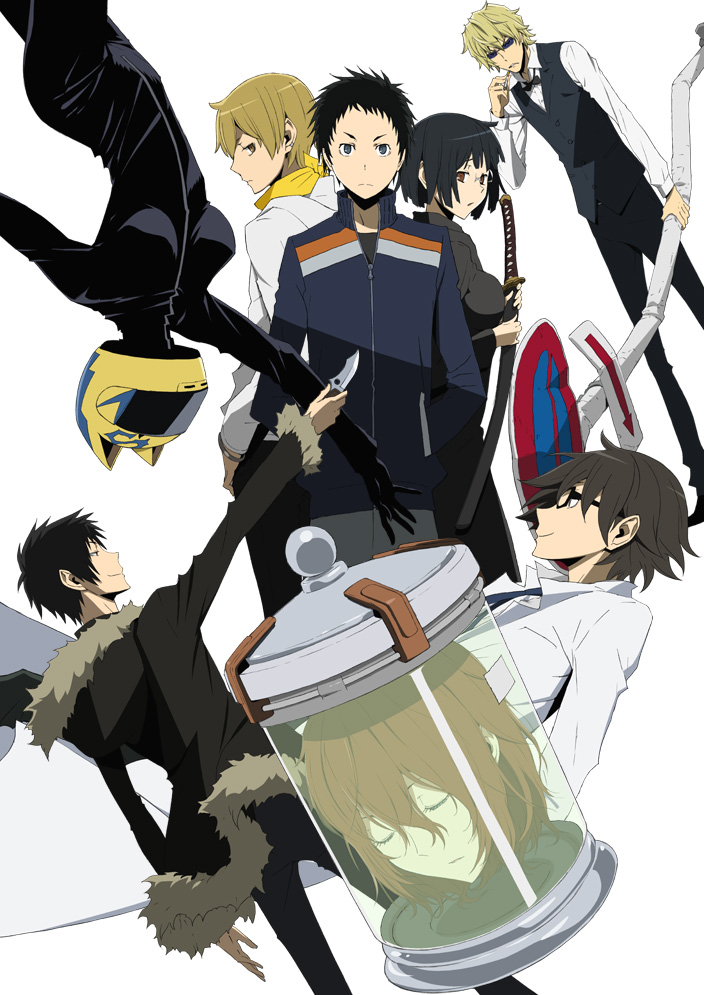
The official ×2 Ketsu key visual uses a mostly white field instead. A central young man faces forward while bodies, a blade and other figures pull diagonally across the frame. An inverted helmeted figure enters from the upper left, and a large container with a sleeping-looking head fills the lower foreground. The lack of a painted city makes these conflicting orientations especially legible. Comparing the two images suggests two ways to advertise an ensemble: connect people through a place, or make their bodies and directions compete for attention.
Original visual reference
The useful question is who knows which part of the city
Our analytical approach is to track information before trying to reduce the cast to a single protagonist. A character can be socially central while understanding very little about the consequences of another person’s actions. A newcomer’s uncertainty gives viewers an entry point, but the ensemble soon makes any one perspective feel incomplete. The city’s ordinary routines and extraordinary inhabitants consequently belong to the same field of attention.
Rumor is especially useful as a reading lens. People can act on what they believe circulates through a community without having a complete account of its source. That creates a difference between an event, a retelling and a motive. On a rewatch, consider when an earlier scene becomes easier to understand because a later viewpoint supplies a missing relationship. This is a method for examining the narrative, not an instruction to consult a spoiler-filled character wiki during the first episode.
Prose narration, animated editing and manga page layout offer different ways to control that uncertainty. A novel can stay with a line of thought; animation can cut to another place before a connection settles; manga allows a reader to return instantly to a face or panel. We would compare those choices through a named scene rather than declaring the entire adaptation faithful or unfaithful from its episode count. A shorter explanation does not, by itself, establish that a financial constraint caused its removal.
Brain’s Base and Shuka belong to different screen productions
The original anime’s official credits name Takahiro Omori as director, Noboru Takagi for series composition, Takahiro Kishida for character design and Makoto Yoshimori for music, with Brain’s Base producing the animation. The ×2 credits retain those key creative roles but identify Shuka for animation production. Do not assign every installment to Brain’s Base merely because it produced the first television series.
The manga adaptations require another distinction. Akiyo Satorigi draws the main manga and its Saika and Yellow Scarves arcs. Their English catalogs list four, three and three volumes respectively. Each arc has its own beginning and numbering. They are related adaptations of Narita’s source, but Saika volume one is not labeled main-series volume five by its publisher.
Aogiri draws RE;DOLLARS, whose reviewed English catalog reaches volume eight. We identify that catalog coverage without declaring that it adapts every source novel or that an officially announced cancellation has occurred. A change of manga artist is useful when discussing page rhythm and character rendering; it is not a change to the original novelist’s credit. Yasuda’s source illustration role also remains distinct from Kishida’s screen character designs.
A manga reader’s uncertainty exposes a real navigation problem
The displayed AniList score is 79/100, normalized to 7.9/10 and observed October 3, 2026, for the original 2010 television anime. That entry covers twenty-four television episodes. The figure is not our rating and does not average the ×2 seasons, supplementary episodes, main novels, SH or manga. An edition containing extra episodes does not broaden the scope of the database entry.
A selected r/Durarara discussion begins with a reader who has finished a manga edition and asks whether the story is complete and how it relates to the novels and anime. Replies recommend the source novels and contrast manga artists’ handling of sequential storytelling and polish. These are individual preferences, not a measured audience consensus. We avoid repeating the post’s character revelations or adopting a commenter’s precise adaptation arithmetic as an official chapter map.
The useful lesson is that a successful local endpoint can resemble a franchise endpoint when edition names are hidden. Our recommendation is to check which manga arc you completed before choosing the next medium. If you mainly want the ensemble on screen, finish the television route; if you want the source’s sustained narration, begin the novels. The story includes violence and disturbing relationships, so a colorful cast and comic exchanges should not substitute for a suitability check.
Collection counts, release dates and commercial claims need different evidence
The official 2012 Japanese first-series Blu-ray collection lists twenty-six installments including the two extras, across six Blu-ray discs with three CDs. It also lists English subtitles and a dub among that edition’s features. Those specifications concern the named package. They do not establish that every currently sold regional edition has identical audio, subtitles or extras, or that streaming platforms worldwide provide the same coverage.
The official supplementary-anime page identifies episode 19.5 as an adaptation of an anniversary short story and documents its 2016 theatrical preview. A theatrical event for an extra episode is not automatically a new feature-length sequel. Likewise, the publication date of an English novel is not the date on which the original television episode first aired. These distinctions help a reader compare what a product actually contains before treating a date as a new narrative installment.
No audited franchise profit or production budget was established in the sources reviewed here. A long list of licensed volumes demonstrates available publishing products, not their profitability. Community reports that a manga has not appeared recently should prompt an official catalog check; they do not justify a definitive cancellation label or a promised revival. Future availability checks should name the region, language, arc and format rather than claiming that a title is universally in print.
Keep the full map readable without making every side story compulsory
Choose one main entry route and keep its labels. On screen, complete the original television run and then ×2 Shou, Ten and Ketsu; visit the supplements separately. In prose, read the main thirteen before deciding whether to begin SH or sample Side Stories?!. In manga, follow the named arcs with their separate numbering. None of those instructions requires a game or live-action product as a missing chapter of the anime/manga/prose map.
The official anime sites and publisher catalogs are our first evidence for installments, credits and editions. Fandom and Novel Updates can help navigate characters, prose titles and community terminology, but linked summaries may expose outcomes. A wiki chronology can be interesting after completion without being the safest first viewing order. Fan translation navigation also does not establish an official English license.
Baccano! offers another Narita ensemble adapted by several of the same screen creators, with a different historical setting and approach to information. Hell Girl offers a contrasting Omori-directed work organized around moral consequences. Those creator connections are useful next reads, not required pieces of Durarara!! continuity. A future source update should identify which branch changed so that a new SH book, manga volume or special can be added without renumbering unrelated routes.
Primary sources and useful navigation
- Official original anime · episode list
- Official original anime · staff
- Official original anime · homepage artwork
- Official ×2 Shou · episodes 1–12
- Official ×2 Ten · episodes 13–24
- Official ×2 Ketsu · episodes 25–36
- Official ×2 · staff and original key visual
- Official ×2 · Shuka staff credit
- Official extras · 4.5 and 13.5 promotional videos
- Official episode 19.5 · story and theatrical preview
- Official 2012 collection · 26 installments and edition specifications
- Yen Press · main novels and separate collection
- Yen Press · main volume 13 conclusion
- Yen Press · nine Side Stories?! tales
- Yen Press · SH catalog
- Yen Press · SH volume 1 and year-and-a-half setting
- Yen Press · main manga catalog and artist
- Yen Press · Saika manga
- Yen Press · Yellow Scarves manga
- Yen Press · RE;DOLLARS catalog and artist
- AniList · named anime audience score
Community and catalog routes
- MyAnimeList · named anime catalog
- Reddit · selected post-manga route discussion; spoilers
- Durarara!! Wiki · character and format navigation; spoilers
- Novel Updates · source prose navigation
The production and publisher links support project facts. Catalog and community pages are secondary navigation and may reveal later events.
Explore related story guides
Original series imagery is reproduced under permission asserted by the site owner; the source and rights credits are retained. The route diagram is Animeteor’s own explanatory graphic.
Production and edition updates
Durarara!! Relay — Japanese PS Vita product
KADOKAWA identifies Durarara!! Relay as a Japanese PlayStation Vita product released on 29 January 2015. Its relay scenario changes the viewpoint character between chapters. The current publisher catalog explicitly states that sale of the download edition has ended. This is historical game evidence, not a new 2026 release or a present download offer.
See the separate production record →
Durarara!! Enshu Hosoku — 2021 stage production
The official Enshu Hosoku stage archive identifies Ryohgo Narita’s source, director Nobuhiro Mori and writer Noboru Takagi. It lists August 2021 performances in Tokyo, Aichi and Osaka, with Shohei Hashimoto as Mikado, Taishi Sugie as Masaomi and Yukina Fukushima as Anri. Its news archive includes a cancellation/refund notice for 13 August; the posted schedule is not treated as proof that every planned performance occurred.