Original TV 1–25 → Gaiden 1–4 → Gemini 1–12 is our contextual route. Original episode 26 is optional; Iwahara’s manga fits after the first series, while Nokiya’s branch remains separate.
Reviewed 3 October 2026 · Opening premise and adaptation relationships. Major endings withheld; linked catalog summaries and discussions may contain spoilers. · Licensed access varies by country.

The source and screen branches

Context order differs from release order: Gaiden appeared after Gemini. Shikkoku no Hana is optional connective reading; Nokiya’s manga is a separate branch.
- WATCH · context: Original TV · 1–25 → Gaiden · 4 episodes → Gemini · 12 episodes
- WATCH · extra: Original episode 26 · Optional after first TV
- READ · bridge: After original TV → Shikkoku no Hana · 1–4 → Then Gaiden / Gemini
- READ · parallel: Nokiya manga · 1–2 · Separate manga branch
An original series, a bridge, and a second television story
Darker than Black begins in a Tokyo transformed by the appearance of Hell’s Gate. The ordinary sky has been replaced, and people called Contractors work inside a world of clandestine operations. Hei moves between an apparently unassuming civilian identity and his work as BK201. The opening premise invites a useful question: how much can you know about a person when the institutions watching him reduce him to a designation and a useful ability?
Our contextual first-view route is the original 25 television episodes, the four-part Gaiden, and the twelve episodes of Gemini of the Meteor. Gaiden explains developments between the television series, whose settings are separated by two years. This recommendation places the bridge before the second series to supply context. It is an editorial viewing route, not original release order: the second television series aired before the Gaiden home-video installments appeared.
The original series also has an unbroadcast episode 26. Treat it as an optional addition after the first television run rather than inserting it into the numbered broadcast sequence. The official anniversary collection describes all 26 episodes, including that additional episode. A listing of 25 episodes and a collection of 26 can therefore describe the same first series with different coverage; neither establishes another television season.
| Entry | Coverage | Suggested role |
|---|---|---|
| Original television series | 25 broadcast episodes | Begin here |
| Original episode 26 | Unbroadcast extra | Optional after first series |
| Gaiden | 4 episodes | Contextual bridge before Gemini |
| Gemini of the Meteor | 12 television episodes | Second TV series |
Two manga branches have different authors and different functions
The anime’s original-work credit belongs to BONES and Tensai Okamura. A manga bearing the same franchise name is not evidence that this animation adapts an earlier manga source. The two manga branches should also remain separate. KADOKAWA’s second volume credits Nokiya as artist, BONES and Okamura for the original work, and Arclight for the scenario. This two-volume Japanese edition is not volumes one and two of Yuji Iwahara’s later series.
Iwahara’s Shikkoku no Hana, often called Jet Black Flower in English discussion, runs for four volumes. Square Enix describes its opening as taking place weeks after the first series’ Tokyo Explosion event and explicitly presents the fourth volume as completing a story leading toward Gaiden and Gemini. For readers who want that optional connective story, finish the first series, read its four volumes in order, then continue to Gaiden. Do not replace the publisher’s weeks with an unsupported one-year gap.
Yen Press’s August 2009 announcement documents an English license for Nokiya’s manga. It does not license every comic with the Darker than Black name. We have not established a current English purchase route for Iwahara’s four-volume branch from the reviewed primary catalogs. Nor was a prose adaptation verified here. Official fanbooks are reference material; a detailed setting explanation does not turn such a book into a narrative novel.
Visual case: an isolated operative inside a crowded promotional frame
The Aniplex key visual places Hei in a high dark collar before a purple nighttime city. A blade crosses the lower foreground, and the large white title occupies much of the bottom. Above him, faces and other figures are divided into smaller visual compartments. The central operative has a strong silhouette, while the people surrounding him remain visible as separate fragments. This is official promotional artwork, not a screenshot of a newly identified canonical scene.
Our reading is that the composition suits a mystery built from partial knowledge. The viewer sees a network of people but receives no explanatory relationship chart from the picture alone. Its divided presentation is not evidence that the anime originated as a manga. It also cannot establish whether a pictured person is trustworthy, who survives, or what a later installment reveals about Hei’s loyalties.
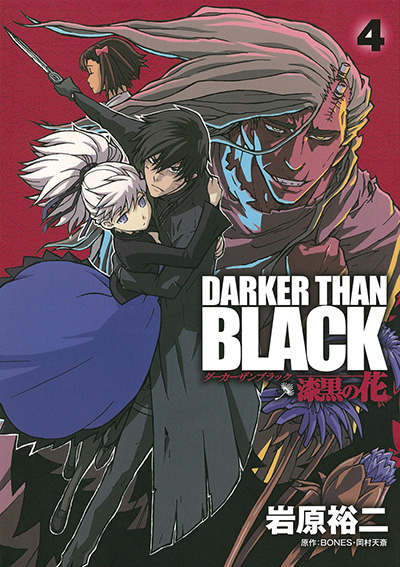
The fourth Shikkoku no Hana cover uses a red field and a more entangled arrangement of figures. Hei and a silver-haired girl occupy the central grouping, with additional faces and flowing dark shapes crowding the surrounding space. The numeral four identifies its place in Iwahara’s manga branch. We present the original publisher cover without repainting it into a supposedly official animation frame; its closeness and diagonals offer a visual contrast with the anime key visual’s compartmentalization.
Original visual reference
The Contractor label is a claim to examine rather than a complete personality
The official premise describes Contractors as possessing extraordinary abilities and being regarded as emotionally detached. Our analytical interest lies in the distance between that classification and the relationships a story can show. A designation makes an operative legible to an organization: a code, an ability, an assignment. It tells a viewer much less about how that person experiences dependence, obligation or a decision that does not fit the assignment.
Hei’s civilian presentation is especially useful for examining this distance. A mundane interaction and a covert operation can place the same person inside very different expectations. On a rewatch, compare what people think they know from his visible behavior with what an institutional label encourages them to assume. That question allows discussion of identity and performance without disclosing the resolution of the first series’ central mysteries.
Gaiden changes the scale of this inquiry by concentrating on Hei and Yin during their flight. Its official introduction foregrounds their reliance on each other and changes in Yin’s expression of will. Our interpretation is that this makes the bridge relational as well as chronological: understanding a later situation involves understanding what a connection costs. The bridge provides context, but does not require readers to accept a fan’s preferred explanation of every ambiguous supernatural rule.
Keep original concepts, animation design and music credits distinct
The first series’ official staff page identifies Okamura as director, Iwahara as original character designer, and Takahiro Komori as character designer and chief animation director. BONES produces the animation, with Yoko Kanno credited for music. These are different contributions: Iwahara’s concept work and later manga authorship do not erase Komori’s task of adapting character appearance for a sustained animated production.
The second series retains Okamura, Iwahara and Komori in the corresponding principal credits, but its music credit is Yasushi Ishii. An article attributing every soundtrack across the franchise to Kanno would overlook that change. The second series also names its contributing writers separately. A familiar studio and character identity can coexist with a changed creative arrangement, so compare the credited installment before discussing its sound or narrative emphasis.
The first official cast identifies Hidenobu Kiuchi as Hei, Misato Fukuen as Yin and Nana Mizuki as Misaki Kirihara. Performance gives the undercover premise another layer: viewers hear a character inside an interaction rather than merely reading an institutional description. This is a framework for analyzing presentation, not a claim that a particular actor independently authored the character’s decisions. Creator links likewise do not establish that another BONES production shares this fictional universe.
Complicated fan orders are options, not mandatory interleaving
The displayed AniList audience score is 77/100, normalized to 7.7/10, observed October 3, 2026. Its scope is the 2007 television anime with 25 episodes. It does not score episode 26, Gaiden, Gemini or either manga branch. The figure is an external audience indicator rather than an Animeteor vote or an average of unlike franchise entries.
A selected Darker than Black community discussion asks whether the manga is required and how the entries fit together. Replies range from a straightforward first-series, Gaiden, second-series sequence to an elaborate order interrupting the first run with comics and the bonus episode. This is evidence that readers have different navigation preferences, not official proof that new viewers must stop halfway through the original television story.
Our recommendation keeps the first television run intact, then labels the optional manga connection and contextual bridge explicitly. If a viewer prefers release order, Gaiden can instead be watched after Gemini with the understanding that it looks back between the series. That alternate route preserves the production-era reveal order. Either way, avoid searching ending explanations before viewing; later official synopses and community threads can disclose far more than this opening guide does.
A box can contain two functions under one series title
The official Japanese Gemini package page lists a January 2014 Blu-ray box containing twelve television episodes and four Gaiden episodes. These sixteen installments are not sixteen Gemini television broadcasts. Earlier packaging distributed the bridge through even-numbered volumes of the second series’ home-video release. Check included titles as well as an episode total when comparing editions or diagnosing an apparently missing bridge.
The first-series official news archive describes a later collection with all 26 episodes. Anniversary screening and collection announcements are catalog events rather than evidence of a newly commissioned third season. Similarly, Square Enix’s completed fourth manga volume and an older English licensing announcement remain historical publishing evidence. None establishes that an item is presently in stock or available with subtitles in every region.
No audited production budget, franchise profit or verified return on investment was established in the reviewed sources. Historical package prices cannot supply those figures, and a current marketplace asking price would describe resale conditions rather than original production economics. The actionable comparison is edition coverage: first-run broadcasts, the optional extra, the bridge, the second series and the separately authored comics. Verify region compatibility and language before buying a physical release.
A clear route leaves room for optional connective reading
Start with the original broadcast episodes. Add episode 26 if wanted, then use Gaiden before Gemini for a contextual first viewing. Readers interested in Iwahara’s connective manga can place Shikkoku no Hana volumes one through four after the original run and before the bridge. Nokiya’s two-volume branch stays separately labeled rather than being attached as another numbered section of Iwahara’s work.
The official staff, Gaiden and package pages establish the screen entries and their functions. KADOKAWA distinguishes Nokiya’s credits; Square Enix establishes Iwahara’s opening placement and completed four-volume coverage. Fandom and MyAnimeList remain useful navigation destinations, but an old community page calling a manga ongoing should not override a publisher’s completed final-volume record. Community chronology suggestions likewise remain suggestions.
For a future update, verify what a new announcement actually changes before adding another route node: a reissue, a screening and a new adaptation are different events. No narrative novel branch is supplied to fill an empty format slot. Games and live-action projects, if subsequently verified, belong in their separate adaptation area under Animeteor’s policy. The map is designed to grow when evidence changes while retaining the distinction between main viewing, contextual additions and optional comics.
Primary sources and useful navigation
- Aniplex · original premise and official anime key visual
- Original anime · staff and cast
- Official Gaiden · four-part bridge introduction
- Gemini · staff and music credits
- Gemini · twelve TV episodes and four Gaiden package contents
- Original anime · collection includes unbroadcast episode 26
- Square Enix · Shikkoku no Hana 1, weeks after first-series event
- Square Enix · Shikkoku no Hana 4, completed connective manga
- KADOKAWA · Nokiya manga volume 2 and separate credits
- Yen Press · historical English license announcement for Nokiya manga
- AniList · named anime audience score
Community and catalog routes
- MyAnimeList · named anime catalog
- Reddit · selected discussion of optional manga and different viewing orders
- Darker than Black Wiki · reference navigation; spoilers
The production and publisher links support project facts. Catalog and community pages are secondary navigation and may reveal later events.
Original series imagery is reproduced under permission asserted by the site owner; the source and rights credits are retained. The route diagram is Animeteor’s own explanatory graphic.