Watch the 2021 first season, episodes 1–13, then the 2024 second season, episodes 1–12. Start Zappon’s original novels or Ikeno’s manga at volume one. The completed fifteen-volume prose route extends beyond the manga’s separately packaged adaptation; Rit’s Japanese spinoff is optional.
Reviewed 1 October 2026 · Dismissal, civilian work and early illness premise; later resolutions withheld. · Licensed access varies by country.
The source and screen branches

Novel and manga numbers are not interchangeable. The Rit manga is an optional branch; later-season artwork does not change the starting season. No exact uninspected chapter handoff is claimed.
- READ · source prose: Novel volume 1 → Main novels through volume 15 · completed
- READ · manga branches: Masahiro Ikeno main manga · 1–12 OR separate manga Mutsuki Higashioji Rit spinoff · optional earlier perspective
- WATCH · anime: 2021 first season · 13 episodes → 2024 second season · 12 episodes
Choose Red’s first season or the original prose
Banished from the Hero’s Party begins with a familiar fantasy rupture: an adventurer loses his place in an important group. Red’s response gives the premise its particular direction. He seeks a livelihood in Zoltan, gathering herbs and opening a shop, rather than organizing every new relationship around the people who rejected him. Romance and work become part of the same attempt to make an ordinary life possible.
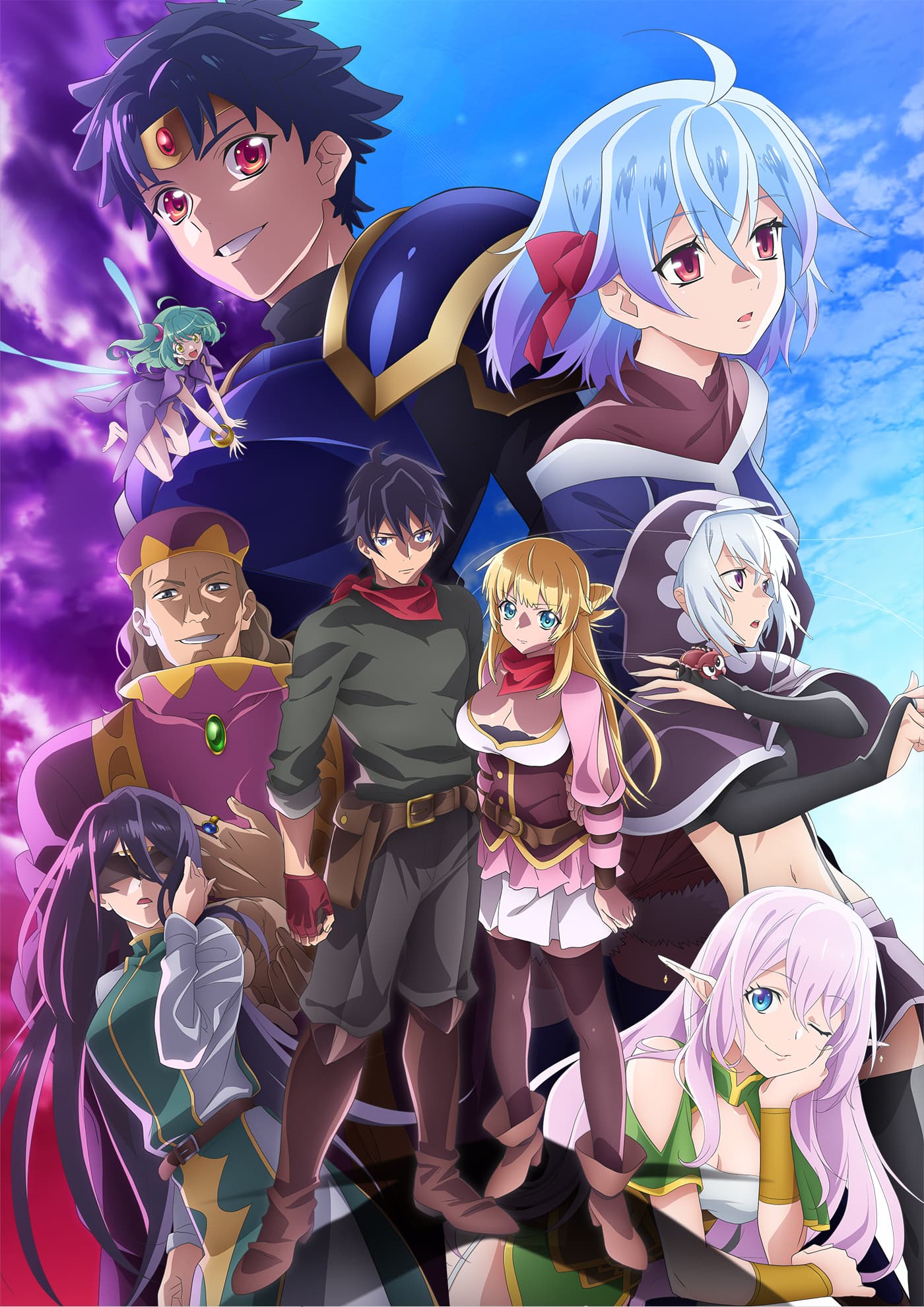
For animation, begin with the 2021 first season and its thirteen episodes, followed by the 2024 second season and its twelve episodes. The current official homepage prominently displays second-season artwork; that does not make it the starting installment. Our promotional image is explicitly labeled as belonging to that later season.
For the source story, start Zappon’s light novel at volume one. The English publisher also has a manga adaptation drawn by Masahiro Ikeno. Those are alternative ways to enter the premise, with separate volume numbers. A twelve-book manga list and a fifteen-book prose list are not two numbering systems for identical packages.
A completed novel series is different from an adaptation’s stopping point
KADOKAWA’s completion announcement identifies Japanese novel fifteen, released on 1 July 2025, as the final source volume. Yen Press’s English novel-fifteen record gives 11 August 2026 as its release date. Both dates precede this guide’s review. The distinction matters when an older recommendation still describes the English ending as a future book.
Yen Press lists twelve books for Ikeno’s manga adaptation. Its twelfth-book description concerns a confrontation already represented in the first anime season, rather than the full later prose trajectory. Its recorded English publication date is 28 April 2026. We do not repeat that product synopsis’s specific resolutions here.
If the anime makes you want the complete source route, the prose is the useful choice. This guide recommends beginning at one for comparison. It does not import a forum’s novel-five or novel-nine handoff without checking a named edition against the screen scenes. Buying manga twelve because twelve sounds like a final novel number would answer a different question.
| Format | Verified sequence | Practical route |
|---|---|---|
| Light novel | Fifteen-book source; Japanese completion 2025 | Read from novel one |
| Main manga | Twelve English collected books | Read manga one onward; separate adaptation scope |
| TV anime | 2021 season: 13; 2024 season: 12 | First season → second season |
| Rit spinoff manga | Separate Japanese princess-centered series | Optional additional perspective |
The original team and the two anime productions
Zappon writes the source and Yasumo provides its illustrations. Yen Press separately credits Ikeno for the main manga’s drawings and Dale DeLucia for the English translation. Giving the manga artist a distinct credit is useful: panel layout and character performance on a page are part of an adaptation’s work, not automatically the novelist’s contribution.
The official first-season record names Makoto Hoshino as director, Megumi Shimizu for series composition, Ruriko Watanabe for main character design and Yukari Hashimoto for music. Animation is credited jointly to Wolfsbane and Studio Flad. Ryota Suzuki and Kanon Takao voice Red and Rit in Japanese.
The second-season credits change the production arrangement: Satoshi Takafuji is director, Hoshino is chief director, and Studio Flad is the animation studio. Shimizu, Watanabe and Hashimoto retain their named roles. This prevents a single studio or director label from flattening two different production records into one.
Case check: useful work replaces a rank label
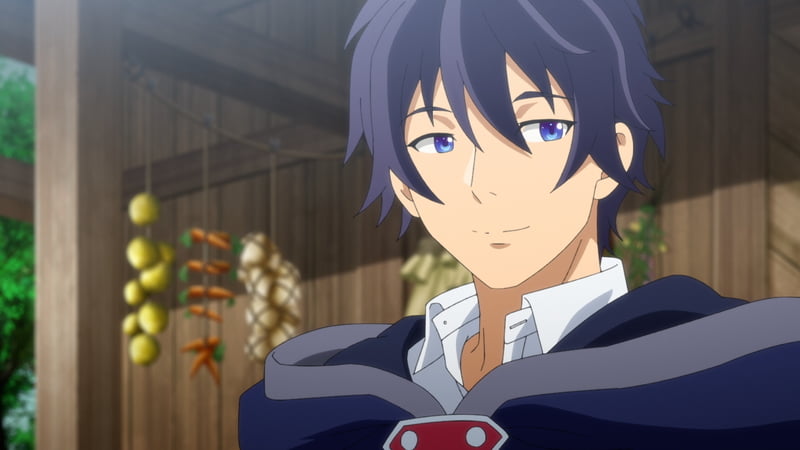
The original first-episode still below shows Red in front of wooden walls and hanging produce. His expression is relaxed and the lighting is bright. It is a civilian setting rather than an image of a climactic fight. Preserving the full frame keeps those ordinary materials visible beside his face.
The official premiere synopsis connects Red’s banishment with a local child falling seriously ill. That pairing gives the first episode a concrete question: what can the former party member do for people living nearby? His usefulness can be evaluated through a local need, independently of a grand expedition’s judgment.
Our interpretation is that the setting changes the scale of competence. A modest task can have immediate consequences for someone who is not part of the heroic mission. The image anchors that reading in an early civilian environment; it does not establish a treatment outcome or authorize claims about real medicine.
Original visual reference
Does a quieter life require abandoning responsibility?
Red’s desired life still contains obligations. A shop has customers, a home has another person’s preferences, and a settlement has problems that cannot be solved by announcing retirement. The interesting question is which obligations he chooses, and how much room those choices leave for affection and rest.
The romance can be read alongside that practical work. Sharing a business and a household makes a relationship something organized through decisions, not only declarations. Look for moments that ask who contributes, who gets to decide, and whether another person’s wish is treated as a genuine preference.
The fantasy’s blessings also make social roles unusually forceful. The opening setup identifies Red as a Guide and Ruti as the Hero; those labels raise a question about whether assigned usefulness should determine a whole life. The guide keeps later changes to those roles out of its spoiler-light introduction.
How to examine the dismissal without reducing it to one statistic
When discussing an adventuring group, separate attack strength, organization, communication and the relationships that make cooperation possible. A judgment about one member’s combat contribution does not automatically establish what happens to the other functions when that person leaves.
This provides a more precise discussion prompt than asking whether Red was secretly the strongest. Identify what the group needed in a particular scene, who supplied it, and what the others noticed. A person can be misjudged because a necessary contribution is difficult to see, not merely because their spectacular ability was concealed.
For an adaptation comparison, record the conversation in your licensed prose or manga edition and the matching anime episode. Does the format explain support work directly, leave it in background action, or focus on the insult? Those choices affect how the dismissal is understood. They require an actual matched example before declaring one version more faithful.
Rit’s separate manga is an optional branch
KADOKAWA identifies a princess-centered spinoff manga with drawings by Mutsuki Higashioji, original work by Zappon and character designs by Yasumo. Its Japanese title distinguishes it from Ikeno’s main adaptation. The publisher’s first-volume page describes Rit’s life before her reunion with Red.
That makes it an optional earlier-perspective branch, not a TV episode to insert into the first season. Start with the main premise, then explore it if Rit’s independent experience interests you. We do not claim a licensed English release for this spinoff from the Japanese record alone.
The older anime site still points toward some original book and magazine URLs that now redirect to general catalogs. This guide therefore supplies direct publisher product records where available. A redirected source page should not be treated as proof that a particular chapter remains free to read.
Circulation is a dated publisher claim, not adaptation profit
KADOKAWA’s 2025 completion announcement describes a cumulative series circulation milestone of three million copies. Keep that attribution and date attached to the figure. The phrase concerns the publisher’s series count; it is not a disclosure of anime viewers, unique paying readers or net revenue.
Novel, manga and disc records establish different ways the property is published. They do not reveal production budgets or how income is divided among rights holders. A book’s list price multiplied by a circulation figure would not produce a defensible profit calculation.
For a purchasing decision, compare the medium and included story rather than the apparent size of a catalog. Someone who wants the full prose conclusion has different needs from someone who wants an animated romance or Ikeno’s panels. Later-season promotional art should help identify the property without changing that choice.
Readers disagree about what the story gets right
The reviewed Reddit essay argues that Red’s new life is more compelling than a straightforward revenge response. Replies dispute its assessment of the dismissal, emphasizing support roles and relationships. Those are attributed positions within one discussion, not a consensus about whether Ares was right.
The disagreement is useful because it reveals two questions that should be separated: whether a group assessed a member fairly, and whether rebuilding a life must stay centered on that assessment. Our guide uses those questions without repeating the thread’s major ending details or assigning diagnoses to characters.
For a neighboring thematic comparison, Violet Evergarden also places skilled civilian work after military experience, but letter writing creates a different kind of responsibility from Red’s herb business. The after-battle collection explains why both belong on the shelf. Their individual guides keep their anime, prose and optional branches distinct.
Primary sources and useful navigation
- Official project, premise and character introductions
- Official first-season episode index and original still
- Official second-season episode index
- Official separate first/second-season staff records
- Yen Press English source novels
- Yen Press novel fifteen: English release date
- Yen Press main manga and artist credits
- Yen Press manga twelve: adaptation context; later-story spoilers
- KADOKAWA 2025 completion/circulation announcement; historical record
- KADOKAWA Rit spinoff volume one and creator records
- Related guide: Violet Evergarden civilian work and adaptation routes
Community and catalog routes
- Reviewed discussion: moving on, dismissal and support roles; spoilers
- Fan wiki; secondary navigation and spoilers
- MyAnimeList first-season catalog; secondary navigation
The production and publisher links support project facts. Catalog and community pages are secondary navigation and may reveal later events.
Find this work in our thematic collections
Original series imagery is reproduced under permission asserted by the site owner; the source and rights credits are retained. The route diagram is Animeteor’s own explanatory graphic.
Games and live-action adaptations
- Slow living with Princess — Game: Apothecary life simulation · action RPG