Watch the original twelve-episode 2016 anime, then its companion episode. The complete Japanese upper-and-lower novelization adapts the show and includes additional stories.
Reviewed 2 October 2026 · Opening premise and format relationships; major ending revelations withheld. Linked publisher summaries and discussions may reveal later events. · Licensed access varies by country.
The source and screen branches

Anime is the origin. Episode thirteen is a companion, not season two; the two Japanese novels are adaptations, and no source manga or post-anime chapter is invented.
- WATCH · origin: 2016 television · 12 episodes → Begin episode 1
- WATCH · companion: Episode 13 · 2017 → Three side stories afterward
- READ · novelization: Story Works · upper book → Lower book · complete in two
The revenge story starts with an original anime
91 Days is an original animated production, not an adaptation of a source manga or novel. Begin its twelve-episode 2016 television run at episode one. A separate episode thirteen contains companion stories and is best approached afterward, even when a service puts all thirteen items under one series heading.
The Japanese PASH! Books novels adapt the animation in two books credited to Story Works. Read the upper book before the lower book. They are an alternative treatment with additional material, not proof that the television story requires a pre-existing novel for its opening premise or that a second anime season has been published.
No source manga or verified English novel edition was established for this guide. The core map therefore keeps the anime origin, companion episode and Japanese novelization visible without adding empty format branches. The story takes place in a fictional Prohibition-era American town; following this viewing route is not a historical course about a documented criminal family.
| Route | Start | Scope |
|---|---|---|
| Television | 2016 episode 1 | Twelve-episode main run |
| Companion animation | Episode 13 afterward | Three side stories; not season two |
| Japanese novelization | PASH upper → lower | Two-book anime adaptation |
| Manga | No verified source route | No invented reading continuation |
Upper and lower are two published novelization books
PASH! Books dates the upper book to 16 September 2016, ISBN 9784391149241, and the lower book to 28 October 2016, ISBN 9784391149258. The publisher marks the lower book and the series complete. This identifies the novelization’s two-book publication status, without changing which medium originated the story.
The upper product credits Story Works as author and the Vanetti Families credit for illustrations. It also identifies a bonus story concerning Barbero and Nero. The lower description identifies an additional story involving Avilio in Chicago. These are specific publisher descriptions; they do not authorize the guide to claim every unseen prose scene resolves every debated screen moment.
Crunchyroll’s September 2017 catalog announcement separately identifies episode thirteen as three short stories first included with the seventh home-video volume on 5 July. That dated announcement establishes its companion status. It does not establish that the same streaming service still supplies the complete title in every territory in October 2026.
A cover arranges apparent partnership around an unresolved threat
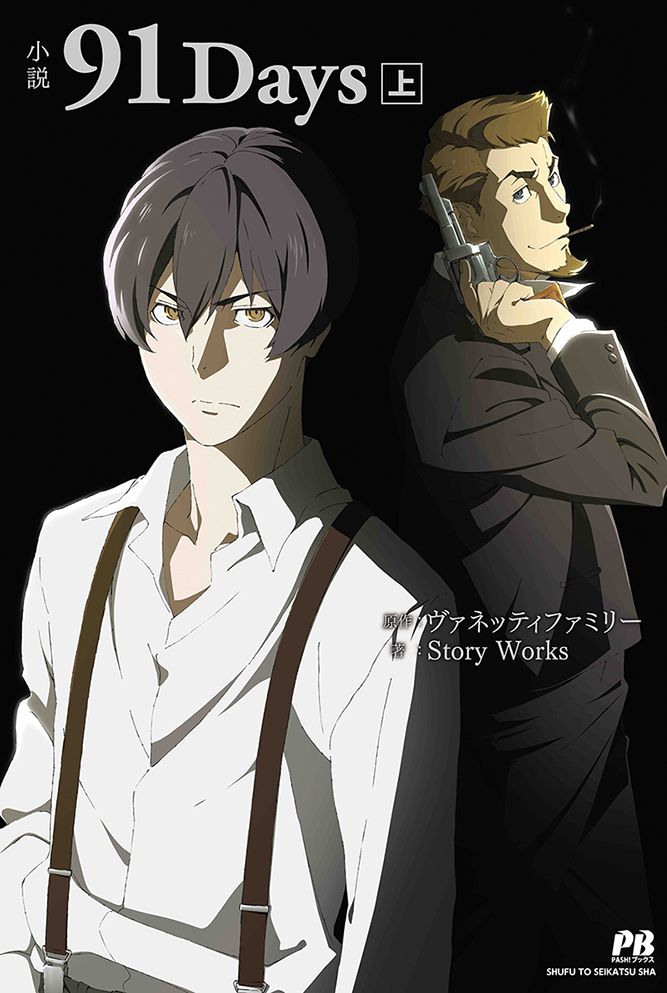
The selected original upper-book cover places a dark-haired man in a light shirt and suspenders in the foreground. Behind him, a light-haired man turns sideways with a handgun near his shoulder. The Japanese upper-volume marker and Story Works credit are part of the cover. This is publisher artwork, not a screenshot of an actual gunshot.
Our visual reading notices that the figures share the same composition while facing different directions. The nearer figure’s frontal position asks for attention, while the second figure’s weapon introduces the possibility of violence. Their arrangement can frame the tension between proximity and mistrust, without proving what either person will choose at the end.
The distinction matters because the story’s premise places Avilio near Nero for a concealed purpose. A cover can advertise that relationship without documenting a named scene. We keep that analytical boundary explicit: an illustration supplies visible posture and equipment, while a claim about a particular betrayal requires the licensed episode or chapter itself.
Original visual reference
Infiltration turns closeness into an instrument
Our central interpretation begins with a practical contradiction in revenge through infiltration. Avilio needs access to the people associated with his family’s destruction, and access depends on becoming useful or trusted. He must participate in social arrangements he ultimately intends to damage, so progress toward his objective can create relationships that complicate it.
A close reading can distinguish performing loyalty from experiencing attachment. A person may begin a conversation for information and later discover that its emotional consequences do not remain neatly under control. The guide does not assign a final answer to that problem, but asks viewers to trace how the cost of proximity changes over time.
This makes a revenge narrative more than a sequence of targets. The method changes the person pursuing the objective and the people who respond to him. Readers should inspect what each character knows at a named moment rather than interpreting every gesture through knowledge acquired only at the ending. That preserves the unfolding dramatic uncertainty.
A usable identity must persuade people who know less than the viewer
The premise gives Avilio a reason to enter the Vanetti circle while concealing his history. Our analysis asks how an identity becomes credible through repeated conduct, not merely through a new name. Work, favors, risk and speech can make a person seem dependable to people whose information differs from the audience’s.
That difference supports dramatic tension. Viewers can notice a gap between an apparently ordinary interaction and the concealed purpose behind it. A close reading should specify which information has actually been disclosed, avoiding the assumption that every character already understands the full plan because the viewer has been introduced to the premise.
The novelization offers another medium in which to investigate perspective. PASH’s descriptions identify additional material, but this guide has not claimed an exhaustive comparison of every internal thought against every screen gesture. Such a comparison needs the relevant licensed passages and episodes, including edition details where translation changes the wording being examined.
Illicit trade creates relationships that violence alone cannot maintain
The publisher situates the fictional town around bootleg liquor and competing criminal groups. Our interpretation treats that trade as a reason people need one another, even when they cannot rely on lawful protection. Distribution, supply and access create dependencies; a threat may force compliance briefly without providing the cooperation needed to keep an enterprise working.
A close reading can follow what counts as leverage in a particular negotiation. Is a character offering product, information, status or an alliance? Naming the exchange clarifies why personal violence and commercial activity interact. The story’s economy becomes part of its social structure rather than a decorative label placed behind a revenge plot.
This is an analysis of fictional incentives, not instruction for criminal activity or a claim that the town documents actual Prohibition statistics. A historical comparison would need independent historical sources and a defined subject. For the guide’s purpose, the useful question is how imagined commercial dependencies change the freedom of the people inside them.
Production records and audience scores identify particular versions
Shuka lists 91 Days among its animated productions, while the licensed distributor’s companion-episode announcement identifies Hiro Kaburagi directing the television series. PASH credits Story Works on the later prose books. Those relationships keep the original production distinct from its novelization and prevent a prose author credit from being reassigned as the animation’s source creator.
The official production archive now lives on Shochiku’s anime domain. Its 25 January 2024 notice records the website address change, explaining why the old 91days.family address is unreliable. The current archive and studio catalog provide working production references, while PASH supplies the separate novelization records; an old domain failure does not mean the archive disappeared.
The displayed AniList 7.6 out of 10 belongs only to the twelve-episode 2016 television entry. It excludes episode thirteen and the two prose books. Linked secondary navigation and anime discussion can help readers examine interpretations, but audience opinions do not convert an ambiguous ending into an officially confirmed sequel or establish present streaming rights.
A catalog announcement remains a dated distribution record
The two Japanese novels and the additional home-video episode establish real ancillary publication around the original show. They do not measure how profitable the production was. A disc volume, licensed stream and printed book have different commercial structures, and the guide does not merge them into a fabricated title-level revenue estimate.
No audited 91 Days net profit or complete animation budget was verified. The 2017 streaming announcement is explicitly historical; visitors should use current authorized regional catalogs to confirm access. An unavailable official domain, meanwhile, is a source-maintenance issue rather than evidence that a series has gained or lost a season.
Watch the main twelve episodes, then choose the companion episode or the Japanese two-book novelization. The reading route begins at the upper book instead of at an invented post-television chapter. Future updates should prioritize working official distribution records and genuinely new announcements, with every publication date attached to its format and territory.
Primary sources and useful navigation
- Official production archive · migrated address
- Shuka · production catalog
- PASH Books · complete two-book novelization
- PASH Books · upper book, author and bonus story
- PASH Books · lower book and completion
- Licensed distributor · historical episode-thirteen announcement
- AniList · named adaptation audience score
Community and catalog routes
- MyAnimeList · named adaptation catalog
- Reddit · anime discussion, spoilers possible
- Wikipedia · secondary format navigation
The production and publisher links support project facts. Catalog and community pages are secondary navigation and may reveal later events.
Find this work in our thematic collections
Original series imagery is reproduced under permission asserted by the site owner; the source and rights credits are retained. The route diagram is Animeteor’s own explanatory graphic.