Ashita no Joe (1970) — live-action film guide
LIVE-ACTION GUIDE · Sources checked 04 October 2026 · Opening-premise spoilers; publicity and linked summaries may reveal later material.
Yasuharu Hasebe’s 1970 live-action feature is a separate early cinema adaptation starring Shoji Ishibashi. It is distinct from both the 1970 television anime and the 2011 live-action film.
- Format / status
- Live-action theatrical feature · released
- Japanese theatrical release
- 22 July 1970
- Runtime
- 84 minutes
- Director
- Yasuharu Hasebe
- Joe Yabuki
- Shoji Ishibashi
- Selected cast
- Seiichiro Kameishi; Ryutaro Tatsumi
- Production / distribution
- Shinkokugeki Eiga / Nikkatsu
- Film record format
- Colour · CinemaScope; archive publicity photograph is black and white
Production and edition
Nikkatsu’s film archive identifies the 1970 feature and its production team separately from the long television adaptation. Joe Yabuki’s boxing ambition supplies the opening premise; this guide does not reproduce the ending or claim an exact correspondence between every film scene and manga chapter. The record identifies Shoji Ishibashi as Joe, Seiichiro Kameishi as Rikiishi and Ryutaro Tatsumi as Danpei. The archive describes a colour CinemaScope production even though the supplied publicity photograph is black and white.
An adaptation lens
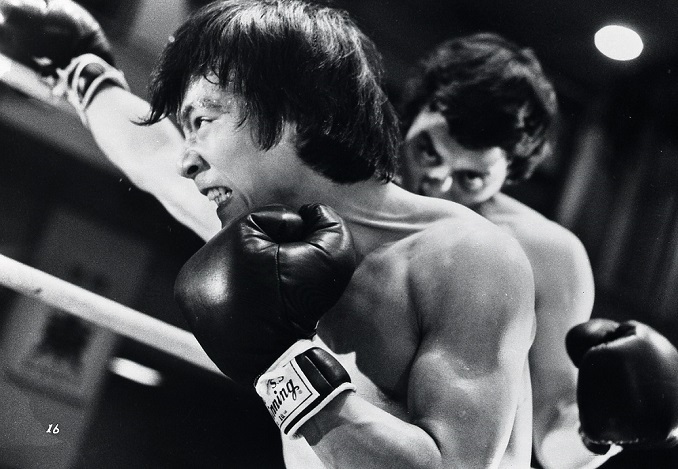
A live-action boxing image makes the performer’s body, contact and ring space immediate visual evidence. The full original photograph retains both fighters rather than extracting a headshot. This gives readers a concrete basis for thinking about how the manga’s confrontations are embodied in a feature. A publicity image alone cannot establish choreography, performance quality or the rhythm of a complete fight, and the interpretation here remains limited to the visible composition and verified production identity.
The 84-minute feature occupies a different narrative container from the source manga and the 79-episode first television series. Condensation is therefore a useful question for comparison, without inventing a chapter boundary or asserting which later events the film omits. Its historical proximity to the original anime does not make it part of the anime’s episode order. The black-and-white promotional image also should not be mistaken for proof that the film itself was shot in black and white.
Choosing this route
Choose the 1970 film as its own live-action branch. The 2011 feature already has a separate guide and cast; neither replaces the other. Return to the main Ashita no Joe analysis for the manga and two television series, and avoid inserting this film between anime episodes as if it were an extra canonical chapter.
Release and access
The verified date is the Japanese theatrical release on 22 July 1970. Nikkatsu’s historical archive does not establish current streaming access, worldwide distribution, subtitle availability or a recent restoration. Check an authorized territorial distributor for the exact edition. No contemporary audience score or hands-on viewing assessment is invented.
Sources and credits
The production facts above come from the identified official records. The adaptation lens is Animeteor editorial interpretation, not a scored review or an exhaustive scene comparison.