Nodame Cantabile (2007) — Nintendo DS game guide
GAME GUIDE · Sources checked 04 October 2026 · Opening-premise spoilers; original promotional screenshots can reveal creatures and environments.
The 2007 DS product turns Nodame’s music-school setting into touch-controlled performance, conversation and minigame activities.
- Product / edition
- Nodame Cantabile · Japanese DS product
- Publisher
- Bandai Namco Games
- Release
- 19 April 2007
- Players
- One
- Format
- Music-school variety and rhythm activities
- Distinct products
- Separate from Dream Orchestra and the later DS game
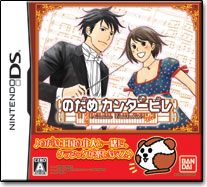
Product and edition
Nintendo’s manufacturer record identifies this Japanese DS product by its 19 April 2007 release. Its adventure component lets players move through the music-school setting and converse, while performances use touch rhythm controls. Keep it separate from the December 2007 Wii product and the later Tanoshii Ongaku no Jikan Desu DS title. Shared characters do not make those editions interchangeable.
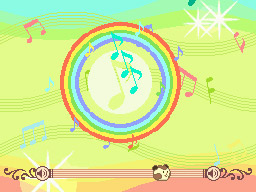
Gameplay and story
Our comparison begins with how musical timing becomes an action. A screen story asks the viewer to attend to a performed phrase; the touch interface asks the player to respond. The circular screen displayed here brings notes and a visible performance area into the same field. It cannot tell us how forgiving the timing is, how the touch input feels or whether the audio is accurate on every device. Those questions need play evidence.
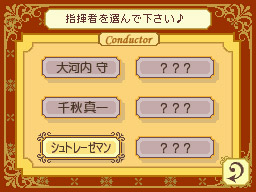
The conductor menu and result screen connect preparation with evaluation. Choosing a conductor frames the performance through a familiar character, while the result gives the activity an explicit response. Our reading is that this lets a music-school premise become a sequence of practical attempts rather than only a narrated ambition. It does not prove that improving at the game transfers to instrumental skill, and a promotional result is not a verified player achievement.

Choosing this route
Choose this edition for a compact touch-based encounter with the property. Read the manga for its source sequence or follow the anime and performed-film routes separately. None of these screenshots identifies a chapter after an anime ending. Minigame progress and conductor selection are product activities, not new volumes of the manga. The useful comparison is how each medium invites attention to music, relationships and practice.
Platforms and access
The source establishes a historical Japanese cartridge, not a current download offer. Confirm language, hardware and lawful stock before choosing a copy. Original 256-by-192 screens are retained at native dimensions with complete controls. They are useful records of interface design and do not promise modern display fidelity or measured input latency. No hands-on score or current resale-price claim is supplied.
Sources and credits
- Nintendo — exact product and manufacturer description
- Nintendo — performance touch-screen gallery
- Nintendo — result gallery
- Nintendo — conductor-selection gallery
Facts are drawn from the identified publisher and developer records. The story lens is editorial interpretation, not a hands-on review, performance test or audience rating.