Food Wars!: Yujo to Kizuna no Hitosara — Nintendo 3DS game guide
GAME GUIDE · Sources checked 04 October 2026 · Opening-premise spoilers; original promotional screenshots can reveal creatures and environments.
FuRyu’s 2015 Nintendo 3DS adaptation pairs a separate school-and-cooking adventure with character conversations. Its full dialogue screens document this specific product; the discontinued Bandai Namco mobile game is a different release.
- Japanese release
- 17 December 2015
- Publisher
- FuRyu
- Platform
- Nintendo 3DS
- Japanese title
- 食戟のソーマ 友情と絆の一皿
- Official genre
- Cooking-battle adventure
- Japanese classification
- CERO C · age 15+

Product and edition
Yujo to Kizuna no Hitosara is the Nintendo 3DS Food Wars! product published by FuRyu on 17 December 2015 in Japan. Its exact Japanese name, 友情と絆の一皿, should be retained when searching an old package or the publisher’s archive. This guide does not combine it with Saikyo no Recipe Okawari!!, Bandai Namco’s separate iOS/Android service that ended on 5 January 2017. The main anime’s numbered Plates are also different identifiers. A cooking theme and shared students can connect the products culturally without making their release dates, service history or story coverage interchangeable.

Gameplay and story
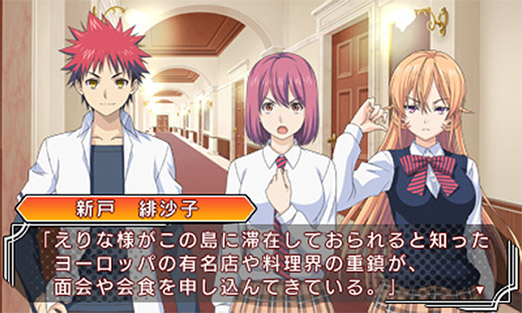
The selected opening-level interface shows several students and an adult participant sharing an indoor conversation. The speaker label and full text area are part of the game image, so the scene can be understood as an interactive story presentation rather than a detached anime publicity still. Our interpretation is that the adaptation creates room for conversational context around culinary pressure. That is a different kind of engagement from following a television contest at a fixed pace. The official system page describes both cooking battles and exchanges with companions; the dialogue gallery demonstrates only the latter, and does not let us claim to have tested the battle rules.

The outdoor conversation changes the social setting and the visible speaker, while the corridor image places Soma beside characters with different positions in the school. That gives a useful reading question: when does a culinary institution feel like a ranking system, and when does it feel like a group of people getting to know each other? These frames support that editorial lens without revealing which dish wins a later challenge or assigning a relationship outcome. They retain the complete publisher-supplied dialogue interface. The gallery’s separate illustrated event pictures have not been mislabeled as gameplay or used to replace the two additional in-game conversation screens.
Choosing this route
The game is an optional interaction with Food Wars!, outside the manga-to-anime map. Begin the source manga or original television Plate for the introductory story; choose this product for a different combination of culinary competition and character exchanges. Its package does not certify a complete adaptation of all thirty-six manga volumes or all five television seasons. Readers comparing a game scenario with a particular episode would need the actual licensed materials, rather than inferring chapter equivalence from a familiar cast member. The title’s emphasis on friendship and bonds is a useful expectation to investigate, not proof of any uninspected ending.
Platforms and access
FuRyu’s specifications identify a historical Japanese Nintendo 3DS package and download release. The archive’s purchase prices and reservation themes describe the original campaign and do not establish current digital availability. Confirm the exact cartridge, region compatibility and Japanese language before choosing an edition. A current used listing is a seller’s offer rather than a guarantee supplied by this guide. The Japanese age classification and the main Work’s discussion of expressive fanservice can help orient expectations, but no hands-on performance score or audience-rating average is assigned to the game.
Sources and credits
- FuRyu exact product
- FuRyu release specifications
- FuRyu system and original full gallery
- FuRyu story page
- Separate mobile service termination statement
Facts are drawn from the identified publisher and developer records. The story lens is editorial interpretation, not a hands-on review, performance test or audience rating.