Watch Zombie Land Saga (2018), then Revenge (2021), twelve episodes each, then Yumeginga Paradise. The anime is original; Soraji’s related comic and Fukagawa’s completed three-book prequel are optional reading branches.
Reviewed 1 October 2026 · Opening zombie-idol premise, format and credit records; film ending and prequel revelations withheld. · Licensed access varies by country.

The source and screen branches

First-viewing screen order, not a rearrangement by the characters’ historical lives. Manga branches are associated products rather than the anime’s source. Regional film distribution dates and availability differ.
- WATCH · main sequence: Zombie Land Saga · 2018 · episodes 1–12 → Revenge · 2021 · episodes 1–12 → Yumeginga Paradise · continuation film
- READ · associated manga: Megumu Soraji · anime-associated comic OR Kasumi Fukagawa · The First Zombie · three books
- LISTEN / EXPLORE · optional: Official soundtrack / Franchouchou recordings OR Cast live events / official Saga location map
Start with the 2018 original television series
Zombie Land Saga brings seven revived girls together as Saga’s local idol group, Franchouchou. Sakura Minamoto wakes without an ordinary explanation for her situation; producer Kotaro Tatsumi gives the group an equally extraordinary assignment. The undead premise opens a story about performing, cooperation and being seen rather than a conventional campaign of magical conquest.
The dependable first-viewing route is the 2018 television series, episodes one through twelve, followed by 2021’s Zombie Land Saga Revenge, episodes one through twelve. Then watch the continuation film, Yumeginga Paradise. Both official episode indexes and the film’s introduction preserve these distinct installments. Revenge is the second season, not a remake you can substitute for the opening.
This is an original anime project. Associated manga exists, but it does not precede the television production as its source. A reader browsing our anime/manga badges should therefore see related access routes rather than assume a familiar source-comic-to-animation hierarchy. No inspected primary record establishes an original source novel or a required prose branch.
The film continues the screen story
The Japanese film project records a 24 October 2025 theatrical release. Crunchyroll’s North American announcement separately dates its United States and Canadian cinema event to 19 January 2026. Those are different regional distribution milestones for the same film, not two sequels. Its June 2026 streaming announcement explicitly says availability can depend on region.
Yumeginga Paradise follows the television route rather than condensing the first season into a recap. The official introduction presents the group on a larger stage, and Saga’s tourism federation describes the progression from the first television work through Revenge to the film. Save the film for after season two so its established performers and relationships have context.
Do not reorder the series by the characters’ historical lives on a first viewing. Their different eras are part of how the television story introduces its ensemble. A historical prequel comic can reveal information that the screen story deliberately withholds. Publication order and an in-universe chronology answer different questions.
| Branch | Verified scope | Suggested place |
|---|---|---|
| Original TV | 2018; episodes 1–12 | First |
| Revenge | 2021; episodes 1–12 | After original TV |
| Yumeginga Paradise | Japanese 2025 film; regional 2026 releases | After Revenge |
| Soraji manga | Anime-associated Japanese comic branch | Optional separate reading |
| The First Zombie | Fukagawa prequel comic; three completed books | Optional after meeting the TV ensemble |
Two manga branches serve different purposes
The Cycomi listing credits Megumu Soraji for the anime-associated comic. The official franchise catalog also identifies Saga Mirai Kaitaku-hen, released on 30 June 2021, as its final collected installment, with a Shogakukan digital-edition link. This is an associated comic route with its own presentation, not proof that a numbered book picks up exactly after a television finale.
The First Zombie is a separate prequel comic drawn by Kasumi Fukagawa, credited with the original project team. Shueisha’s catalog lists three Japanese books; the third was released on 19 December 2022. Ultra Jump’s contemporary notice explicitly calls that volume the conclusion. That verified completion applies to this side comic, not an announcement that every part of the screen franchise has ended.
The prequel explores Tae’s earlier life. Even a publisher description can reveal connections a newcomer has not learned, so it is linked as optional spoiler-bearing reading. These inspected Japanese records do not establish a licensed English prose series or an English manga release schedule. Fan translations should not be mistaken for publisher editions or promoted as official access.
Keep television and film director credits separate
The first television project credits Munehisa Sakai as director, Shigeru Murakoshi for series composition and Kasumi Fukagawa for character design, with animation by MAPPA. The original project identifies MAPPA, Avex Pictures and Cygames as its participating companies. This makes a single named manga author an inaccurate substitute for the production’s actual origin.
Revenge retains Sakai, Murakoshi and Fukagawa in those roles. Its music credits identify Yasuharu Takanashi and Funta7, while the official staff page separately records music production at Avex Pictures. When discussing songs, distinguish composition, production and performance rather than attributing every audible element to the animation studio.
The film changes the directing structure: chief director Konosuke Uda, directors Takeru Sato and Takafumi Ishida, screenplay by Murakoshi and animation by MAPPA. Fukagawa, Jinshichi Yamaguchi and Fumihide Sai receive character-design credits. Returning franchise personnel and new directing responsibilities coexist; the credit change alone cannot establish budget, artistic superiority or the reason for a production interval.
The ensemble is also a performed musical identity
The Japanese cast links Sakura to Kaede Hondo, Saki to Asami Tano, Ai to Risa Taneda, Junko to Maki Kawase, Yugiri to Rika Kinugawa, Lily to Minami Tanaka and Tae to Kotono Mitsuishi. Kotaro is performed by Mamoru Miyano. These character-to-performer connections help readers navigate cast appearances and authorized music products.
The official character records distinguish Ai’s earlier idol career from Junko’s experience in a different idol era. That difference gives a useful analytical question: when performers disagree about a relationship with their audience, are they protecting the same idea of professionalism? Our reading treats the ensemble’s incompatible expectations as material for cooperation rather than interchangeable character decoration.
A stage event featuring the voice cast is another franchise product, not an additional animated season. Likewise, a song released under Franchouchou’s group identity need not be an unseen narrative chapter. The guide links the official music and event catalogs so a visitor can choose that material without putting it into the mandatory screen sequence.
Case check: an undead face fills a performance frame
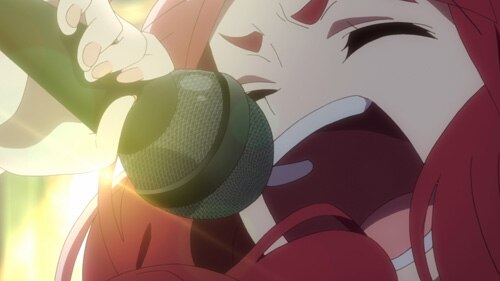
The original premiere still below shows Sakura close to a microphone, eyes closed and mouth open, with the scarred pale face of her zombie appearance. Bright stage light enters from the left; the microphone occupies a large part of the foreground. The intact official frame is modest in resolution, so it is used as a bounded illustration rather than enlarged into a misleadingly sharp banner.
Our reading focuses on how the performance equipment changes the function of the horror image. The face could signal danger in another setting, but here the microphone places that same bodily difference inside an act of making sound for an audience. The collision of vulnerability, spectacle and undead appearance makes the genre mixture visible in one frame.
This is a still, not a recording of the soundtrack. It cannot prove the exact song, a vocal technique, audience approval or what a lyric means. Those claims require the relevant audiovisual sequence and authorized text. Its narrower value is compositional: the character is both visibly unusual and occupying the recognizable position of a performer.
Original visual reference
Being publicly recognizable and privately concealed
The idol premise depends on visibility, while an undead body supplies reasons to conceal information. That tension makes ordinary promotional goals unusually complicated. Building an audience is not simply an increase in attention; it also creates more opportunities for the public to encounter details the group cannot easily explain.
For an episode-level analysis, ask who controls a performance’s terms. A producer can arrange an appearance, but the performers still have to coordinate, react and support each other. A successful event should not automatically erase a disagreement about how they were treated. The comedy can expose that imbalance without making the manager’s confidence a reliable account of reality.
The mixture also changes the meaning of another chance. Returning to activity does not require every member to have the same history, ambitions or relationship with past loss. Our interpretation emphasizes what the ensemble has to negotiate in the present. That provides a useful comparison with the undead collection’s more solitary arrivals and more hierarchical organizations.
Saga is a real place as well as the project’s setting
The official Saga tourism federation maintains a franchise manhole guide with a map and locations. Its inspected page records thirty-two designs and connects them with places around the prefecture. That is concrete evidence of a public tourism collaboration, not merely a fan’s claim that an anime has recognizable scenery.
The distinction between represented place and visitor experience matters. A filmed-looking anime location does not establish current opening hours, transport access or permission to enter a property. Use the official map as a discovery route, then check the individual site before traveling. A later travel-focused article can verify those practical details separately.
The collaboration helps explain the project’s local promotional dimension, but it does not establish economic impact by itself. Counting illustrated covers or events cannot yield attributable tourism receipts, an animation budget or net franchise profit. The inspected official project pages support named products and collaborations; they do not supply an audited financial return.
Music, discs and live events are optional companion routes
The first-season disc catalog lists a television Blu-ray box, an original soundtrack, Franchouchou’s The Best and recorded live events as different products. The Revenge catalog separately offers its discs, songs and live recordings. Someone interested chiefly in the music can follow these official routes without hunting for an imaginary extra anime episode.
The Revenge SAGA.3 record specifies television episodes nine through twelve plus companion music and promotional extras. A bonus song or a creditless opening is not necessarily a fresh story installment. Its first-production packaging and historical store bonuses should not be advertised as guaranteed current stock simply because an old product page remains online.
The maintained film project also lists a future 2027 Saga Arena event among current franchise notices. An event announcement is not confirmation of a third television season. News updates should retain that product distinction and their review dates, especially when an image or title makes a concert look like new animation.
Viewers ask whether the film is a recap
The reviewed June 2026 Reddit streaming-release discussion includes exactly that discovery question: is the movie a recap, and where does it fit? Other participants explain that it follows season two, while some celebrate finally seeing it and report launch-time audio availability. These individual observations show a navigation need, not a measured audience consensus.
Our screen map answers the placement question using the official project sequence. The distributor’s region-dependent release notice supplies the access qualification; a user’s temporary missing dub cannot establish permanent unavailability. Keep discussion links separate from release evidence, and expect the movie threads and fan wiki to contain ending spoilers.
Compare this work with Dead Mount Death Play through public identity and with Overlord through how an undead body changes social recognition. The comparison does not make their fictional histories compatible. Franchouchou’s group labor, Narita’s city mystery and Nazarick’s institution need their own source records and separate continuity diagrams.
Primary sources and useful navigation
- Official original project, television credits and character profiles
- Original season episode index
- Official premiere still and opening account
- Revenge official episode index
- Revenge official staff and cast
- Official film project, separate credits and maintained notices
- Distributor North American theatrical release record
- Distributor streaming notice; region-dependent availability
- Cycomi associated comic; Japanese reading
- Official Saga Mirai Kaitaku-hen final-comic record
- Shueisha prequel edition catalog; descriptions contain spoilers
- Ultra Jump prequel completion announcement; spoilers
- Original-season music and disc catalog
- Revenge SAGA.3 episode scope and companion products
- Official Saga tourism federation franchise map
- Related guide: Dead Mount Death Play
- Related guide: Overlord
Community and catalog routes
- Reviewed film streaming discussion; film and ending spoilers
- Zombie Land Saga fan wiki; secondary navigation and spoilers
- MyAnimeList original television catalog
The production and publisher links support project facts. Catalog and community pages are secondary navigation and may reveal later events.
Find this work in our thematic collections
- Undead power and life beyond death: five anime with different stakes
- Five anime about performers and the identities an audience sees
Original series imagery is reproduced under permission asserted by the site owner; the source and rights credits are retained. The route diagram is Animeteor’s own explanatory graphic.
November collaborations and a separate performed stage route
The film’s official 2 October notice confirms a collaboration with Cygames presents Imari Bay Fireworks on 21 November 2026 in Japan. A separate 30 September notice schedules Franchouchou performers at the Saga International Balloon Fiesta on 2 and 3 November. These are future local events tied to the existing production, not a new anime season or live-action film.
Official fireworks collaboration · Official Balloon Fiesta appearance dates
The archived Stage de Dōn! production lists 5–6 September 2020 at Sogetsu Hall. It is performed theatre outside the television/film story route; its historical production page does not announce a new live-action television series.
Read the separate source-backed publication and collaboration report
The official film portal’s 24 October 2025 notice separately documents collaborations with Granblue Fantasy, Princess Connect! Re:Dive, Uma Musume and Shadowverse: Worlds Beyond. These were crossover events in existing games, not four standalone Zombie Land Saga games or ongoing October 2026 events.