Watch episodes 1–12, then 13–24. Read Narita and Fujimoto’s main manga from volume one. The Japanese Solitaire prose and its comic adaptation are optional branches; they are not the original source or a required anime prequel.
Reviewed 1 October 2026 · Public reincarnation premise and production/format relationships; later identities and outcomes withheld. · Licensed access varies by country.

The source and screen branches

The manga is the main source. Solitaire prose is an associated side story with its own comic adaptation; no exact anime chapter handoff or English side-novel edition is asserted.
- READ · main source: Collected manga · volume 1 onward → English collected books OR digital serial chapters
- WATCH · 2023 anime: First cour · episodes 1–12 → Second cour · episodes 13–24
- READ · optional side branch: Japanese Solitaire prose · Narita / Fujimoto OR Solitaire comic adaptation · separate edition
A necromancer arrives in contemporary Shinjuku
Dead Mount Death Play shifts an otherworldly conflict into contemporary Shinjuku. Its opening follows the Corpse God, a necromancer whose reincarnation places him in the body of a boy named Polka Shinoyama. This is the public premise established by the official first-episode account, rather than an assumption that the apparent fantasy hero is the central traveler.
Watch the 2023 television adaptation from episode one through twenty-four. The first twelve episodes form the first cour, followed by episodes thirteen through twenty-four in the second. A service may label that later block Part 2, but the official numbered story archive continues at thirteen; it does not restart a separate origin story.
The main source is the manga written by Ryohgo Narita and drawn by Shinta Fujimoto. Start its first collected volume for the full opening. The Novel badge on this guide refers to a separately verified Japanese Solitaire spinoff; it does not mean that an original Polka light novel must be read before the manga or anime.
Keep collected books, serial chapters and the side story separate
Square Enix’s maintained Japanese manga listing reaches volume seventeen, released 24 April 2026. The English Yen Press catalog identifies collected volume fifteen, released 23 June 2026. These are language-specific publication records, not evidence that either numbered volume marks the end of the principal story. The older anime homepage’s twelve-volume advertisement reflects its 2023 context.
Yen Press also offers a separately listed digital serial route. That catalog presents individual chapter numbers, not another collection of novel volumes. Someone buying a collected book and a later chapter should check the actual contents and avoid paying for overlapping material. We do not infer an exact anime continuation chapter from a search snippet.
The inspected English volume credits Christine Dashiell for translation and Abigail Blackman for lettering. Those contributors shape this edition’s readable text and presentation while Narita and Fujimoto remain the original writing and drawing team. Knowing the roles is useful when comparing a licensed book with a fan-maintained entry.
| Route | Verified record | Starting choice |
|---|---|---|
| Main manga | Japanese books through 17; English through 15 at review | Main collected volume one |
| English digital serial | Individual chapter releases in a separate Yen Press catalog | Match contents before combining with books |
| Solitaire side story | Japanese prose and a separate comic adaptation | Optional after meeting the ensemble |
Solitaire has a prose branch and its own comic adaptation
The Japanese Kaijin Solitaire no Shinsen Gijutsu spinoff prose credits Narita as author and Fujimoto as illustrator. Its first book was released 25 November 2023, and the publisher links subsequent prose volumes two and three. This is genuine associated prose, with ISBN 9784757588820 identifying the inspected first edition.
The side-story comic is another product, not the prose divided into panels by the main manga artist. Its inspected volume-five record credits Yata Sugami for drawing and Ume Matsutake for composition, with Narita and Fujimoto in source roles. Released 24 April 2026, that record calls the comic’s first part complete. That statement must not be turned into a completion claim for the principal Dead Mount Death Play manga.
Use either side-story format as an optional exploration after becoming familiar with the cast. Its premise concerns Solitaire’s background, but no inspected source gives us a scene-by-scene insertion point into all twenty-four anime episodes. We also do not promise a licensed English translation of that Japanese prose branch.
The anime changes director between cours
The official anime staff record names Manabu Ono as first-cour director and series composer, with directing cooperation in the second cour. Yoshihiro Satsuma directs that second block. Takaharu Okuma is credited as first-cour subdirector and Yoshiki Kitai as first-cour assistant director. GEEKTOYS produces the animation.
Hisashi Abe supplies character design; the credited music unit is F.M.F, with Yuki Nara, eba and Kana Utatane named. The Japanese cast includes Yuki Sakakihara as Polka, Inori Minase as Misaki and Yuma Uchida as Takumi. A later-cour page therefore should not reuse a simplified first-cour director label without qualification.
Narita’s other licensed writing includes Baccano!; its publisher record provides a direct author-discovery route. Young Gangan also identifies Narita and Fujimoto as a team associated with the Baccano! manga. Shared creators can explain why readers investigate related work, but they do not establish a single continuity linking Shinjuku here to every other Narita title.
Case check: the opening’s skeletal scale
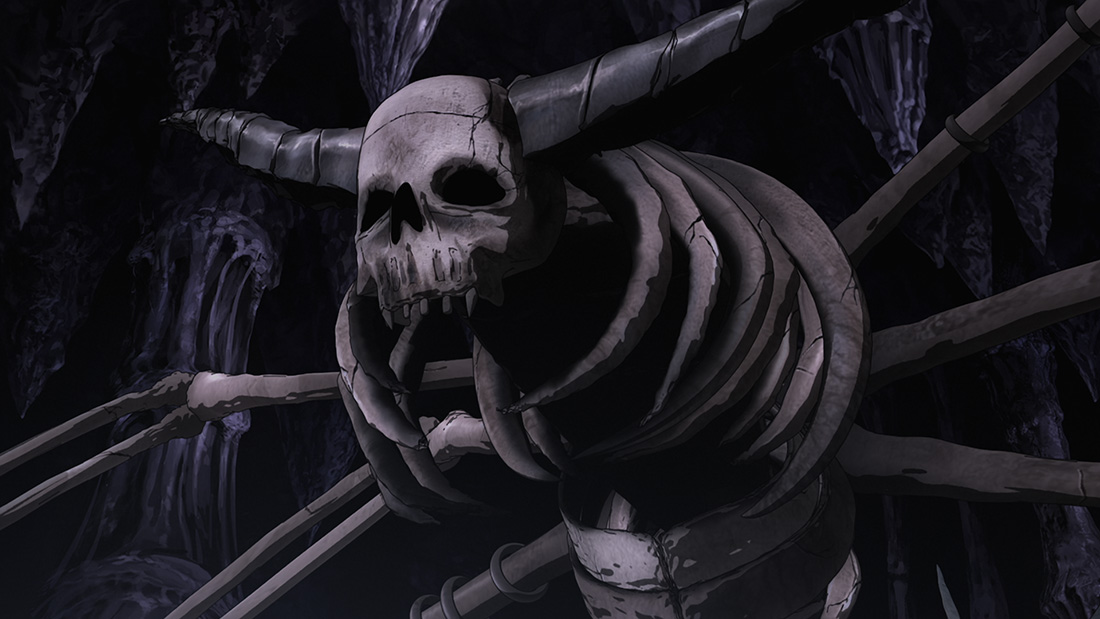
The original episode-one image below shows a horned skull and broad rib cage in a dark cavernous space. Long bony structures extend out of the frame, while rock forms surround the figure. Its lighting and scale are far removed from the everyday appearance of the modern city described by the opening premise.
Our reading uses that contrast to make the transfer understandable. The fantasy opening supplies a vocabulary of overwhelming supernatural presence; contemporary surroundings introduce practical questions about concealment, recognition and what another person thinks they have witnessed. A change of setting can change the consequences of a power even when the power remains formidable.
The still does not show the whole reincarnation process and does not demonstrate every rule governing souls. Nor does it license a claim that a particular modern character controls the skeletal figure. It is a bounded visual reference to the opening fantasy imagery, useful for comparison without reproducing the episode’s full sequence of revelations.
Original visual reference
Great power does not automatically produce peace
In the inspected October 2023 creator interview, Narita describes Polka as possessing a force capable of disrupting peace while trying to use that force to secure a peaceful life. He also discusses creating conspicuous characters who force a situation to move. Those remarks provide an attributed explanation of the ensemble’s pressures rather than our guess about the author’s intention.
Our analytical question follows from that tension: when someone powerful tries to avoid conflict, which other person controls the next encounter? Information brokers, pursuers and witnesses can alter the situation without matching the protagonist’s supernatural ability. A quieter goal does not remove dependency on a network of people.
This is why the show’s urban movement matters. An act has observers, a person has an identity others recognize, and a location can have competing claims. Track who learns something and who remains mistaken. The resulting imbalance can create suspense even before another physical battle starts. That lens is more informative than ranking every character by apparent strength.
Reincarnation also creates a problem of recognition
Polka’s visible body gives other people a name and history to react to, while the newcomer has a different point of reference. Treat those as separate layers. What someone looks like, what they remember and what others believe about them may not align. The official premiere establishes the body-transfer premise; later explanations should be encountered through the story itself.
For a first viewing, notice how an interaction changes once one participant makes an assumption about identity. Does the other person answer, evade, or let the assumption stand? None of those responses automatically proves trust. An urban ensemble becomes easier to follow when each exchange is read as an information problem rather than only a display of magical capacity.
The work contains graphic violence, sexualized material and crime-related threats. Yen Press labels the inspected English volume Mature, eighteen plus. That edition rating is a concrete reading expectation, not a worldwide legal classification of every anime service. Someone looking for a gentle undead comedy should account for the darker mixture here.
Reading after the anime: use a verified edition boundary
The twenty-four-episode anime provides a bounded screen route, while the maintained manga records show further publication. That is enough to distinguish the adaptation from the full source without inventing a seamless next chapter. Reordered exposition, accumulated side scenes and collected-versus-serial packaging can make an apparently exact handoff misleading.
For continuity and characterization, beginning the licensed manga from the opening is the dependable route. If a later revision adds a shortcut, it should name the compared English edition, the last covered scene and any skipped material. The source map here describes format relationships; it does not certify exhaustive chapter coverage.
The official disc records divide episodes one through twelve and thirteen through twenty-four into separate boxes, with associated written and visual bonuses. Those supplements are optional products. An old purchase campaign or retailer bonus listing does not guarantee present stock, current pricing or continuing access to an expired promotion.
Publication evidence is more useful than invented earnings
The ongoing English serial catalog and dated Japanese collected books give readers a concrete way to follow publication. They do not reveal the anime’s production budget, licensing receipts or net income. The inspected sources do not establish a title-specific profit figure, so none is estimated here.
The main manga, side-story prose, comic branch and disc supplements also demonstrate why a franchise-wide volume count would be unhelpful. Each product serves a different reading or viewing purpose. Our map preserves those distinctions so a visitor can select a route rather than mistake more related products for more mandatory homework.
The premiere discussion shows differing expectations
The reviewed Reddit premiere discussion includes people surprised by the reverse-isekai direction, comparisons with Overlord and readers whose interest came from Narita’s authorship. Other comments criticize the early edge and fan service or say promotional material suggested a different kind of show. These are contrasting participant responses, not a representative audience poll.
That discussion helps frame a useful decision: are you arriving for a necromancer spectacle, an ensemble of eccentric people or Narita’s interconnected plotting? The opening presents material that can satisfy one expectation while unsettling another. Its source-material corner and the fan wiki may reveal future participants and outcomes, so treat those links as optional deeper navigation.
Our undead collection connects this title with Overlord and Solo Leveling through power associated with death. The connection is thematic. Here, a modern city and contested identities shape the premise; another series’ summoning hierarchy or kingdom history is not a rulebook for this one. Use the individual guide to choose the experience you actually want.
Primary sources and useful navigation
- Official anime introduction and maintained project
- Official opening synopsis and original images
- Official twenty-four-episode index; later spoilers
- Official cour-specific staff and Japanese cast
- Square Enix main manga and associated products
- Japanese main manga seventeen; dated publication and later spoilers
- Licensed English collected manga
- English volume fifteen: date, credits and Mature rating; spoilers
- Licensed English individual serial chapter route; spoilers
- Japanese Solitaire prose: credits and related novels
- Japanese Solitaire comic fifth volume; first-part completion and contributors
- Narita creator interview: force, peace and ensemble construction
- Official first-cour disc edition
- Official second-cour disc edition
- Related author’s licensed Baccano! prose
- Related thematic guide: Overlord
Community and catalog routes
- Reviewed premiere discussion; opening and source-comment spoilers
- Dead Mount Death Play fan wiki; secondary navigation and spoilers
- MyAnimeList first-cour catalog
The production and publisher links support project facts. Catalog and community pages are secondary navigation and may reveal later events.
Find this work in our thematic collections
Original series imagery is reproduced under permission asserted by the site owner; the source and rights credits are retained. The route diagram is Animeteor’s own explanatory graphic.
A physical amusement product is a separate license
SANKYO’s 25 March 2026 announcement identifies the separately licensed physical pachinko product e Fever Dead Mount Death Play 魂神9000, with a planned June 2026 delivery to Japanese halls. This is a historical distributor announcement, not verification of current access in a particular venue. It does not announce another anime cour or establish a standalone narrative console or mobile game.