For a first viewing: Overlord → II → III → IV → The Sacred Kingdom. The two 2017 films summarize season one. Start the prose or first manga adaptation at volume one; New World is a later Japanese manga route, not a new first chapter.
Reviewed 1 October 2026 · Opening premise and format/chronology relationships; later battle outcomes withheld. · Licensed access varies by country.

The source and screen branches

Chronology alternative: IV 1–7 → The Sacred Kingdom → IV 8–13, inferred from the official episode-eight account. Compilation films revisit season one; prose/manga numbers are not interchangeable.
- READ · original prose: Start at volume 1 → English catalog through volume 16 · not labeled complete
- READ · manga route: Miyama / Oshio adaptation · volume 1 onward → Matsuki’s New World · later Japanese continuation
- WATCH · first-viewing route: I → II → III → IV · thirteen episodes each ↓ The Sacred Kingdom · new-story film OPTIONAL Optional season-one compilation films / comedy
Begin in Nazarick, before the kingdom-scale conflicts
Overlord begins with a player staying in a beloved online game until its scheduled shutdown. Momonga waits in Nazarick, a headquarters whose rooms and inhabitants carry the memory of a guild that has largely moved on. The opening asks what survives when a shared activity loses the people who gave it meaning. The subsequent change in his situation turns that personal attachment into a problem of authority.
For a first viewing, follow Overlord, Overlord II, Overlord III and Overlord IV, then The Sacred Kingdom feature film. The four television seasons each contain thirteen episodes. This release-oriented recommendation preserves complete season blocks and introduces the ensemble before the film’s larger political conflict. It is an editorial viewing choice, not a claim that the film happens after every event in season four.
For reading, begin Kugane Maruyama’s prose at volume one. The manga is a separate illustrated adaptation with its own numbering. A viewer seeking internal explanation and a reader seeking panel-driven pacing have different priorities; neither should choose a book by matching its number to an anime season.
One new-story film and two optional compilation films
The Undead King and The Dark Hero are the two 2017 compilation films associated with the first television season. Their official archive labels them as compilations. After watching that season, they are optional revisits rather than two required new chapters before Overlord II. Their release dates were 25 February and 11 March 2017 in Japan.
The Sacred Kingdom is a different project: a 2024 feature with a dedicated conflict and viewpoint characters. Its introduction describes a threatened country seeking aid from an undead-led state. That film should not be mistaken for another season-one summary because its title also contains the word kingdom.
A story-oriented alternate route is seasons one through three, Overlord IV episodes one through seven, The Sacred Kingdom, then IV episodes eight through thirteen. This placement is our chronology inference from the official episode-eight account, which already treats aid to the Sacred Kingdom as a past development, alongside the film’s described crisis. It is not an official instruction to interrupt a first viewing. Later-season episode pages contain considerable spoilers.
| Route | Order | Purpose |
|---|---|---|
| First viewing | I → II → III → IV → The Sacred Kingdom | Finish each television season before moving on |
| Story-oriented alternate | I → II → III → IV 1–7 → film → IV 8–13 | Place the crisis before season four’s later references |
| Optional revisits | The Undead King / The Dark Hero after season one | Compilation films; not a new continuation |
Prose, the first manga adaptation and New World
Yen Press’s current prose catalog identifies books through volume sixteen, The Half-Elf Demigod Part II. That establishes a licensed English reading record; it does not prove that volume sixteen is the completed ending. We do not attach an unverified date to an unpublished next novel. The two Sacred Kingdom prose books have their own volumes twelve and thirteen in that catalog.
The English manga catalog reaches volume nineteen and credits Hugin Miyama, Satoshi Oshio, Maruyama and so-bin in distinct roles. Nineteen manga books are not nineteen original novels. A manga ending, a collected edition’s final number and the whole franchise’s completion are separate questions.
KADOKAWA’s Japanese New World manga record credits Matsuki and presents a later-stage continuation of the comic route. It lists collected volume four, released 26 March 2026, and continued online publication. Follow the earlier manga before this later starting point. The Japanese listing is not evidence that an English New World edition exists, and its rotating online chapter windows do not promise permanent free access.
Who writes, draws and animates each route?
Maruyama writes the source novels, with so-bin’s illustrations defining their visual identity. Yen Press identifies Andrew Cunningham as translator for the inspected English prose and manga editions. Translation credit belongs to the edition; it is not the author of the original story.
The first anime archive credits Naoyuki Ito as director, Yukie Sugawara for series composition and Takahiro Yoshimatsu for character design. Madhouse supplies animation production. Season four instead lists Satoshi Tasaki for character design, while retaining Ito and Sugawara in the named directing and composition roles. This is why one generic staff list should not silently describe every installment.
The film’s record credits Ito with direction, composition and screenplay, with Sugawara providing screenplay cooperation and Tasaki serving as character designer and chief animation director. Shuji Katayama provides music; Satoshi Hino voices Ainz. Those production continuities help explain the recognizable screen identity without turning the studio into the owner or novelist.
Case check: the undead arrive as an organized presence
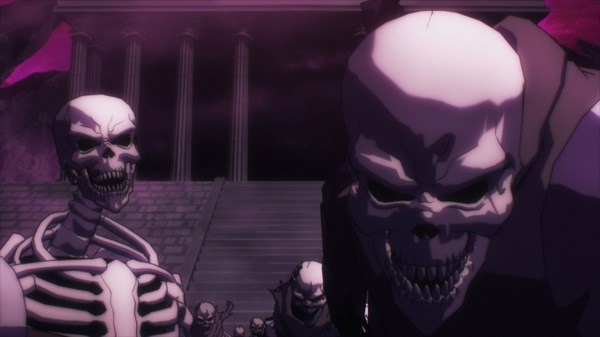
The original first-episode still below contains several skeletal figures before a columned structure and broad steps. A large skull occupies the right foreground while another torso is clearly visible on the left. Purple light runs through the frame. This is actual opening-series imagery, not a newly generated scene or a crop from the later film poster.
The visual separates individual anatomy from collective presence. A skull is an immediate sign of death, but the repeated figures and monumental architecture also imply organization. Our reading connects those visible elements with the opening’s established headquarters: power comes with a built environment and inhabitants, rather than appearing as an isolated skill icon.
The frame alone does not identify every figure’s rank, prove the mechanics of a spell or establish how many troops exist. It should not be used as evidence for a particular battle outcome. Its narrower contribution is useful enough: it makes the undead setting legible while leaving later revelations and violent climaxes out of the introductory guide.
Original visual reference
The necromancer, the ruler and the person performing certainty
Overlord’s thematic appeal involves more than an escalating damage statistic. An undead protagonist changes how others interpret his appearance; a ruler must decide how to act through an organization; a former player carries memories that subordinates do not necessarily share. These positions can create tension even when physical opposition seems weak.
To analyze an early scene, separate three questions. What does Momonga know? What do those around him believe he knows? What action follows from the difference? The gap can sustain comedy and unease simultaneously. An impressive exterior may settle another character’s doubts without settling the protagonist’s own uncertainty.
This also makes the series a complicated power fantasy. Following the central character’s thoughts does not require accepting his organization’s actions as ethically justified. Ask whose fear is visible and whose viewpoint is absent in a scene. A story about commanding undead forces can still reveal vulnerability elsewhere, even when its central ruler remains physically secure.
An introductory route should communicate the actual tone
Expect dark fantasy violence, threatening domination, sexualized comedy and disturbing situations. A reader arriving from a relaxed settlement story should not assume that a shared fantasy setting guarantees similar emotional stakes. The protagonist’s association with Nazarick does not make every threat harmless to the people outside it.
Our undead collection connects Overlord with other works through death-related identity, power and social consequences. Solo Leveling’s shadow-commanding progression and a displaced necromancer in a modern city offer comparison points, not a shared cosmology or identical moral outlook. Decide whether you want organizational politics, personal progression or a crime-shaped mystery before following a recommendation.
Comedy, reference books and other associated products
The Undead King Oh! is Juami’s separately credited comedy manga, available in a Yen Press series listing. Treat it as a tonal companion rather than a replacement for the source novels’ central route. Likewise, the official first-season archive describes Ple Ple Pleiades as a small-character anime with its own production credits. Optional comedy material need not interrupt a newcomer’s main season sequence.
The Complete Anime Artbook and its II III companion are useful for character settings, backgrounds and production discussion. They are reference publications rather than additional story seasons. Their names do not imply that an early book contains every subsequently released film design. The inspected publisher description helps identify scope before purchase.
Game collaborations and anniversary music releases demonstrate associated products, but they are not required to understand the four-season route. Check the product’s current platform and region directly if you wish to use it. A historical promotional announcement is not a guarantee that a game remains playable or an expired campaign remains available.
What the public figures can and cannot establish
The maintained film website’s book section advertises more than fourteen million cumulative copies for the series. We attribute that threshold to the promotional record reviewed here; it is not a new audit of 2026 sales, a count of unique readers or a statement about the novel alone.
That circulation claim cannot be converted into animation profit by multiplying it by a retail price. Publishing, distribution, licensing and theatrical accounting involve different parties and reporting categories. No title-specific production budget or verified net-profit figure is established by the inspected book and project pages, so this guide leaves those financial quantities unfilled.
A reader discussion raises useful adaptation questions
The reviewed July 2022 season-four premiere discussion includes a reader pointing viewers toward separate posts about cut source material. Another exchange reads the series as comedy built around the protagonist’s fear of failing others’ expectations. Those are attributed participant interpretations, not a measured consensus or a substitute for the licensed prose.
The practical lesson is to keep an anime reaction separate from claims about omitted book passages. If a commentary describes internal reasoning, check the relevant edition before treating it as something the episode explicitly shows. Source-corner threads and the fan wiki can expose later events, so use them after the corresponding installment. Their historical streaming lists also need fresh regional checks.
Primary sources and useful navigation
- Official original anime introduction
- Official premiere still and episode index
- Official first-series staff and compilation-film dates
- Official second/third series episode archive
- Official fourth series: episode-eight chronology evidence and staff
- Official film: introduction, staff and promotional book record
- Official dated releases and four season episode counts
- Yen Press licensed prose catalog
- English prose volume sixteen; edition credits
- Yen Press licensed first manga catalog
- Manga nineteen: contributor roles; later spoilers
- KADOKAWA New World manga; later-story spoilers
- Licensed optional comedy manga
- Licensed artbook scope
- Official early comedy-short announcement; expired preview windows
Community and catalog routes
- Reviewed season-four premiere discussion; source and later spoilers
- Overlord fan wiki; secondary navigation and spoilers
- MyAnimeList first-series catalog
The production and publisher links support project facts. Catalog and community pages are secondary navigation and may reveal later events.
Find this work in our thematic collections
Original series imagery is reproduced under permission asserted by the site owner; the source and rights credits are retained. The route diagram is Animeteor’s own explanatory graphic.
Games and live-action adaptations
- OVERLORD: ESCAPE FROM NAZARICK — Game: 2D exploration action · 2022
ESCAPE FROM NAZARICK is a separate Clementine game branch
KADOKAWA’s OVERLORD: ESCAPE FROM NAZARICK is an ENGINES-developed 2D exploration action game for Nintendo Switch and Steam. Its supervised Clementine scenario and ability-recovery structure belong to the game’s own route; they are not required between anime seasons. The Japanese product date is 16 June 2022, while Steam displays 15 June.