Begin with TV episodes 1–13, then Extra Episode, the 2019 Eternity and the Auto Memory Doll film, and the 2020 Movie. For internal chronology, insert Extra between TV episodes 4 and 5. Read the Japanese novels from the first book; the film and prose are separate narrative presentations.
Reviewed 1 October 2026 · Early workplace premise; major client outcomes and film ending withheld. · Licensed access varies by country.

The source and screen branches

The two watch lanes organize the same animation differently. Extra officially fits between TV 4 and 5. The films and prose do not merge into a universal chapter handoff.
- READ · Japanese novels: First book → second book ↓ Gaiden → Ever After OR collection edition Anniversary -Flower- · compilation + extras
- WATCH · recommended first route: TV episodes 1–13 → Extra Episode → 2019 Eternity and the Auto Memory Doll → 2020 Violet Evergarden: The Movie
- WATCH · chronological alternative: TV episodes 1–4 → Extra Episode → TV episodes 5–13 → Then the 2019 and 2020 films
Start with the television series or the source novels
Violet Evergarden follows a former soldier learning to write letters on behalf of other people. Her new occupation requires an unfamiliar kind of attention: a client may know what happened yet struggle to say what it means. The postwar setting makes that problem personal. Moving into civilian life involves work, relationships and a vocabulary that military orders cannot supply.
For a first animated viewing, our recommended route is the thirteen television episodes, the Extra Episode, Eternity and the Auto Memory Doll, then the 2020 Movie. This keeps the TV run intact before its supplementary installment and two films. It is an editorial viewing recommendation, not a claim that release order and internal chronology are identical.
For prose, begin with Kana Akatsuki’s first Japanese book and follow the publication sequence through the second book, Gaiden and Ever After. The anime and novels are distinct presentations. A film ending should not be converted into a novel chapter handoff without comparing the actual texts. Reading from the beginning is the most useful route for understanding those differences.
Where the Extra Episode fits
The official 28 March 2018 announcement places the Extra Episode between television episodes four and five, during an intervening period of several months. It originally accompanied Japanese Blu-ray/DVD volume four, released on 4 July 2018. That disc also included TV episodes eleven through thirteen; disc packaging therefore does not determine the story’s chronological position.
If chronology is your priority, watch episodes one through four, then Extra, then five through thirteen. Otherwise finish the TV series before Extra. These are two ways to organize the same screen material, not competing continuities. The map separates them so a newcomer does not mistake the special for a second season.
Check a streaming listing for the actual special title or description, rather than relying on an episode number imported from another service. A platform can list a special separately from the TV season. Neither a separate tile nor a number fourteen changes the official placement of this story.
| Preference | Television and special | Next screen installments |
|---|---|---|
| First viewing | TV 1–13 → Extra Episode | 2019 Eternity → 2020 Movie |
| Internal chronology | TV 1–4 → Extra → TV 5–13 | 2019 Eternity → 2020 Movie |
| Source reading | First book → second → Gaiden → Ever After | Separate prose route; no automatic film handoff |
Four prose books and an anniversary compilation
The publisher’s Japanese records identify four books: the first in December 2015, the second in December 2016, Gaiden in March 2018 and Ever After in March 2020. Akatsuki writes the prose and Akiko Takase supplies the illustrations. These are useful edition identifiers when a shop translates the titles differently or labels the first pair simply as upper and lower volumes.
The Anniversary -Flower-, released on 25 December 2025, repackages the four books with additional short fiction, including two new stories. It is a collection with extra material, not a fifth television season. If you already own the four individual books, inspect the publisher’s contents before treating every page of the larger book as new narrative.
The Novel badge on this guide identifies that Japanese source publication. The linked records do not establish a licensed English edition of Violet Evergarden prose. An English file shared by a fan and an English publisher’s authorized book are different products; identify publisher and edition before paying for a translation.
Who shaped the prose and animation?
The TV staff page credits Taichi Ishidate as director, Reiko Yoshida for series composition, Takase for character design, Haruka Fujita for series direction and Takaaki Suzuki for world setting. Kyoto Animation produced the animation; Evan Call composed the music. Yui Ishikawa voices Violet in the Japanese cast. These credits connect the illustration, writing, performance and production roles without treating them as interchangeable.
Fujita directed the 2019 side-story film. Its own production page should be used when discussing that film, rather than applying the TV director credit to every project. Producer Shinichiro Hatta’s official interview explains that the side story and the 2020 film were developed concurrently. Their release sequence still provides a straightforward viewing route.
In her anniversary interview, Akatsuki reflects on the animation reaching audiences beyond the original books and on returning to Violet’s prose after other work. Readers interested in her writing can also investigate Agents of the Four Seasons: Yen Press identifies Akatsuki as its author and Suoh as illustrator. That is another authored series, not a story within Violet’s setting.
Case check: letter writing is a workplace skill
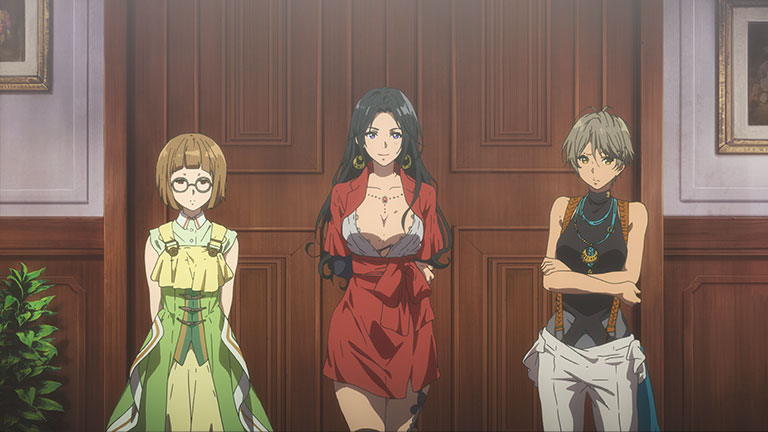
The original episode-two image below shows three postal employees before dark wooden doors. Their clothing, expressions and postures differ; the composition places them together as colleagues. Violet is not in this selected frame. It supplies a workplace reference for the episode rather than a portrait of its title character.
The official episode-two synopsis describes a complaint after Violet follows a client’s words too literally in a letter. This opening problem is more specific than a general claim that she has trouble with emotions. The job requires distinguishing what someone says aloud from the message they want another person to receive.
Our reading of the scene’s context is that becoming a competent writer depends on relationships as well as technique. Typing an accurate sequence of words can still produce an unsuccessful communication. The coworkers in the image make that learning environment visible. The still supports this bounded observation; it does not prove how every later assignment is resolved.
Original visual reference
What a letter lets the story examine
A letter involves at least three positions: the person whose feeling is being expressed, the professional finding words for it, and the recipient interpreting those words. Violet stands between those positions. An effective reading of the series asks whether she has understood the speaker, rather than judging the result only by how beautiful a sentence sounds.
That structure also makes absence tangible. A message can travel where its writer cannot, but delivery alone cannot guarantee reconciliation or understanding. The interest lies in the limits of communication as much as its promise. For a first viewing, watch how a request becomes a draft and how the intended audience changes what must be included.
The postwar premise raises questions about life beyond usefulness in battle. A civilian profession offers a different measure of competence: care, listening and accountability to a client. That is our thematic interpretation, not a clinical diagnosis of Violet or a claim that employment neatly resolves trauma. War-related injury, grief and loss remain relevant expectations for viewers.
The 2020 film belongs to the screen branch
Hatta explicitly calls the 2020 film an original story arising from the TV adaptation’s different expression of the novels. He also explains that scenario and setting information were shared with Akatsuki. That supports both facts at once: the author was consulted, and the film should not be labeled a direct transcription of a particular final prose volume.
The producer describes the film as the culmination of the TV project. Our watch route therefore places it after the series and side story, while keeping the books on their own lane. This avoids presenting a prose ending and an animated ending as sequential events in a single chronology.
After completing a route, choose one early letter-writing situation for comparison. Notice whose perspective supplies information, when Violet’s response is revealed, and how long the audience is asked to wait before learning the recipient’s reaction. These are concrete adaptation questions. A difference in emphasis can be meaningful without making either presentation an erroneous version.
Compare full compositions rather than cropped faces
The TV still is preserved in its original rectangular composition. The shared doorway and spacing between the employees matter to the workplace reading; enlarging a single face would remove that relationship. The separate key visual gives a broader promotional identity, but it is labeled as artwork rather than evidence from a particular scene.
Hatta’s interview records a move from television’s 16:9 frame to the films’ wider 2.31:1 composition. This is a production detail with a practical viewing implication: retain the full film frame when discussing how characters relate to a landscape or room. A thumbnail crop can change the very arrangement an analysis is trying to describe.
A still cannot demonstrate music, vocal timing or motion. Those require watching and listening to the actual sequence. The imagery here gives readers a visible reference and an original source link, while the interpretation remains limited to the details that the selected image and official episode record actually establish.
What the anniversary products reveal—and what they do not
The anniversary publication brings previously dispersed prose into one package. For readers comparing editions, the useful questions are included stories, language, format and whether extra goods are wanted. A deluxe package and a book-only edition need not be equally useful to someone primarily interested in reading.
An anniversary campaign demonstrates continued editorial and merchandising activity. It does not disclose animation cost, project profit or how many people finished watching the series. This guide makes no financial estimate from a book price, a fan discussion or the number of products on a shop page.
The commercial decision is consequently concrete: choose an identifiable prose edition if you want the source, and check a current licensed service or disc record for the screen route. Territorial availability and shipping terms can change independently of whether the story itself is complete.
A useful community question needs a current publisher check
The linked Reddit discussion begins with a Japanese learner asking where to obtain the original novels. Replies point toward the publisher’s shop and a then-upcoming free anniversary reading campaign. That is a useful example of a reader’s access problem, not proof that the suggested shipping arrangements or free chapters remain available today.
The publisher now marks the rotating 2025 chapter campaign as ended. It still links a standing first-book preview, and its 2026 Laura opening preview has a stated closing time on 25 December. Follow the official page for those conditions. An old forum reply can direct attention to a resource while still requiring a fresh check.
In our after-battle collection, compare Violet’s professional communication with Frieren’s long perspective on relationships. They share a reason to think about life after conflict, but their source media and viewing commitments differ. The collection explains that thematic connection; this guide supplies Violet’s own routes and edition records.
Primary sources and useful navigation
- Kyoto Animation: television project and original key visual
- Official television episode index and original still
- Official TV staff and Japanese cast
- Official Extra Episode placement and disc announcement
- Official 2019 side-story film and credits
- Official 2020 film
- Producer Hatta: source adaptation, film conception and aspect ratio
- KA Esuma Bunko: four prose books and ISBNs
- Publisher anniversary edition and time-limited preview conditions
- Publisher standing first-book preview in Japanese
- Akatsuki anniversary interview: author and prose development
- Yen Press: Akatsuki’s separate Agents of the Four Seasons novels
Community and catalog routes
- Reviewed reader question: obtaining Japanese source books
- Fan wiki: secondary navigation; later-story spoilers
- MyAnimeList television catalog; secondary navigation
The production and publisher links support project facts. Catalog and community pages are secondary navigation and may reveal later events.
Find this work in our thematic collections
Original series imagery is reproduced under permission asserted by the site owner; the source and rights credits are retained. The route diagram is Animeteor’s own explanatory graphic.
Production and edition updates
Violet Evergarden Anniversary Flower — Japanese 2025 edition
Kyoto Animation’s anniversary publisher page dates Anniversary Flower to 25 December 2025. The edition combines the four main prose books, the earlier Tailor and Queen stories and two new Laura and Flower stories. The source novels and these prose extras are not a newly announced television season.