For a first anime viewing, finish original episodes 1–24. Then revisit altered episode 23 beta before Steins;Gate 0; the film is an optional follow-up to the original conclusion. The source is a visual-novel game. UDON’s complete manga and Japanese prose novelization are separate adaptations.
Reviewed 1 October 2026 · Opening time-message premise and branch labels; character fates and endings withheld. · Licensed access varies by country.

The source and screen branches

First viewing: complete the original 24 episodes before returning to the beta branch. The two episode-23 versions diverge; Zero is not a beginner’s prequel. Optional products are not mandatory interleaved chapters.
- PLAY · original game: STEINS;GATE · original game → Explore its interactive routes → STEINS;GATE 0 · separate game
- WATCH · original route: Original episodes 1–22 → Ordinary episodes 23–24 → Film · optional screen follow-up
- WATCH · beta branch: Shared original episodes 1–22 → Altered episode 23 beta → STEINS;GATE 0 · TV project
- READ · adaptations: Yomi Sarachi · English Complete Manga OR Miwa · Japanese Ouroboros prose novelization
The source is a visual-novel game, not the manga
Steins;Gate begins with Rintaro Okabe and the Future Gadget Laboratory in Akihabara, where a device unexpectedly allows messages to be sent into the past. The original game is a visual novel developed through the 5pb./Nitroplus project; the Steam edition lists MAGES. as developer and Spike Chunsoft as publisher. Its 2016 Steam date is an edition date, not the franchise’s first appearance.
For a first screen visit, watch the original twenty-four-episode television story in its ordinary order. For an interactive source visit, choose the original Steins;Gate game and follow its routes. UDON’s Yomi Sarachi manga is another adaptation, collected in an English omnibus. Japanese prose novelizations also exist, but they are not the source from which the game was adapted.
The format distinctions are unusually important here. A visual novel uses text, sound, illustrations and interaction; a prose novel is a printed reading product. Our Novel badge includes a verified Japanese prose adaptation, while the source-game route is named explicitly in this guide. Neither is silently presented as an English prose ebook.
Case check: an ordinary street becomes uncertain
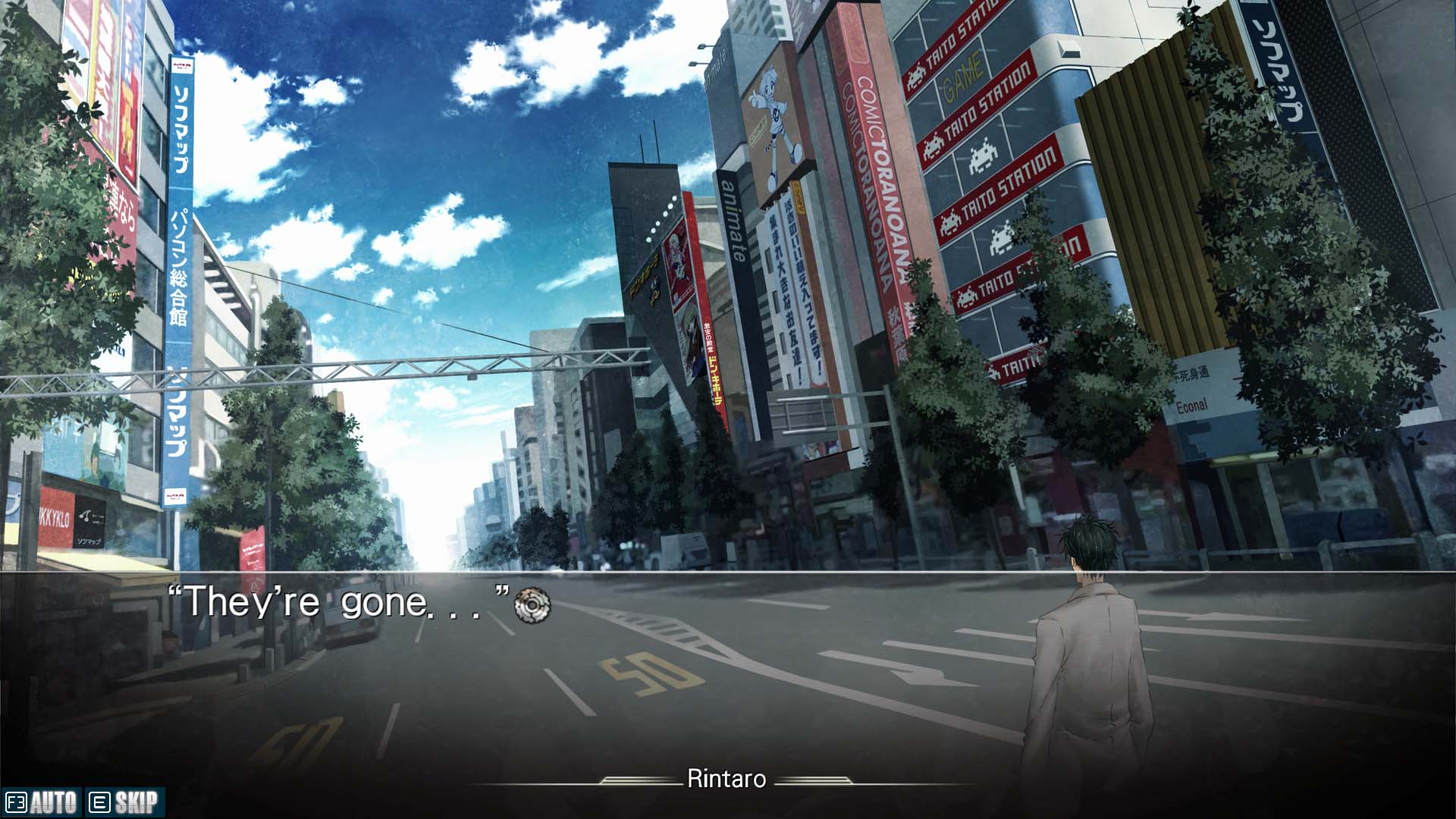
The publisher’s original-game screenshot below shows an almost empty Akihabara street, Okabe at the lower right and a short observation in the dialogue interface. Its city signs, daylight and broad road remain recognizable even though the absence of people makes the scene unsettling. It is a screenshot from the original game’s licensed Steam presentation, not an anime frame or a new RE:BOOT illustration.
Our reading is that the familiar setting gives temporal uncertainty a concrete form. A change matters when a person can compare it with what they expected to see. The image does not need to show a machine operating to place observation at the center of the scene. Its dialogue layer also makes the protagonist’s perception part of how the player receives information.
This supports a useful viewing question: who has noticed a change, and what evidence do they have? It does not by itself identify a complete worldline explanation or establish an ending. The anime promotional ensemble above has another function, introducing people and setting rather than proving that one game scene appears unchanged on screen.
Original visual reference
Knowledge is the suspense mechanism
Time-travel fiction can become an exercise in memorizing dates. A more useful lens for Steins;Gate is the uneven distribution of knowledge. An action may look harmless to the person taking it because they do not yet know its consequences. Suspense develops when the audience or a character has reason to reinterpret something that once appeared ordinary.
Keep a short mental distinction between observed events, reported events and explanations offered by a character. Those categories need not coincide. This approach gives an early conversation a purpose beyond collecting clues: it establishes whose account you are relying on. Later information can change that reliance without making the earlier scene meaningless.
The idea of sending information backward also separates intention from outcome. A message can be precise while its effect remains difficult to anticipate. Our interpretation focuses on that imbalance rather than treating technical terminology as a guarantee of real-world scientific accuracy. The work’s official game portal identifies it as a science-fiction adventure, with fiction built into its stated concept.
Finish the original story before choosing the alternate branch
Nitroplus’s dated 2017 rebroadcast notice explicitly distinguishes the traditional twenty-four-episode version from a twenty-three-episode beta-worldline version leading toward Steins;Gate 0. The national Media Arts Database record independently identifies the altered episode twenty-three as Divide by Zero / Open the Missing Link. These are different versions of a branching point.
Our first-view recommendation is to complete original episodes one through twenty-four, then revisit the altered episode twenty-three beta before starting Zero. This preserves the original story’s ending as a complete first experience. The beta version is not a replacement that every newcomer must substitute for the ordinary episode twenty-three.
A chronological interleaving is a separate preference. If you choose it later, label which episode twenty-three you mean and which branch it leads toward. A number alone is insufficient. We keep the map spoiler-light by showing the structure without explaining the choice or outcome that makes the branches different.
Zero and the film answer different navigation questions
Steins;Gate 0 has its own official television project, based on its own game record. It should be approached after the original introduction and the beta-branch context. The word zero does not make it the earliest item a newcomer should watch; a title’s number and a story’s access requirements are different things.
The 2013 film Load Region of Déjà Vu has another maintained KADOKAWA project page. Its introduction explicitly assumes events from the original conclusion, which is why it belongs after that original story. We treat it as an optional screen follow-up. Its existence does not turn it into a necessary bridge to Zero or an additional ending route in the original game.
For any supplementary episode listed by a distributor, check the exact title and packaging. The original website records a special episode separately from its broadcast stories. Do not infer that an interface’s episode twenty-five is part of the original twenty-four-episode broadcast route, or confuse that supplement with the altered twenty-third episode.
A complete manga omnibus collects an adaptation
The official UDON/distributor record credits Yomi Sarachi and says its Complete Manga omnibus collects the three-book manga series. That is a practical way to obtain that particular English adaptation. Complete in this product title does not mean it contains every game route, prose companion, Zero installment or later franchise branch.
KADOKAWA separately records Choshiro Miwa’s Japanese prose novelization Enkan Rensa no Ouroboros. That product proves a prose route exists without changing which medium originated the work. Choose a print edition by author, medium and product identifier. A matching title on a shop page is not enough to establish that two editions tell the story in identical detail.
An exact anime-to-manga continuation number would be especially misleading for an adaptation packaged as its own complete collection. The useful choice is whether you want to experience that presentation from its beginning, rather than treating it as leftover chapters after a screen ending. The same principle applies when exploring other Science Adventure titles.
Source project, animation staff and edition credits
KADOKAWA’s original-anime record names Takuya Sato and Hiroshi Hamasaki, Jukki Hanada for series composition, Kyuta Sakai for character design and WHITE FOX for animation production. The separate film record credits Kanji Wakabayashi as director and lists its own production roles. Keeping the film and TV credits distinct makes creator navigation more accurate.
The game’s maintained franchise portal names Chiyomaru Shikura’s planning/source role, while the current English RE:BOOT portal describes new visual and audio work, including newly recorded music by Takeshi Abo. These edition-specific changes are useful research paths, not proof that the newer game is superior. The original-game screenshot here remains labeled as original-game imagery.
RE:BOOT is a revised edition with a future English release date
The official English RE:BOOT page announces 29 October 2026 and describes a revised presentation with added material. That is still a future date at our 1 October review. We record the announcement rather than pretending to have played this English release or verified its new ending scenario.
The same official page reports more than four million worldwide units for the Steins;Gate series. That is a series-level publishing claim on a maintained game portal, not units sold by the 2016 Steam edition alone. It also does not establish anime profit or manga circulation. Review percentages on a storefront describe its participating reviewers and should not be converted into sales totals.
A useful correction from a manga question
In the inspected Reddit thread asking for side manga, one reply reminds the reader that Steins;Gate originated as a visual novel rather than a manga. That is a helpful example of the format confusion this guide addresses. Another comment gives a preference for the Zero manga; it remains that person’s preference, not a consensus or a canon ruling.
For a first-story discussion, ask what makes an observation trustworthy when information can arrive out of order. Keep ending and beta-branch explanations under an appropriate spoiler label. Wiki and Science Adventure catalog entries can help identify a product, but their episode and character pages often reveal exactly the outcomes a newcomer is trying to preserve.
Primary sources and useful navigation
- Official game portal: originating project and editions
- Licensed original-game Steam page and original screenshot
- KADOKAWA: original TV project, ensemble illustration and staff
- Nitroplus: ordinary 24 episodes versus beta 23-episode branch
- National Media Arts Database: altered episode twenty-three record
- Official Steins;Gate 0 screen project
- KADOKAWA: film project and assumed original-story context
- UDON/distributor: Yomi Sarachi Complete Manga omnibus
- KADOKAWA: Choshiro Miwa’s Japanese prose novelization
- Official English RE:BOOT page: edition and announced release
Community and catalog routes
- Reddit: inspected source-format and manga discussion
- Reddit: title community; branch and ending spoilers
- Fandom: title wiki; later-story spoilers
- MyAnimeList: anime catalog lookup
- Wikipedia: secondary franchise overview
The production and publisher links support project facts. Catalog and community pages are secondary navigation and may reveal later events.
Find this work in our thematic collections
Original series imagery is reproduced under permission asserted by the site owner; the source and rights credits are retained. The route diagram is Animeteor’s own explanatory graphic.
Games and live-action adaptations
- STEINS;GATE — Original Steam Edition — Game: Science-fiction visual novel
- STEINS;GATE RE:BOOT — Steam — Game: Reworked science-fiction visual novel
Production and edition updates
STEINS;GATE RE:BOOT — Steam and Western console dates
The English publisher portal dates the Steam launch to 20 August 2026 and Western Switch 2, Switch, PS5 and Xbox Series X|S editions to 29 October 2026. Steam displays 19 August for app4012810; that difference is attributed rather than converted into one worldwide release date. The console date remains upcoming at this review.
See the separate production record →
STEINS;GATE — Skydance TV development announcement, 2020
MAGES.’s 27 January 2020 corporate release records the 26 January anniversary announcement of a globally distributed live-action television project with Skydance Television. The release describes development at that historical moment. It does not establish that filming is active in 2026, give a cast, confirm a present release date or announce that a finished series is available.